On January 27, 2026, the SEC filed charges against Archer-Daniels-Midland Company and three former executives for accounting and disclosure fraud. <cite index="53-1">The charges were for materially inflating the performance of a key ADM business segment, Nutrition, which ADM touted to investors as an important driver of the company's overall growth.</cite>
This is the most carefully documented accounting enforcement case of 2026. Every fact in it is confirmed from the SEC's own administrative order (Release No. 33-11403-S), the SEC's press release (PR 2026-15), ADM's Form 8-K filed January 27, 2026, and independent legal analyses by Volkov Law, Cleary Gottlieb, Gibson Dunn, and the Harvard Law Forum.
The ADM case is important for CFOs not because ADM's fact pattern is unusual, but because it is common. Segment operating profit pressure, intersegment pricing adjustments, the temptation to use transfer prices to manage segment results, and the failure to disclose that intersegment transactions are not at arm's-length market terms: these are features of many multisegment corporate environments. The SEC identified a specific instance and charged it as fraud. The question for every controller and CFO reading this post is whether their own intersegment transaction controls and segment MD&A disclosures would survive the same scrutiny.
The companion blogs in this cluster (the SEC Financial Reporting and Accounting Unit blog and the Gibson Dunn mid-year enforcement update blog) covered the institutional context: the August 5 enforcement unit and the broader H2 enforcement pipeline. This blog covers the ADM case specifically, in enough granular detail for a controller to benchmark their own controls.
What Did the SEC Allege Against ADM and Its Former Executives?
The SEC filed settled charges against ADM and its former executives Vince Macciocchi and Ray Young, and a litigated action against its former executive Vikram Luthar, for materially inflating the performance of a key ADM business segment, Nutrition.
The SEC's settled order against ADM, Macciocchi, and Young finds that when Nutrition was in danger of falling short of its operating profit forecasts, Macciocchi, the former President of Nutrition, Young, ADM's CFO, and another senior finance executive pressured employees to identify adjustments that would shift operating profit from other ADM business segments to Nutrition to ensure that Nutrition met its forecasts.
Luthar's complaint alleges he directed the adjustments to Nutrition's transactions with other ADM business segments when Nutrition was falling short of its operating profit targets for fiscal years 2021 and 2022. The adjustments included retroactive rebates and price changes not customarily available to ADM's third-party customers that were essentially one-sided transfers of operating profit to Nutrition, with the goal of making it appear that Nutrition was meeting the 15% to 20% per year operating profit growth targets.
ADM settled with the SEC, paying a civil penalty of $40 million, and agreed to cease and desist from violations of Section 17(a) of the Securities Act and Sections 10(b), 13(a), 13(b)(2)(A), and 13(b)(2)(B) of the Exchange Act and Rules 10b-5, 12b-20, 13a-1, 13a-11, and 13a-13. ADM did not admit or deny the findings. The Department of Justice closed its investigation of ADM with no further action.
Macciocchi and Young settled with the SEC. Luthar is the subject of a litigated complaint, meaning his case is continuing.
What Specific Accounting Standards Did ADM Allegedly Violate?
The SEC's order and complaint identify violations across multiple provisions of the federal securities laws. Understanding which legal provisions were charged is important because each provision corresponds to a specific category of financial reporting failure that the new enforcement unit is equipped to pursue.
Exchange Act Section 10(b) and Rule 10b-5: the antifraud provisions. The SEC alleged that ADM made materially false and misleading statements and omissions in its SEC filings in connection with the purchase or sale of securities. The false statements included public representations about Nutrition's operating performance and the terms on which intersegment transactions were recorded.
Exchange Act Section 13(a) and the associated reporting rules (Rules 12b-20, 13a-1, 13a-11, 13a-13): the periodic reporting requirements. ADM's annual reports (Form 10-K), current reports (Form 8-K), and quarterly reports (Form 10-Q) contained materially inaccurate segment-level financial information that was incorporated into the consolidated periodic reports filed with the SEC.
Exchange Act Section 13(b)(2)(A): the books and records provision. This provision requires companies to make and keep books, records, and accounts that accurately and fairly reflect the company's transactions and dispositions of assets. The adjustments to intersegment transactions that were not at market terms resulted in books and records that did not accurately reflect the actual terms of those transactions.
Exchange Act Section 13(b)(2)(B): the internal controls provision. This provision requires companies to devise and maintain a system of internal accounting controls sufficient to provide reasonable assurance that transactions are recorded as necessary to permit preparation of financial statements in conformity with GAAP and to maintain the accountability of assets. The SEC alleged that ADM's internal controls were insufficient to prevent or detect the improper intersegment adjustments.
Section 17(a) of the Securities Act: the offering fraud provision, applicable because ADM was an SEC reporting company that had offered securities to the public.
The SEC's order found violations not only of antifraud and disclosure provisions but also of internal accounting control and books-and-records provisions of the federal securities laws. These controls are the infrastructure that enables accurate financial reporting. Weak, incomplete, or overridden controls not only distort results but signal deeper governance failures.
What Was the Role of Segment Reporting in the ADM Case?
The ADM case is fundamentally a segment reporting case. The fraud did not occur in ADM's consolidated financial statements. ADM's consolidated revenue, consolidated operating income, and consolidated assets were not alleged to be materially misstated. The alleged fraud occurred at the segment level, in the Nutrition segment's reported operating profit, which was presented to investors as evidence of the segment's growth trajectory.
Under ASC 280-10-50, the segment reporting standard, companies must disclose operating profit or loss for each reportable segment. The CODM (chief operating decision maker) evaluates segment performance based on segment-level results. Investors use segment-level results to assess the performance and growth trajectory of each of the company's business lines and to value the company's different businesses individually.
ADM had publicly represented that the Nutrition segment was an important driver of the company's overall growth and had specifically promoted the segment's 15% to 20% annual operating profit growth target to investors. That representation made segment-level performance information material in a way that it might not be for a segment that management had not specifically highlighted as a growth driver.
The order finds that the adjustments rendered the disclosure in ADM's periodic reports that it recorded intersegment transactions at amounts "approximating market" false, as they resulted in intersegment transactions being recorded on terms that did not approximate market.
This is the specific disclosure failure: ADM's 10-K and 10-Q filings contained an accounting policy disclosure that described intersegment transactions as recorded "at amounts approximating market." That disclosure was false because the retroactive rebates and price changes applied to intersegment transactions were specifically designed to transfer profit to Nutrition and would not have been available to third-party customers on market terms.
The structure of the fraud: the consolidated financial statements eliminated intersegment transactions in consolidation, so the profit transfers between Nutrition and other segments did not affect consolidated results. But the segment-level operating profit disclosures, which are presented before consolidation eliminations, showed Nutrition's operating profit as inflated by the non-market transfers, and the other segments' operating profit as artificially reduced.
What Was the Disclosure Failure That Created Individual Executive Liability?
The three former executives were charged individually at different levels of liability, reflecting the SEC's assessment of each person's knowledge and role.
Macciocchi, the former President of Nutrition, led efforts to identify and structure the adjustments. The order finds that Macciocchi and another executive led efforts to identify and structure adjustments for fiscal years 2021 and 2022. Macciocchi settled.
Young, ADM's CFO, negligently approved the adjustments. The settled order against Young uses a negligence standard, not an intent standard. Young is charged with negligently approving transactions that he had a responsibility as CFO to scrutinise. Young settled.
Luthar, the third executive, is the subject of a litigated complaint alleging he directed the adjustments, making his the most culpable alleged conduct. His case continues.
The CFO-specific lesson is in Young's charge: the finding of negligence, not intent. Young is alleged to have approved intersegment adjustments without adequately scrutinising their terms or their consistency with the company's public disclosure that intersegment transactions were recorded at market-approximating prices. He did not need to have known the adjustments were fraudulent to face enforcement charges. He needed only to have failed to exercise appropriate care in reviewing and approving them.
The individual disclosure failure that created Young's liability: as CFO, Young signed the SOX 302 and 906 certifications for the periodic reports that contained the false "approximating market" disclosure. The certification covered financial statements that reported Nutrition's operating profit at the inflated level, and MD&A disclosures about Nutrition's performance that were based on those inflated numbers. A CFO's personal certification of a filing containing a material misstatement, even when the CFO did not intentionally cause the misstatement, is the individual liability nexus.
The ADM case underscores a fundamental compliance truth: strong internal controls and transparent disclosures are not optional. They are core risk mitigants that protect investors, markets, and corporate reputations. The case highlights how breakdowns in accounting controls and disclosure practices, even when aimed at projecting performance, can quickly spiral into regulatory enforcement, civil penalties, and individual liability.
What Is the "Accounting and Disclosure Fraud" Standard the SEC Is Now Using?
The ADM case illustrates the specific legal framework the SEC uses to characterise segment-level reporting manipulation as both an accounting fraud and a disclosure fraud, rather than as merely an accounting irregularity or a disclosure deficiency.
The accounting fraud element: the intersegment transaction adjustments were recorded in ADM's books and records on terms that were not market-approximating and were designed to shift operating profit between segments. This makes the accounting entries themselves fraudulent, not merely inaccurate. The intentional design of the adjustments to achieve a specific segment profit outcome, rather than to reflect the actual economic terms of the transactions, is what elevates the recording error to an accounting fraud.
The disclosure fraud element: the SEC charged ADM's periodic reports with containing false and misleading statements about intersegment transaction terms ("approximating market") and about Nutrition's operating performance. The disclosure fraud element does not require a separate statement that is entirely false. It requires that existing disclosures be false or misleading in light of what they purport to represent.
The combination of the two elements, accounting fraud (false entries) and disclosure fraud (false statements in SEC filings about those entries), is what produces the full set of charges under Sections 10(b), 13(a), 13(b)(2)(A), and 13(b)(2)(B). Each provision addresses a different aspect of the same underlying conduct.
The practical standard for CFOs: the SEC does not need to prove that the misstatement in the consolidated financial statements was material. The Nutrition segment's inflated operating profit appeared in the segment footnote and in MD&A discussions of segment performance. Those segment-level disclosures are part of the periodic report and are subject to the same antifraud and disclosure standards as the consolidated financial statements. A segment-level misstatement that is eliminated in consolidation can still produce full enforcement charges if the misstatement affects investor understanding of segment performance.
What Internal Controls Did ADM Allegedly Lack or Circumvent?
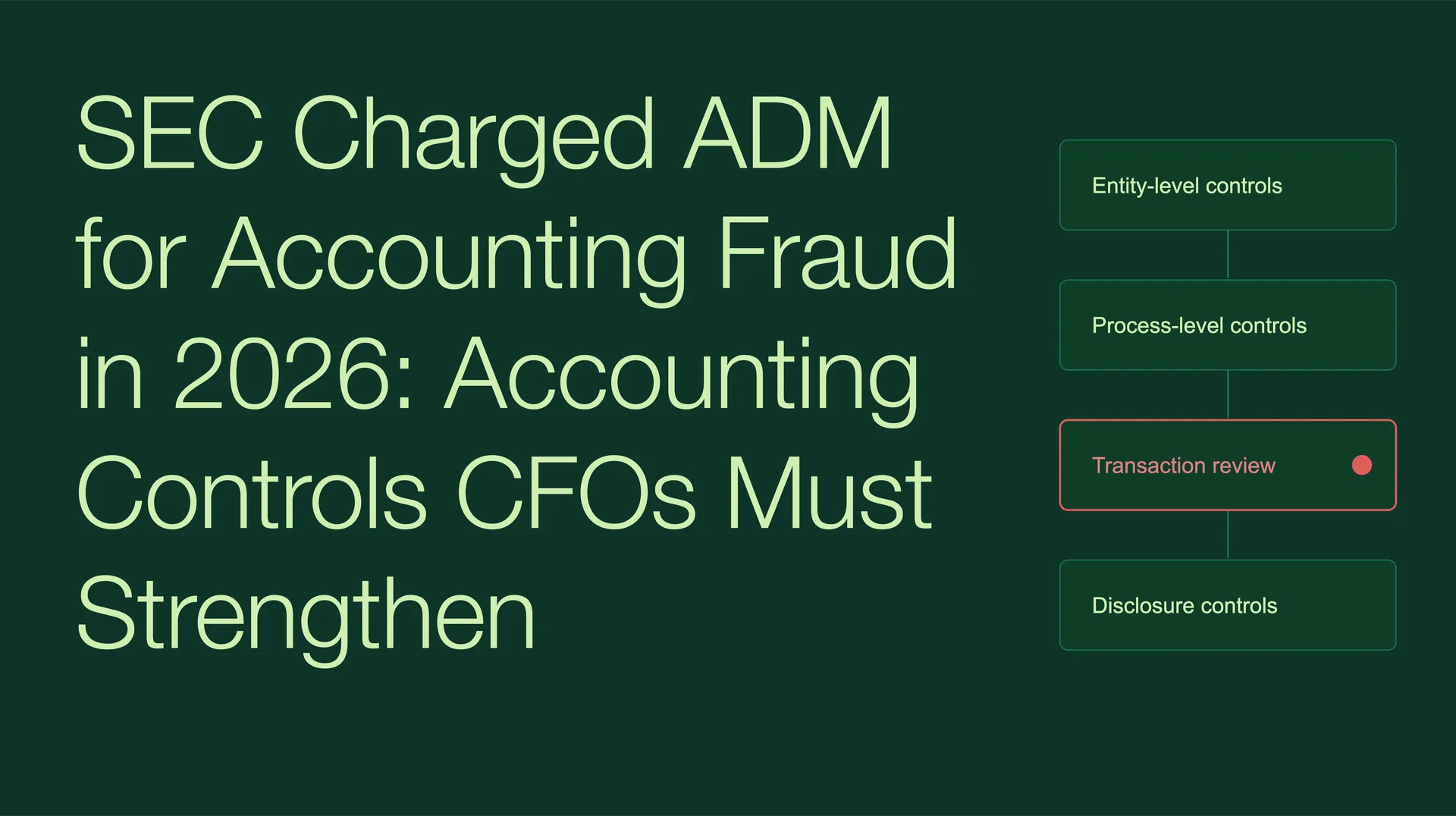
The Exchange Act Section 13(b)(2)(B) charges address the internal controls failures specifically. The SEC identified three categories of internal controls weakness in the ADM case.
First: insufficient controls over the approval of intersegment pricing adjustments. The retroactive rebates and price changes that shifted profit to Nutrition required approval from senior executives. But the controls around that approval process were insufficient to ensure that the approvals were made on the basis of legitimate business terms rather than on the basis of segment profit targets. A properly designed control would have required documentation of the business rationale for any intersegment pricing adjustment and independent review of whether the terms approximated market terms.
Second: insufficient controls over the relationship between intersegment transaction terms and disclosed accounting policies. ADM's periodic reports stated that intersegment transactions were recorded at amounts "approximating market." For that disclosure to be accurate, there must be an internal control that compares the actual terms of intersegment transactions to available market benchmarks and confirms they approximate market terms before the disclosure is included in the periodic report. The SEC's finding that the disclosure was false implies that no such control existed or that it failed.
Third: insufficient controls to prevent management override. The pressure that Macciocchi and others applied to employees to identify adjustments that would shift operating profit to Nutrition represents a management override of the normal intersegment pricing process. Internal controls must include specific controls designed to prevent, detect, and report management override of transaction terms. COSO's internal controls framework specifically addresses management override risk as one of the most significant fraud risks for which controls must be designed.
SEC staff have repeatedly emphasised that investors care about segment performance because it informs expectations about overall corporate health. Robust controls over financial reporting are risk mitigants, not back-office checklists. Programs must ensure that controls are enforced even under performance pressure from senior management.
What Does the ADM Case Mean for Your Company's Segment Reporting Controls?
The ADM case produces a specific control design question for every multisegment company: are your intersegment transaction controls sufficient to prevent, detect, and disclose the type of transfer pricing manipulation the SEC identified in ADM's Nutrition segment?
The specific controls the ADM case implies must exist:
Intersegment pricing policy documentation: a written policy that describes how intersegment transaction prices are set, what the required basis for intersegment prices is (market-approximating, cost-plus, or other specified basis), and who has authority to approve intersegment pricing.
Intersegment pricing review control: a periodic reconciliation of actual intersegment transaction terms to the documented pricing policy and to available external market benchmarks. For companies that represent intersegment transactions as approximating market terms, this reconciliation must confirm that the representation is accurate at each period-end.
Approval authority matrix for intersegment adjustments: retroactive adjustments to intersegment transaction terms are a specific fraud risk the ADM case identified. The approval authority for any retroactive intersegment adjustment should be above the level of the segment president requesting the adjustment and should require independent finance review.
Disclosure consistency control: a control that compares the language in the intersegment accounting policy disclosure in the periodic report to the actual terms of intersegment transactions for the period. The control must confirm that the disclosure accurately describes the basis on which intersegment transactions are recorded.
If your company's segment reporting process relies on intersegment pricing set by individual segment finance teams without independent review, and if the periodic report discloses that intersegment transactions are at market or at amounts approximating market without a reconciliation to confirm that representation, the ADM case identifies exactly the control gap the new enforcement unit is equipped to scrutinise.
What Should Your CFO Ask Your Disclosure Committee About the ADM Case Lessons?
Four specific questions for the CFO to ask at the next disclosure committee meeting, each derived from a specific finding in the ADM SEC order.
Question 1: does our MD&A segment discussion describe segment operating profit in a way that investors could use to assess segment performance without understanding the role of intersegment transfer pricing? If the answer is yes, the MD&A may need additional disclosure about the basis for intersegment pricing and how it affects segment operating profit relative to what the segment would earn on arm's-length third-party terms.
Question 2: have any intersegment transaction terms been adjusted in the current period, and if so, what was the documented business rationale? Any retroactive intersegment adjustment should have a documented business rationale that does not reference segment operating profit targets. An adjustment documented as "to ensure Nutrition meets its operating profit target" is the ADM fact pattern.
Question 3: is the "approximating market" or equivalent intersegment pricing disclosure in our current period's periodic report accurate and supported by a reconciliation? The specific false disclosure in ADM was that intersegment transactions were recorded at amounts "approximating market." If your periodic report contains a similar representation, can the controller confirm it is accurate for the current period?
Question 4: has the CFO personally reviewed the segment operating profit disclosures in the current period's filing, including the intersegment transaction footnote, before signing the SOX 302 certification? Young's negligence charge arose from approving transactions without adequate scrutiny. The CFO's SOX 302 certification covers the segment-level disclosures in the periodic report, not just the consolidated financial statements.
Frequently Asked Questions
What did the SEC charge ADM with in 2026?
The SEC filed settled charges against ADM and its former executives Vince Macciocchi and Ray Young, and a litigated action against Vikram Luthar, for materially inflating the performance of a key ADM business segment, Nutrition.</cite> The charges covered violations of the antifraud provisions (Section 10(b) and Rule 10b-5), the periodic reporting requirements (Section 13(a)), the books and records provision (Section 13(b)(2)(A)), and the internal controls provision (Section 13(b)(2)(B)).
What accounting fraud did ADM allegedly commit?
When Nutrition was in danger of falling short of its operating profit forecasts, executives pressured employees to identify adjustments that would shift operating profit from other ADM business segments to Nutrition. The adjustments included retroactive rebates and price changes that were targeted to specific dollar amounts to hit Nutrition's operating profit goals, and would not have been provided to third parties. The adjustments rendered the disclosure in ADM's periodic reports that intersegment transactions were recorded at amounts "approximating market" false.
Who were the three ADM executives charged?
Vince Macciocchi (former President of Nutrition) and Ray Young (ADM's CFO) settled with the SEC. Vikram Luthar is the subject of a litigated complaint alleging he directed the adjustments. Young was charged on a negligence standard for approving the adjustments. Macciocchi settled for leading efforts to identify and structure the adjustments. Luthar is alleged to have directed the adjustments and his case continues.
What internal controls failures did the SEC identify in the ADM case?
Three categories: insufficient controls over the approval of intersegment pricing adjustments (no independent review confirming business rationale and market-approximating terms), insufficient controls over the relationship between intersegment terms and the accounting policy disclosure in periodic reports, and insufficient controls to prevent management override of normal intersegment pricing processes when segment profit targets were at risk.
What does the ADM case mean for CFO liability in financial reporting?
The Young charge establishes that negligent approval of intersegment adjustments, without adequate scrutiny of their terms or consistency with public disclosures, creates individual enforcement liability under the "approximating market" standard. A CFO who signs a SOX 302 certification covering segment-level disclosures that are materially false faces individual enforcement charges even if the misstatement is eliminated in consolidation and does not affect the consolidated financial statements.
Key Takeaways
- On January 27, 2026, the SEC filed settled charges against ADM and its former executives Macciocchi and Young, and a litigated complaint against Luthar, for materially inflating the performance of the Nutrition segment through retroactive intersegment transaction adjustments.
- ADM paid a $40 million civil penalty and agreed to cease and desist from future violations. The DOJ closed its investigation with no further action.
- The specific accounting fraud: retroactive rebates and price changes that transferred operating profit from other segments to Nutrition when Nutrition was falling short of its 15% to 20% annual operating profit growth target. The adjustments were not available to third-party customers and were specifically designed to hit segment profit targets.
- The specific false disclosure: ADM's periodic reports stated intersegment transactions were recorded "at amounts approximating market." That statement was false because the adjustments produced non-market terms.
- The ADM case demonstrates that segment-level disclosure manipulation is an enforcement target even when consolidated financial statements are not misstated.The elimination of intersegment transactions in consolidation does not protect segment-level disclosures from antifraud enforcement.
- Young's negligence charge establishes that a CFO can face individual enforcement liability for approving intersegment adjustments without adequate scrutiny, without any allegation of intentional fraud. The negligence standard is the critical CFO-specific lesson.
- The four internal controls that the ADM case implies must exist: written intersegment pricing policy, period-end reconciliation of actual terms to policy and market benchmarks, independent review authority for retroactive adjustments, and a disclosure consistency control confirming the "approximating market" representation is accurate.
- The new SEC Financial Reporting and Accounting Unit, announced August 5, has the dedicated accounting expertise to identify and investigate the specific type of segment-level transfer pricing manipulation the ADM case involves. The probability that similar fact patterns at other companies will be identified and investigated has increased materially since August 5.