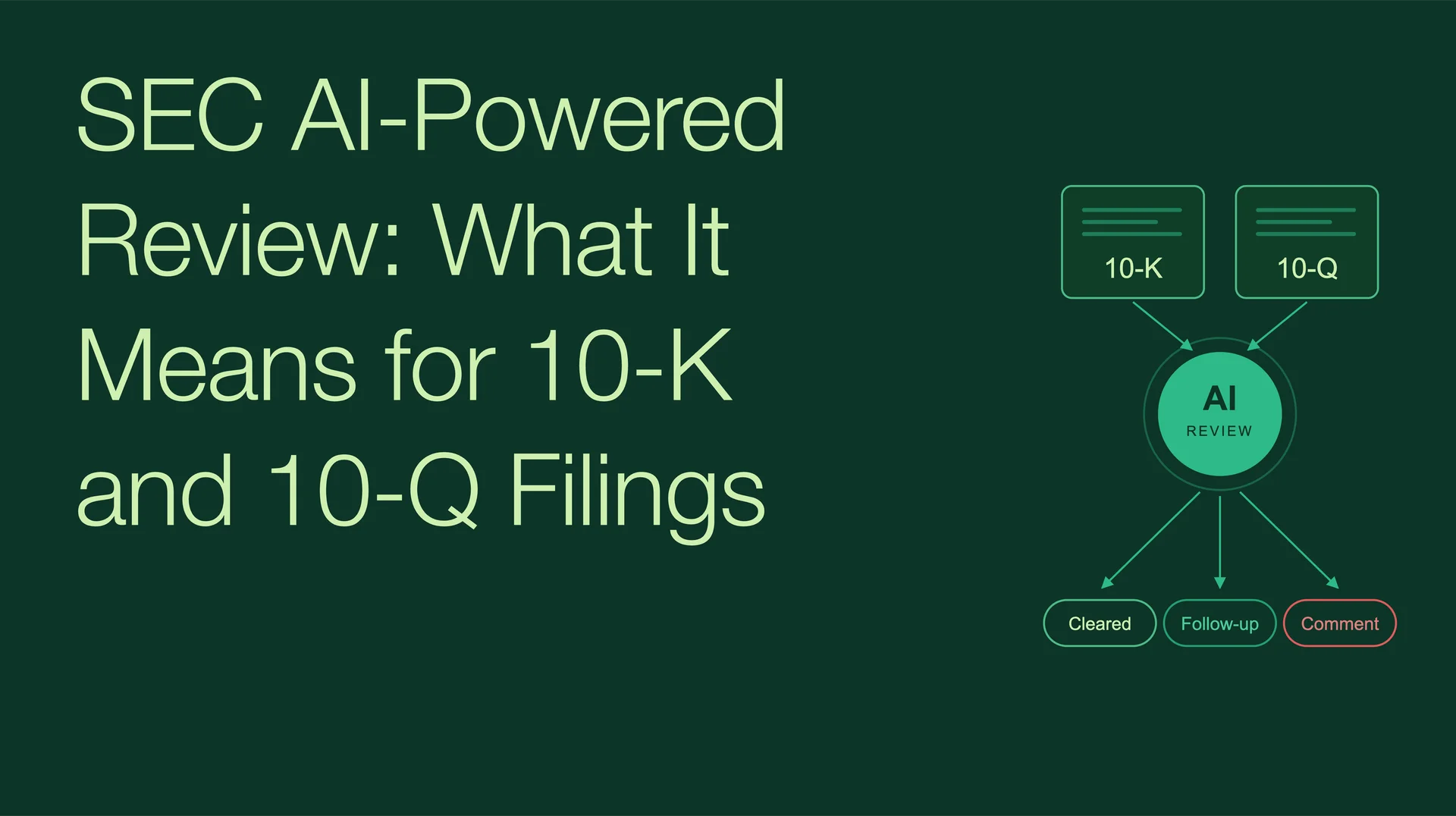
As the SEC rebuilds its fraud-fighting capabilities under new leadership, it plans to use AI to sift through vast quantities of public company filings and identify emerging risks and trends, an official said.
The confirmation came from a specific SEC official speaking to Global Investigations Review. The Law.com report published August 11, 2026 reported the same statement from the same briefing. Both reports are independently confirmed. The SEC official's statement was made in the context of describing the new Financial Reporting and Accounting Unit announced August 5.
This is the most consequential development for disclosure drafting practice in the Atkins era, and it has received zero coverage from the preparer's perspective. Every analysis of the Law.com statement has been written for securities litigators and defence counsel. The question those lawyers are asking is: how does the SEC's AI capability affect enforcement risk for companies already under investigation? The question CFOs and disclosure counsel should be asking is different: how does the SEC's AI capability change what I must do when drafting the Q3 10-Q that will be read by this system?
The companion blogs in this cluster cover the Financial Reporting and Accounting Unit's mandate (August 13 blog), the Gibson Dunn mid-year enforcement patterns (August 13 blog), and the ADM accounting fraud case (August 18 blog). This blog covers none of that. It covers the AI-reader question specifically: what does the SEC's AI look for, what does it find, what does it flag, and how do you draft disclosures that do not give it reasons to send you a comment letter or escalate you to the enforcement unit?
What Did Law.com Confirm About the SEC's New AI-Powered Filing Review Capability?
Law.com confirmed that as the SEC rebuilds its fraud-fighting capabilities under new leadership, it plans to use AI to sift through vast quantities of public company filings and identify emerging risks and trends, an official said.
Global Investigations Review reported the same statement from the same SEC official: the SEC plans to use AI to sift through vast quantities of public company filings and identify emerging risks and trends.
The institutional context: the statement was made in connection with the August 5 creation of the Financial Reporting and Accounting Unit, which is led by Timothy Zimmerman and reports to Osman Nawaz (Principal Deputy Director). The unit's mandate covers financial reporting fraud and auditor misconduct. The AI-powered filing review capability is the technological infrastructure the unit is using to scale its investigative capacity beyond what a team of attorneys and accountants could manually review.
The SEC is not new to technology-assisted filing review. The SEC's CETU (Cyber and Emerging Technologies Unit) has used algorithmic tools to screen trading data for market manipulation patterns for years. The EDGAR full-text search system allows automated keyword screening of the entire filing database. What is new is the confirmation that AI, rather than keyword-based or rules-based screening, is being applied to the financial reporting content of public company filings specifically in support of the new enforcement unit's mandate.
What the SEC official's statement specifically describes: AI to "sift through vast quantities of public company filings." The word "sift" implies a filtering function: the AI reads many filings and surfaces a smaller set for human review. "Identify emerging risks and trends" implies pattern recognition across filings, not just keyword matching within a single filing. Both descriptions are consistent with the capabilities of modern large language models and natural language processing systems applied to financial document corpora.
What the statement does not confirm: the specific AI tools the SEC is using, the specific filing sections it is screening, the specific patterns it is trained to identify, or whether the AI is generating draft comment letters or only surfacing filings for human attorney review. Those operational details have not been publicly disclosed.
What Types of AI Does the SEC Use to Scan Public Company Filings?
The SEC has not publicly described the specific AI tools or technical architecture it uses for filing review. What can be inferred from the SEC's public statements, its EDGAR infrastructure, and its parallel Cyber and Emerging Technologies Unit activities:
Natural language processing for text analysis. NLP tools can process the entire text of a 10-Q or 10-K, identify sections, extract quantitative claims made in narrative form (for example, "revenue grew 12% in Q2"), and compare those claims to the data in adjacent financial tables. This is the consistency checking function described below.
Large language model-based semantic analysis. LLMs can read disclosure language and assess its specificity relative to a reference set. A disclosure that says "we face risks from tariffs" can be assessed for its semantic similarity to peer company disclosures on the same topic. A disclosure that is semantically identical or near-identical to generic industry boilerplate can be flagged for additional review. This is the peer benchmarking function.
Pattern recognition across filing histories. AI systems can compare specific financial metrics (segment operating profit margins, intersegment revenue ratios, reserve levels as a percentage of exposure) across multiple filing periods for a single company and identify patterns inconsistent with the company's own disclosed operating trends. This is the fraud pattern recognition function.
Cross-company anomaly detection. AI systems can compare a single company's disclosures or financial metrics to a peer group and flag statistical outliers. A company whose disclosed tariff impact is materially lower than peers in the same industry and geography is a statistical outlier worth reviewing.
The SEC's EDGAR XBRL data provides structured financial data that makes the quantitative components of these analyses straightforward: every public company's financial tables are tagged in a machine-readable format that the SEC's systems can aggregate and compare across filers without reading the full text of any filing. The SEC's AI capability extends the same analysis to the unstructured narrative components of filings that XBRL does not capture.
AI Consistency Check #1: How the SEC Reads Your MD&A Narrative Against Your Financial Tables in Seconds
The most operationally immediate implication of AI-powered filing review is consistency checking between the MD&A narrative and the financial tables. This is not a new audit discipline. What is new is the speed and scale at which it can be applied by an automated system.
The specific consistency risk: a company's MD&A states that revenue grew 12% in the quarter. The financial table shows revenue of $4.8 billion compared to prior-year revenue of $4.5 billion, a growth rate of approximately 6.7%. The inconsistency is not a fraud; it is an error introduced when the MD&A narrative was updated but the percentage was not recalculated from the final financial table numbers. The error is exactly the type a human reviewer might overlook after reading a 150-page 10-Q for the third time on deadline day.
An AI system reading the same 10-Q flags the inconsistency in less than a second because it extracts the narrative claim (12% growth) and the financial table data ($4.5B to $4.8B), computes the implied growth rate (6.7%), and compares the two values. The difference is outside any reasonable rounding tolerance. The filing is surfaced for human review.
The research on AI failure modes in financial documents is directly relevant here. The "ecological error" as described in AI financial research is the specific error mode where AI produces a plausible but incorrect quantitative claim by selecting an adjacent temporal column (for example, using Q1 2025 data when the context requires Q2 2025 data) or by extracting the wrong variable from a table with multiple similar columns. These are the same types of errors that AI filing reviewers are specifically trained to detect in human-prepared documents. An ecological error in a human-prepared MD&A, where the writer accidentally referenced last quarter's percentage rather than the current quarter's, is exactly the pattern the SEC's AI will find.
The practical MD&A drafting implication: every quantitative claim in the MD&A narrative must be directly traceable to the corresponding financial table number in the same filing, not to last quarter's financial table, not to an analyst presentation prepared separately, and not to a rounding approximation that differs from the precise table figure. The check for this traceability must be a named step in the disclosure committee's final review process, completed from the final EDGAR submission package, not from a near-final draft.
AI Peer Benchmarking #2: Why "Generic" Tariff and Geopolitical Language Now Gets Flagged Algorithmically, Not Manually
The SEC's comment letter practice on tariff disclosures, confirmed from the OCA SEC Speaks 2026 presentations covered in the companion blogs, has established that generic tariff language without quantification is inadequate. That standard was previously enforced by human comment letter writers who read individual filings and made individual judgments about whether the disclosure was specific enough.
AI-powered peer benchmarking changes the enforcement mechanism. An AI system can read the tariff disclosure from every company in an industry sector and assess whether each company's disclosure is semantically specific or generic relative to the peer group. A disclosure that uses phrases semantically identical to 70% of peer company disclosures is, by definition, generic. It is not specific to this company's tariff exposure. The AI system flags it with a statistical confidence measure that a human comment letter writer did not have.
The academic research on AI analysis of SEC filings supports this capability. The ECML PKDD 2025 systematic analysis of AI risk disclosures in over 30,000 SEC 10-K filings noted that many disclosures remain generic or lack details on mitigation strategies, echoing concerns raised by the SEC about the quality of AI-related risk reporting. The same analytical framework that identified generic AI risk disclosures across 30,000 filings can be applied to tariff disclosures, Iran war disclosures, interest rate risk disclosures, and any other category where the SEC has indicated it expects company-specific quantification.
The peer benchmarking implication for disclosure drafting: a disclosure that would have satisfied a manual comment letter review when a single reviewer read it in isolation may not satisfy an algorithmic review that has read every peer company's disclosure on the same topic. The test for disclosure adequacy is no longer "does this read as specific enough in isolation?" It is "does this read as specific relative to how 200 peer companies disclosed the same risk?"
The practical action for disclosure teams: before finalising any risk factor or MD&A section that addresses a topic the SEC has flagged as a comment area (tariffs, geopolitical risk, AI use, non-GAAP reconciliation), review at least five peer company disclosures on the same topic. If your disclosure is semantically indistinguishable from the peer disclosures, it is generic by the algorithmic standard the SEC's AI reader will apply.
AI Pattern Recognition #3: How the SEC Detects Systematic Accounting Manipulation Across a Company's Filing History
The third and most consequential AI capability described by the SEC official is pattern recognition across filing history. This is not consistency checking within a single filing. It is trend analysis across multiple quarters or years of a single company's filings.
The specific patterns that AI-powered longitudinal analysis can identify:
Segment result migration. If Segment A's operating margin systematically increases each quarter as Segment B's operating margin decreases by approximately the same amount, without business-specific explanations, the pattern is consistent with intersegment transfer pricing manipulation. The ADM case involved exactly this pattern: Nutrition's operating profit growing while the agriculture and carbohydrate segments' profits shrank. A human review of any single quarterly filing might not detect this pattern. An AI reader that has ingested all 20 quarters of a company's segment reporting can identify the trend in seconds.
Reserve management. If a company's allowance for credit losses or insurance reserve consistently declines in quarters where earnings are below consensus estimates and increases in quarters where earnings would otherwise exceed consensus estimates, the pattern is consistent with reserve management. A human reviewer reading a single 10-Q might not see the pattern. An AI reader with access to 12 quarters of reserve data and earnings history will.
Revenue recognition timing. If recognised revenue systematically accelerates in the final days of fiscal quarters (detectable from the pattern of receivable ageing and cash collection timing disclosed in XBRL data), the pattern is consistent with channel stuffing or premature revenue recognition.
Non-GAAP adjustment consistency. If specific adjustment categories in the non-GAAP reconciliation grow as a percentage of the GAAP-to-non-GAAP gap over multiple quarters, while the underlying business condition the adjustment purports to represent does not grow correspondingly, the pattern is inconsistent with the non-recurring characterisation.
Each of these patterns requires multi-quarter data aggregation that is operationally impractical for human comment letter writers to perform across thousands of public companies. It is well within the capability of an AI system with access to the EDGAR XBRL database.
What the ADM and Key Tronic Cases Reveal About What the AI Reader Is Trained to Find
The ADM case (January 2026) and the Key Tronic case (April 2026) are the Financial Reporting and Accounting Unit's two landmark precedents. They also reveal, by inference, the specific patterns the SEC's AI reader is designed to detect, because those patterns are what the enforcement investigation eventually confirmed.
In the ADM case: the pattern was systematic intersegment transfer pricing adjustments that shifted operating profit to the Nutrition segment across multiple quarters. The pattern was not visible in any single filing. It was visible across the filing history of the segment-level disclosures. An AI reader trained to identify segment operating profit migration patterns, of the type described above, would have flagged ADM's Nutrition segment trend well before the enforcement investigation confirmed the cause.
In the Key Tronic case: the pattern was books and records errors that produced inaccurate revenues and expenses across several fiscal quarters. The errors were not random; they followed a pattern that, if viewed across the filing history, would appear as systematic rather than accidental.
The enforcement implication: the SEC's AI reader is not looking for errors in individual filings in isolation. It is looking for patterns across filing histories that are inconsistent with random error. A company whose financial metrics systematically move in directions that benefit reported earnings or segment performance, across multiple periods, is producing a statistical pattern that AI pattern recognition is specifically trained to surface.
The disclosure committee lesson: the final review before filing should include not only a check for consistency within the current filing but a retrospective consistency check across the past four to eight quarters. Do the current period's disclosures fit the pattern of the prior periods' disclosures in a way that is explainable by disclosed business developments? If the current period's segment results, reserve levels, or non-GAAP adjustments represent a notable change from the historical pattern, the disclosure should specifically address the change and its business cause. An unexplained pattern break is the specific flag that AI readers are designed to surface.
What Is the "Ecological Error", the AI Failure Mode That AI Readers Are Specifically Designed to Catch in Financial Documents
The "ecological error" is the term used in AI financial research to describe the specific error mode where AI produces a plausible but incorrect quantitative claim from a financial document by selecting an adjacent temporal column or the wrong variable from a table with multiple similar columns.
The reason this is directly relevant to AI-powered SEC filing review: AI systems that read financial documents to detect errors are specifically calibrated to find these same types of errors in human-prepared documents, because those are the errors that human preparers make most frequently when updating financial tables across quarters.
Concrete examples of ecological errors in financial document preparation:
A controller updates the revenue comparison table for Q3 2026 but accidentally populates the "Q3 2025" column with Q2 2025 actual data rather than Q3 2025 actual data. The Q3 2026 year-over-year growth rate calculated from this table is therefore wrong. The MD&A narrative based on that table is wrong. An AI reader that cross-references the filing's financial table with the prior-year comparable filing will detect the temporal error.
A disclosure drafter writes that gross margin improved by 350 basis points when the financial table shows gross profit as a percentage of revenue increased from 34.2% to 37.5%, a 330 basis point improvement. The 20 basis point discrepancy between the narrative claim (350 bps) and the calculated table result (330 bps) is an ecological error. An AI reader detecting the inconsistency surfaces the filing.
A non-GAAP reconciliation table shows that stock-based compensation of $124 million is excluded from Adjusted EBITDA. The press release's non-GAAP description says stock-based compensation excluded was $142 million. The $18 million discrepancy between the two documents is an ecological error that an AI cross-referencing the 10-Q against the press release 8-K will detect.
The practical implication: the types of final-review errors that disclosure teams most commonly make under deadline pressure are precisely the types of errors that AI filing review systems are designed to find. The pre-filing checklist must include a systematic extraction of every quantitative claim in the narrative and a verification of each claim against the financial table from which it was derived.
How Does AI-Powered SEC Review Change the Standard for MD&A Drafting in Your Q3 10-Q?
The AI-powered SEC filing review changes the standard for MD&A drafting in three specific ways that differ from what human-only review required.
First, internal consistency between narrative and tables is now machine-verified, not just human-spot-checked. The previous standard was that human reviewers would catch material inconsistencies between the narrative and the tables during the disclosure committee review. The new standard is that a machine will find any inconsistency between them, including immaterial ones that a tired human reviewer might overlook. The practical requirement: every quantitative claim in the MD&A narrative must be extractable from the filing's financial tables by a mechanical calculation, without rounding approximations that differ from the table's precision.
Second, disclosure specificity is now benchmarked against the peer filing population, not assessed in isolation. The previous standard was that a disclosure was adequate if it described the company's specific situation clearly enough for an informed investor to understand the risk. The new standard is that a disclosure must be specific relative to how peers have described the same risk. Generic language is no longer a matter of drafting style; it is a data point in an algorithmic assessment.
Third, cross-period consistency must be explainable. The previous standard required that each period's disclosures accurately describe that period's results. The new standard requires that the pattern of disclosures across periods be explicable by disclosed business developments. A disclosure that is internally consistent within a single quarter but that represents an unexplained break from the historical pattern is a flag under AI pattern recognition that was not a risk under human comment letter review alone.
What Disclosure Practices Create False Positives for the SEC's AI Reader and How to Avoid Them
A false positive for the SEC's AI reader is a disclosure that is accurate and complete but that triggers an AI flag based on surface-level pattern recognition, requiring the company to respond to a comment letter or enforcement inquiry that a more precise AI system would not have generated.
Four specific disclosure practices that create false positive risk under AI review:
Rounding conventions that are not consistently applied. If gross margin is expressed as a percentage to one decimal place in some tables and to two decimal places in others, and if the MD&A narrative uses rounded percentage change figures that derive from one rounding convention rather than the other, the AI reader may flag apparent inconsistencies that are actually rounding artefacts. Use one rounding convention consistently throughout the filing and apply it to all narrative references.
Comparative period descriptions that differ from the comparative table labels. If the MD&A narrative describes a comparison to "the corresponding period of the prior year" but the financial table labels the comparative column as "Fiscal Q3 2025" and the filing date is August 2026, the AI reader may flag a potential temporal mismatch between the narrative and the table. Use identical period descriptors in the narrative and the table labels.
Non-GAAP reconciliation items that appear in one document but not another. If the earnings press release (8-K) includes a non-GAAP adjustment for acquisition-related costs that does not appear in the 10-Q's non-GAAP reconciliation table, the AI cross-referencing the two documents will flag the discrepancy. All non-GAAP measures and reconciliation items must be consistent between the 8-K and the 10-Q.
Segment disclosures that use different segment naming conventions in different parts of the filing. If the segment footnote refers to "Connectivity" and the MD&A section refers to "Starlink" for the same segment, an AI reader may treat these as two different segments and flag apparent inconsistencies in their relative performance. Use identical naming conventions for all segments, products, and geographies throughout the filing.
A Pre-Filing AI Consistency Checklist for Controllers and Disclosure Counsel
Ten specific checks, each addressing one of the consistency, benchmarking, or pattern recognition issues described above, to be completed from the final EDGAR submission package before the filing is authorised.
One: extract every quantitative percentage or dollar change claim from the MD&A narrative. For each claim, verify it by direct mechanical calculation from the financial tables in the same filing. Any discrepancy must be corrected.
Two: verify the comparative period labels in all financial tables match the period descriptions in the MD&A narrative. "Prior year quarter" in the narrative must correspond to the same period as the prior-year column in the financial table.
Three: confirm the non-GAAP reconciliation table in the 10-Q is identical to the non-GAAP reconciliation in the earnings press release (8-K). Every adjustment line item must match in name, amount, and description between the two documents.
Four: confirm that all segment names used in the narrative, the segment footnote, the MD&A, and the risk factors are identical. No segment should be referenced by different names in different sections.
Five: for each significant disclosed percentage change (revenue, gross margin, operating income, segment profit), verify that the underlying base and current period numbers in the financial table, when divided, produce the disclosed percentage within one decimal place of rounding.
Six: for any risk factor or MD&A section covering a topic the SEC has flagged as a comment area (tariffs, AI use, geopolitical risk), read five peer company disclosures on the same topic and confirm that your disclosure contains company-specific quantitative detail that is not generic relative to the peer set.
Seven: compare the current period's segment operating margin for each reportable segment to the prior four quarters' segment operating margins. If the current period shows a significant deviation from the trend without a corresponding disclosed business explanation, confirm that the MD&A specifically addresses the deviation and its cause.
Eight: compare the current period's key reserve balances (allowance for credit losses, warranty reserve, litigation reserve) to the prior four quarters. If any reserve moved in a direction that benefits earnings without a corresponding disclosed change in the underlying risk exposure, confirm that the MD&A specifically addresses the reserve movement.
Nine: verify that every AI tool used to assist in disclosure drafting has had its output independently verified by a qualified financial reporting professional against the financial data sources. Document that verification. The SEC's comment letter practice and the FEI AI-ICFR framework both require documented human oversight of AI outputs in the disclosure process.
Ten: confirm the final filing package used for this checklist is the identical package being submitted to EDGAR, not an earlier draft. The checklist must be run on the version being filed, not on the near-final version reviewed by the disclosure committee.
Frequently Asked Questions
Is the SEC using AI to review public company financial filings?
Yes. A SEC official confirmed that as the SEC rebuilds its fraud-fighting capabilities under new leadership, it plans to use AI to sift through vast quantities of public company filings and identify emerging risks and trends.</cite> The confirmation was reported by Law.com and independently by Global Investigations Review on August 11 and 12, 2026, in the context of the new Financial Reporting and Accounting Unit created August 5.
What types of errors can SEC AI detect in a 10-Q or 10-K?
Based on the SEC official's description and the known capabilities of AI applied to financial documents: inconsistencies between MD&A narrative quantitative claims and financial table data, generic disclosure language relative to peer company benchmarks, systematic patterns in financial metrics across multiple filing periods consistent with accounting manipulation, and cross-document inconsistencies between the 8-K earnings release and the 10-Q filed subsequently.
Does AI-powered SEC review change what my 10-Q MD&A must say?
It changes the standard for three elements: internal consistency between narrative and tables (now machine-verified at a precision that catches rounding errors and temporal column errors), disclosure specificity (now benchmarked against peer company disclosures algorithmically, not assessed in isolation), and cross-period consistency (now assessed across multiple quarters for pattern anomalies, not only within the current period).
How does the SEC's AI compare my disclosures to peer company filings?
The SEC's EDGAR XBRL database makes structured financial data from all public companies machine-readable and comparable. The SEC's AI applies natural language processing to the unstructured narrative components of filings and assesses the semantic specificity of disclosure language relative to a peer group. A disclosure that is semantically similar to generic industry boilerplate can be flagged with a statistical confidence measure that a human comment letter writer reviewing a single filing could not compute.
What is an ecological error in financial reporting and why do SEC AI tools find them?
An ecological error is a quantitative error produced by selecting an adjacent temporal column or the wrong variable from a financial table with multiple similar columns. It is the most common error mode in human-prepared financial documents updated under deadline pressure. AI reading systems are specifically designed to detect ecological errors by cross-referencing narrative quantitative claims against the financial tables from which they should be derived.
Key Takeaways
- A SEC official confirmed that as the SEC rebuilds its fraud-fighting capabilities, it plans to use AI to sift through vast quantities of public company filings and identify emerging risks and trends. This was reported by Law.com and Global Investigations Review on August 11 and 12, 2026.
- The SEC's AI-powered filing review capability covers at least three functions: consistency checking between MD&A narrative and financial tables, peer benchmarking of disclosure language specificity, and pattern recognition for systematic accounting manipulation across filing histories.
- Consistency checking at machine speed: AI readers extract quantitative claims from MD&A narratives and verify them against financial tables in seconds. Ecological errors (wrong temporal column, wrong variable extraction) that human reviewers might miss under deadline pressure are the specific error mode AI readers are trained to detect.
- Peer benchmarking at scale: generic disclosure language, indistinguishable from industry boilerplate, is algorithmically flagged when the AI compares your disclosure to 200 peer company disclosures simultaneously. The standard for disclosure adequacy is now relative to the peer group, not assessed in isolation.
- Pattern recognition across filing history: systematic segment profit migration, reserve management patterns, and non-GAAP adjustment trends that are consistent across multiple quarters but inconsistent with disclosed business developments are the specific patterns AI longitudinal analysis surfaces, exactly the patterns the ADM and Key Tronic enforcement cases involved.
- The ten-item pre-filing AI consistency checklist covers: MD&A narrative-to-table claim verification, comparative period label consistency, non-GAAP reconciliation cross-document matching, segment naming consistency, percentage change mechanical verification, peer disclosure specificity comparison, segment margin trend check, reserve movement explanation, AI-assisted drafting verification documentation, and final EDGAR package confirmation.
- The disclosure committee's final review must now include a systematic extraction and verification of every quantitative claim in the narrative, a cross-document non-GAAP reconciliation check between the 8-K and the 10-Q, and a retrospective pattern review for each significant financial metric across the prior four to eight quarters.