SEC Form 13F Reporting Requirements: 2026 Compliance Guide
If your firm exercises investment discretion over $100 million or more in Section 13(f) securities, you must file Form 13F with the SEC every quarter. But the mechanics are more nuanced than that single sentence suggests, and the most common compliance failures come from misreading the threshold trigger, the first-filing timing rule, and the post-2022 form requirements. This guide covers all of it, including the newly-live Form SHO obligation that most 13F resources still ignore.
Key takeaway: The $100 million threshold is measured on the last trading day of any month of a calendar year, not just at quarter-end. Crossing it in July means you file for the December quarter, not the July quarter.
Who Must File Form 13F?
Any institutional investment manager (IIM) that exercises investment discretion over $100 million or more in Section 13(f) securities, and uses any means of U.S. interstate commerce in its business, must file Form 13F under Section 13(f)(1) of the Securities Exchange Act of 1934.
The definition of IIM is deliberately broad. It covers two distinct categories:
- Entities that invest for their own account: banks, insurance companies, broker-dealers, corporations, and pension funds managing their own portfolios.
- Entities or persons that exercise investment discretion over others' accounts: investment advisers, trust departments, and trustees.
A few points that catch managers off guard:
- Not being an SEC-registered investment adviser does not exempt you. The obligation arises from the Exchange Act, independent of Investment Advisers Act registration. Exempt-reporting advisers and unregistered managers are equally subject.
- Foreign managers are included if they use any means of U.S. interstate commerce (mail, phone, or electronic communication is sufficient) and meet the $100 million threshold.
- Government pension fund managers qualify because "person" under Section 3(a)(9) of the Exchange Act includes governments and their instrumentalities.
- A natural person managing only their own account does not qualify, even if their personal holdings exceed $100 million.
How the $100 Million Threshold Actually Works
The threshold is measured on the last trading day of any month of a calendar year, not at quarter-end. This is the single most common compliance misconception, and Rule 13f-1(a)(1) is unambiguous on the point.
What this means in practice:
- A manager whose portfolio reaches $100 million on the last trading day of July has crossed the threshold, even if it drops back below $100 million by September 30.
- That manager must file Form 13F for the December quarter of that calendar year, due within 45 days of December 31 (typically by February 14 of the following year).
- The manager then files for each of the first three calendar quarters of the subsequent year, regardless of whether holdings remain above $100 million.
The threshold has not been adjusted for inflation since Congress enacted Section 13(f) in 1975. The SEC's own FAQ acknowledges that Congress passed the provision to increase investor confidence in U.S. markets. At 1975 nominal values, $100 million captured a narrow slice of the industry; today it captures a far larger share.
When Is Your First Form 13F Due?
Your first filing is due for the December quarter of the year in which you first reach the $100 million threshold, not the quarter in which you cross it.
This timing rule trips up many first-time filers. Here is how it works:
Threshold CrossedFirst Filing PeriodFirst Filing DueAny month in Q1 2026Q4 2026 (Dec 31)February 14, 2027Any month in Q2 2026Q4 2026 (Dec 31)February 14, 2027Any month in Q3 2026Q4 2026 (Dec 31)February 14, 2027Any month in Q4 2026Q4 2026 (Dec 31)February 14, 2027
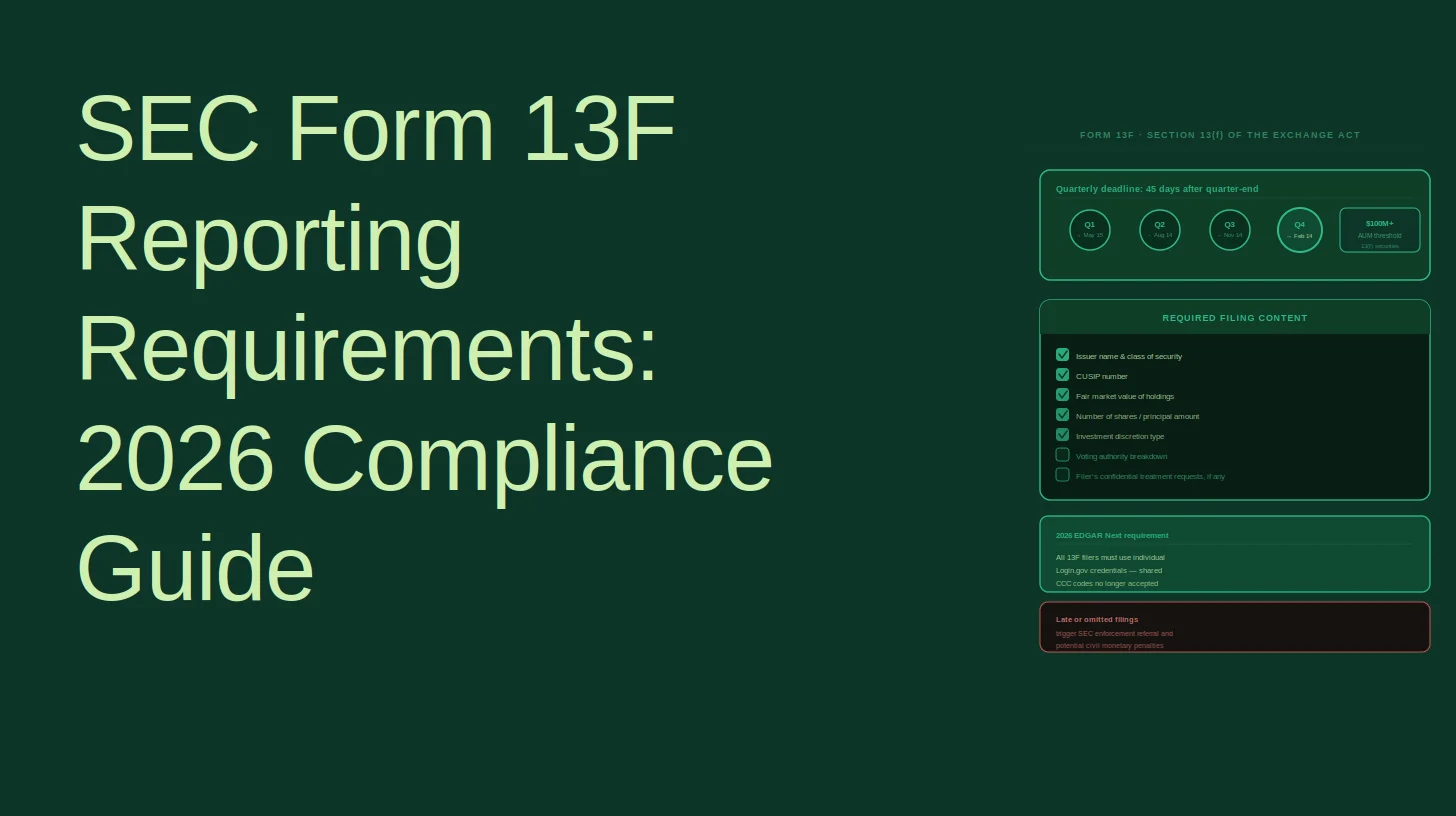
Once you file for the December quarter, you continue filing quarterly for the following year's first three quarters, within 45 days of each quarter-end. The 2026 filing deadlines are approximately February 14, May 15, August 14, and November 14, adjusted to the next business day when a deadline falls on a weekend or holiday.
Key takeaway: A manager who crosses $100 million in March does not file for Q1. It files for Q4 of that same year, due the following February.
What Securities Must Be Reported: The 13F List
Only securities on the SEC's official 13F List must be reported. Filers may rely on the current list to determine reportability, and the list is updated quarterly (last updated April 6, 2026).
Section 13(f) securities include:
- Exchange-traded equities (U.S. national securities exchanges)
- Shares of closed-end investment companies
- Exchange-traded options and warrants (report the option position, not the underlying shares)
- Certain convertible debt securities
- ETFs listed on a U.S. exchange
Section 13(f) securities do not include:
- Short positions (these are addressed by the new Form SHO, discussed below)
- Open-end mutual fund shares
- Most foreign-listed securities
- Bonds and other non-equity debt
Using a stale list is a common source of filing errors. Securities are added and removed each quarter, so filers must validate their holdings against the list current as of the reporting period end date, not the list from the prior quarter.
The 2022 Amendments: What Changed on January 3, 2023
The SEC adopted SEC Release No. 34-95148 in June 2022. The amended form became required starting January 3, 2023. If your systems or templates predate that change, you may still be filing incorrectly.
The five key changes:
- Rounding to the nearest dollar. Dollar values must now be rounded to the nearest dollar, not the nearest $1,000. Legacy systems that still round to thousands are producing non-compliant filings.
- CRD and SEC file numbers required. Managers must now report their Central Registration Depository (CRD) number and SEC file number, if any.
- FIGI as a supplemental identifier. The Financial Instrument Global Identifier (FIGI) may now be used in addition to, but not instead of, the CUSIP number.
- Summary Page checkbox for confidential treatment. A new checkbox on the Summary Page must be checked when confidential treatment is being requested for any position in the Information Table.
- Electronic-only confidential treatment requests. Starting February 28, 2023, all confidential treatment requests must be filed electronically on EDGAR. Paper submissions are no longer accepted.
Duplicative Reporting Rules for Affiliated Managers
When two or more managers each required to file Form 13F exercise investment discretion over the same securities, only one manager needs to include those securities in its report. This rule exists to prevent double-counting in the public data, but it creates a compliance trap for asset management groups with multiple affiliated advisers.
The mechanics, per the Form 13F General Instructions:
- The manager whose holdings are reported by another manager must identify the reporting manager on its own filing (per Special Instruction 5).
- The manager reporting on behalf of another must identify the other manager (per Special Instruction 7).
- Both managers still file; only the securities allocation changes.
In practice, affiliated-manager groups often either double-report the same positions or fail to cross-reference correctly. Both errors draw SEC follow-up. Before each quarter-end, affiliated managers should confirm in writing which entity is the reporting manager for each shared position.
Confidential Treatment Requests: The Post-2022 Process
Managers can request that the SEC prevent or delay public disclosure of specific positions under Section 13(f)(4) of the Exchange Act. The most common basis is FOIA Exemption 4, protecting confidential commercial or financial information, typically used for open-risk arbitrage positions or active acquisition programs.
Key procedural requirements post-February 28, 2023:
- Requests must be filed electronically on EDGAR under Rule 24b-2(i). Paper is no longer accepted.
- The public Form 13F must check the new Summary Page checkbox indicating that confidential treatment has been requested.
- The request must provide sufficient factual support for the SEC to evaluate the merits, including a description of the investment strategy, why disclosure would reveal it prematurely, and whether a program of acquisition or disposition was ongoing at quarter-end and at the time of filing.
- One category of positions is mandatory for confidential treatment: securities held by the account of a natural person or an estate or trust (other than a business trust or investment company). The SEC shall not disclose this information, but the manager must still submit it under the confidential treatment procedures.
Initial requests may cover three, six, nine, or twelve months, and are renewable by filing a de novo request before expiration.
EDGAR XML Technical Requirements and Data Quality
Form 13F must be filed electronically on EDGAR using the EDGAR XML Technical Specification. The text-based ASCII format was discontinued on May 20, 2013. Filers must either use the EDGAR online form or construct the entire filing per the XML spec.
The SEC's own disclaimer on its Form 13F Data Sets page is worth reading carefully:
"Because the data is derived from information provided by individual filers, we cannot guarantee the accuracy of the data sets."
The March 12, 2024 refresh of all historical 13F data sets, which incorporated EDGAR Release 22.4.1 changes, also included processing fixes for missing information table records and filing manager address errors. The fact that systematic errors persisted in historical data until 2024 signals that filer-side validation has been inadequate across the industry.
Common filing errors to validate before submission:
- Stale CUSIPs: validate every CUSIP against the current quarterly 13F List, not a cached version.
- Incorrect rounding: confirm your system rounds to the nearest dollar (not nearest $1,000) per the January 2023 change.
- Missing CRD or SEC file numbers: required since January 3, 2023.
- XML schema errors: run the file against the EDGAR XML Technical Specification before submission; schema errors prevent processing.
- Omitted Summary Page checkbox: if requesting confidential treatment, the checkbox must be present.
The SEC's OMB burden estimate for Form 13F is 2 hours per response (OMB Number 3235-0006, expires January 31, 2029). For any manager with hundreds or thousands of positions requiring CUSIP validation and XML construction, that estimate is not realistic. Build adequate lead time into your compliance calendar.
For a step-by-step walkthrough of the EDGAR submission process itself, see Finrep's guide to filing Form 13F.
Form SHO and Rule 13f-2: The New Parallel Obligation
As of February 2026, institutional investment managers that meet specified short-position thresholds must also file Form SHO monthly under Rule 13f-2. This is a separate obligation from Form 13F, with different thresholds, a different cadence, and different deadlines.
Key facts about Form SHO:
- Effective date: January 2, 2024.
- Original compliance date: January 2, 2025.
- Actual first filing: February 17, 2026, for the January 2026 reporting period, after the SEC granted a temporary exemption on February 7, 2025. The exemption was granted because the technical filing standards were only released on December 16, 2024, leaving filers insufficient time to build and test systems.
- Filing deadline: within 14 calendar days after the end of each calendar month (not 45 days after quarter-end like Form 13F).
- Threshold: a monthly average gross short position of $10 million or more in value, or 2.5% or more of outstanding shares, in any equity security registered under Section 12 or subject to Section 15(d) reporting; or a gross short position of $500,000 or more in any other equity security on any settlement date during the month.
- Public disclosure: the SEC will publish aggregated short-position data, not individual manager data, preserving some confidentiality.
As SEC Acting Chairman Mark Uyeda stated when granting the exemption: "Transparency is essential to well-functioning markets... It is also important to enhance the accuracy of the short sale-related data that would ultimately be provided to investors by giving institutional investment managers additional time."
FeatureForm 13FForm SHOStatutory basisSection 13(f)Rule 13f-2What is reportedLong positionsShort positionsFiling cadenceQuarterlyMonthlyDeadline45 days after quarter-end14 days after month-endFirst live filingLong-standingFebruary 17, 2026Public dataIndividual manager levelAggregated onlyThreshold$100M in 13(f) securities$10M or 2.5% short in any security
Managers who already file Form 13F should assess whether their short positions also trigger Form SHO. The two forms cover the same filer population but are not coextensive: a manager above the 13F threshold may fall below the SHO threshold, and vice versa.
Bank-Specific Dual-Filing Requirement
One obligation that virtually no public-facing 13F resource mentions: if your firm is a bank whose deposits are FDIC-insured, you must file a copy of every Form 13F not only with the SEC but also with the appropriate bank regulatory agency, per Section 13(f)(5) of the Exchange Act. Filers can satisfy this by sending a copy electronically (with confidential access codes removed) or in paper.
FAQ
How often are 13F filings required?Form 13F is a quarterly filing. It must be submitted within 45 days after the end of each calendar quarter: Q1 (March 31), Q2 (June 30), Q3 (September 30), and Q4 (December 31). The 2026 deadlines fall approximately on February 14, May 15, August 14, and November 14.
Does the $100 million threshold apply to assets under management or only Section 13(f) securities?Only Section 13(f) securities count toward the threshold. The aggregate fair market value is measured on the last trading day of any month of a calendar year. Holdings in bonds, mutual funds, and foreign-listed securities that are not on the 13F List do not count.
Do we report client assets or only proprietary holdings?Both. Investment discretion, not ownership, is the trigger. You report all Section 13(f) securities over which you exercise investment discretion, whether held in your own account or in client accounts.
What happens if our holdings drop below $100 million after we cross the threshold?You must still file for the December quarter of the year you crossed the threshold, and for each of the first three quarters of the following year, even if holdings fall below $100 million during that period.
Can we omit small positions from the Information Table?Yes. The form permits omission of individual holdings with fewer than 10,000 shares and less than $200,000 in fair market value. Both conditions must be met.
What are the penalties for late or inaccurate 13F filings?The SEC does not grant extensions for Form 13F. Late filers should submit as soon as possible. The SEC has levied fines exceeding $750,000 for persistent late or inaccurate filings, and enforcement actions have increased in recent years. Inaccurate filings also require an amendment, which must set forth the complete text of the Form 13F and be numbered sequentially.
Does Section 16 reporting interact with Form 13F?Yes, for managers who are also 10% or greater beneficial owners of a public company's equity. Those managers face parallel Section 16 obligations, including Form 4 filings for transactions. The two regimes operate independently but cover overlapping ground for activist investors and large passive managers. For more on Section 16, see Finrep's guide to Form 4 transaction triggers.