SAB 74 Disclosure Requirements: What the SEC Expects in 2026 Filings
If your company has issued-but-not-yet-adopted accounting standards on the horizon, SAB 74 disclosure requirements apply to you right now, in your next 10-K or 10-Q. This guide tells SEC reporting teams, CFOs, and controllers exactly what to disclose, at what level of detail, and when, so the disclosure holds up under SEC comment letter scrutiny.
Key takeaway: SAB 74 (codified as SAB Topic 11.M and at ASC 250-10-S99-6) is not a five-bullet checklist you fill in once. The SEC staff expects disclosures to become progressively more specific and quantitative as an effective date approaches. Boilerplate "impact not yet determinable" language that passes muster 18 months out will draw a comment letter 6 months out.
What Is SAB 74 and Where Is It Codified?
SAB 74 is Staff Accounting Bulletin No. 74, which requires public companies to disclose the potential financial statement effects of accounting standards that have been issued but not yet adopted. It applies to every registrant subject to the Securities Exchange Act of 1934, with no size exemption: emerging growth companies, smaller reporting companies, and large accelerated filers all face the same obligation.
The guidance lives in two places simultaneously, which trips up practitioners:
- SAB Topic 11.M in the SEC's Staff Accounting Bulletin codification (last reviewed November 25, 2025)
- ASC 250-10-S99-6 in the FASB Accounting Standards Codification, where the pre-codification EITF D-28 substance was absorbed
SABs are not formal rules. As the SEC's own codification page states, they "represent interpretations and policies followed by the Division of Corporation Finance and the Office of the Chief Accountant in administering the disclosure requirements of the federal securities laws." That distinction matters less than it sounds: the staff applies SAB 74 in the comment letter process with the same force as a codified rule. Cite both locations in your filing to signal awareness of both.
The Five Required Elements of a SAB 74 Disclosure
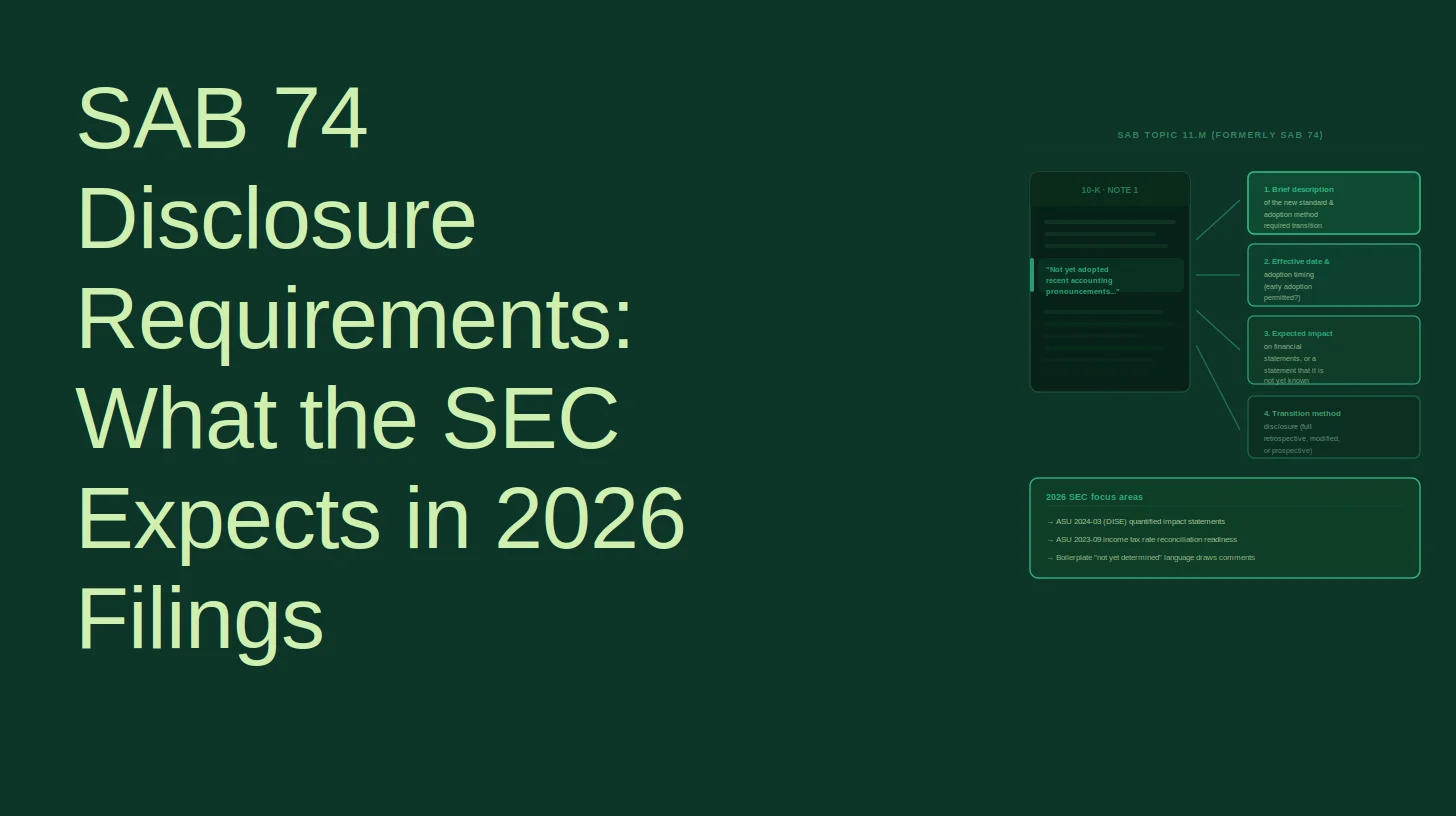
A compliant SAB 74 disclosure must include all five of the following elements for each issued-but-not-yet-adopted standard that is expected to have a material effect on the financial statements, per Deloitte's SEC Comment Letter Considerations Roadmap (Section 2.19):
- A brief description of the standard and what it changes
- The required adoption date and the registrant's planned adoption date if earlier
- The method of adoption expected (e.g., full retrospective, modified retrospective, prospective)
- The anticipated financial statement impact, or a statement that the impact is not yet known or reasonably estimable
- Other significant matters the registrant believes might result from adoption, such as potential debt covenant violations or planned changes in business practices (encouraged, not strictly required)
These five elements are the floor. The SEC staff's expectations, built up through conference speeches and comment letters over many years, go considerably further.
What the SEC Actually Expects Beyond the Text
The single most important thing practitioners miss about SAB 74 is the "escalating disclosure" doctrine. The SEC staff has stated, most recently at the 2023 AICPA and CIMA Conference on Current SEC and PCAOB Developments, that disclosures "are expected to become increasingly more informative as the effective date of a new standard approaches," meaning "companies are expected to disclose additional and more precise quantitative and qualitative information as the effective date gets closer," per KPMG's January 2024 Hot Topic.
In practice, this means the same disclosure that was acceptable in your 10-K two years before adoption becomes deficient one year out, and potentially comment-worthy six months out.
When a registrant cannot yet reasonably estimate the full financial statement impact, the SEC staff expects the following qualitative content beyond a bare "not yet estimable" statement:
- A description of the accounting policies the company expects to apply, compared with current policies
- The company's progress in implementing the standard
- The significant implementation matters still to be addressed
This is not optional. It is the staff's stated position, and it is exactly what the archetypal SEC comment letter demands (see the comment letter section below).
The Partial Estimate Rule
One of the most practically important, and most often missed, points in the SAB 74 framework is this: you do not need a complete estimate to disclose a quantitative figure. The SEC staff has encouraged companies to "disclose known or reasonably estimable quantitative information about adopting a new standard, even if that information may differ from the ultimate effect of adoption, and even if it is for only a portion of the company's arrangements."
If you have completed the analysis for your domestic operations but not your foreign subsidiaries, disclose the domestic figure and note what remains outstanding. A partial estimate is better than no estimate, and the SEC staff treats the absence of a partial estimate as a red flag when one is clearly available.
The Disclosure Maturity Timeline
No existing guidance document maps out what the SEC expects at each stage of the pre-adoption period. Based on the staff's stated positions, here is a practical framework:
Time Before Effective DateExpected Disclosure Content18+ monthsQualitative description of the standard; acknowledgment it is under evaluation; planned adoption date and method if determined12 monthsComparison of current vs. expected accounting policies; description of implementation approach; identification of significant open items6 monthsAll of the above, plus partial quantitative estimates where available; specific description of remaining implementation matters; ICFR changes underway1 quarterQuantitative impact to the extent estimable; final adoption method confirmed; ICFR changes substantially complete or on track; no open items left undisclosed
This is not a bright-line rule from the SEC. It is a practical synthesis of the staff's escalating disclosure doctrine applied to a typical two-year implementation cycle. Adjust the timeline based on the complexity of the standard and your company's implementation progress.
Which ASUs Require SAB 74 Disclosures in 2025 and 2026 Filings?
The 2024 to 2027 window is the most concentrated cluster of major pending ASUs since the 2017 to 2020 wave of ASC 606, ASC 842, and ASC 326, per KPMG's January 2024 analysis. Every public company filing a 10-K or 10-Q in 2025 or 2026 should assess each of the following:
ASUTopicEffective Date (Calendar-Year Public Companies)SAB 74 TriggerASU 2023-01Common control lease arrangementsFiscal year 2024Already effective; assess if adoptedASU 2023-02Proportional amortization methodFiscal year 2024Already effective; assess if adoptedASU 2023-07Segment reporting (Topic 280)Fiscal year 2024 (annual); fiscal year 2025 (interim)Disclosure required in 2023 and 2024 filings pre-adoptionASU 2023-09Income tax disclosuresFiscal year 2025 (annual)Disclosure required in 2024 and early 2025 filingsASU 2024-03Disaggregation of income statement expenses (DISE)Fiscal year 2027 (annual)Disclosure required in 2025 and 2026 filingsASU 2023-06Disclosure improvementsEffective upon SEC removal of related rulesAssess when SEC acts
ASU 2024-03 (DISE) is the most significant standard requiring SAB 74 disclosure in 2026 annual filings. It is effective for annual periods beginning after December 15, 2026, meaning calendar-year companies adopt it in fiscal year 2027. Companies filing their 2025 and 2026 10-Ks must assess and disclose its expected impact now.
Do Disclosure-Only Standards Require SAB 74 Assessment?
Yes, and this is one of the most common mistakes in practice. A standard that changes only note disclosures, with no effect on recognition or measurement, is still within the scope of SAB 74 if the disclosure changes will have a material effect on the financial statements, including the accompanying notes.
KPMG specifically flags ASU 2023-07 (segment reporting) and ASU 2023-09 (income tax disclosures) as disclosure-only standards that nonetheless require SAB 74 assessment. Neither changes how revenue, expenses, assets, or liabilities are recognized or measured. Both require significant new disclosures that can be material.
As Sagar Teotia, then Deputy Chief Accountant at the SEC's Office of the Chief Accountant, stated in a September 2017 speech: "The assessment of the materiality of the new revenue standard must include consideration of the full scope of the standard, including its disclosure requirements." That principle applies equally to every ASU, not just ASC 606.
The BDO and CAQ Alert 2017-03 framework puts it plainly: "Footnote disclosure is an important aspect of adopting new GAAP, even if revenue recognition does not change on adoption, new disclosures are required."
One important boundary: SAB 74 does not require you to provide the complete disclosure that would be required under a fully effective standard. Doing so would effectively constitute early adoption. The staff expects comprehensive qualitative disclosures about expected changes, not a pre-adoption replica of the new footnote.
What SEC Comment Letters Actually Say About SAB 74
The SEC's Division of Corporation Finance monitors public statements by management and cross-references them against filed disclosures. Two comment letters quoted in Deloitte's SEC Comment Letter Considerations Roadmap illustrate the two most common failure modes.
The public statement cross-reference risk:
"We note the disclosures . . . relating to the impact of CECL and the discussion of the quantitative build to the allowance disclosed by your CFO at the conference . . . but were unable to locate this information in your Form 10-K . . . . Please revise to include this information in future filings . . ., consistent with SAB Topic 11:M."
If your CFO discusses a quantitative estimate on an earnings call or at an investor conference, that figure must appear in your next 10-K or 10-Q. The staff reads transcripts.
The inadequate qualitative disclosure:
"You state that you expect the impact of adoption of Topic 842 to be material to total assets and liabilities on the consolidated balance sheets. Please quantify the impact of adoption to the extent that you have determined such amounts. If you cannot reasonably estimate the impact of adoption, please revise to provide more specific qualitative disclosures of the potential impact that this standard will have on your financial statements when adopted. Also describe the status of your process to implement the new standard and the significant implementation matters yet to be addressed. Refer to ASC 250-10-S99-6 and SAB Topic 11.M."
This is the archetypal SAB 74 comment. The company acknowledged materiality but stopped there. The staff wanted a quantitative figure, or failing that, a specific qualitative description of the impact and a status update on implementation. "Impact not yet determinable" is not a complete answer once you are within 12 months of an effective date.
For a broader look at how the SEC uses comment letters to enforce disclosure quality, see Finrep's guide on how to write a results-of-operations section that won't draw SEC comments.
SAB 74 and Internal Controls: The Governance Layer
Most SAB 74 articles stop at the disclosure content. They skip the governance dimension entirely. The CAQ Alert 2017-03 framework, which remains the definitive statement on this point, assigns distinct responsibilities to three parties:
Management must determine whether appropriate internal controls over financial reporting (ICFR) are in place to minimize the risk that SAB 74 disclosures are inaccurate or incomplete. New standards almost always change processes, systems, and controls. Those changes need to be designed, tested, and disclosed.
Audit committees must set the appropriate tone and establish oversight and review processes to ensure management is exercising appropriate judgment and that adequate SAB 74 disclosure controls are in place and operating effectively. If your audit committee is not being briefed on SAB 74 obligations for in-flight ASUs, that is a governance gap.
Auditors must obtain a sufficient understanding of the registrant's implementation status. After a standard's effective date, auditors will ordinarily inquire of management about the application of the new standard as part of their audit procedures. The quality of SAB 74 disclosures in the pre-adoption period directly shapes the audit process post-adoption.
The SEC staff has also encouraged companies to implement new GAAP standards concurrently rather than sequentially by effective date, particularly where system enhancements are involved. A company implementing ASU 2023-09 and ASU 2024-03 simultaneously may need to address implementation progress for both in a single filing, per Teotia's 2017 remarks.
Early Adoption and SAB 74: What Changes
If your company decides to early adopt a standard, SAB 74 disclosure obligations cease for that standard from the adoption date forward. The standard is no longer "issued but not yet adopted." However, the period leading up to early adoption still requires SAB 74 disclosures in the filings before adoption is complete. Early adoption does not retroactively eliminate the obligation to have disclosed the anticipated impact in prior periods.
For companies considering early adoption of ASU 2024-03 (DISE), which permits early adoption, the SAB 74 disclosure in the filing immediately before adoption should be the most complete and specific disclosure in the series, reflecting the full quantitative and qualitative picture available at that point.
Materiality Assessment: The Scope Is Wider Than You Think
The scoping rule for SAB 74, preserved from EITF D-28 in ASC 250-10-S99-6, is that the guidance applies to "all accounting standards which have been issued but not yet adopted by the registrant unless the impact is not expected to be material." The materiality assessment must cover the full scope of the standard:
- Recognition and measurement changes
- Presentation changes
- New disclosure requirements in the notes
A standard with no income statement or balance sheet impact can still be material if it requires significant new disclosures that involve significant judgments. ASU 2023-07 and ASU 2023-09 are the current examples. Do not limit your materiality assessment to line-item financial statement effects.
For context on how the SEC approaches materiality more broadly, Finrep's related piece on SEC Climate Rescission: Drafting SAB 74 Disclosures covers the specific application of this framework to climate-related standard adoption.
FAQ
What is SAB Topic 11.M?SAB Topic 11.M is the SEC staff's codified version of Staff Accounting Bulletin No. 74. It requires public companies to disclose the potential effects of issued-but-not-yet-adopted accounting standards in both interim and annual SEC filings. It is also codified at ASC 250-10-S99-6 in the FASB Codification.
Can I say "the impact is not yet reasonably estimable" and leave it at that?Not without more. The SEC staff expects that statement to be accompanied by a description of the accounting policies you expect to apply, a comparison with current policies, and a status update on implementation progress and remaining open items. A bare "not yet estimable" statement will draw a comment letter as the effective date approaches.
Do disclosure-only standards like ASU 2023-07 require SAB 74 disclosures?Yes. If the new disclosure requirements are expected to be material to the financial statements, including the notes, SAB 74 applies. The materiality assessment must consider the full scope of the standard, not just its income statement or balance sheet effects.
What happens if my CFO discusses an estimate on an earnings call but the 10-K says the impact is not yet estimable?The SEC will likely issue a comment letter citing SAB Topic 11.M. The staff monitors public statements and cross-references them against filed disclosures. Any quantitative information disclosed in a public forum must appear in the next SEC filing.
Does SAB 74 apply to SABs themselves, not just FASB ASUs?Yes. The original SAB 74 text covers "accounting standards" broadly, and SAB Topic 11.M explicitly references both ASUs and SABs. A newly issued SAB that is not yet effective can trigger SAB 74 disclosure obligations if its impact is expected to be material.
What is the most significant ASU requiring SAB 74 disclosure in 2026 filings?ASU 2024-03 (Disaggregation of Income Statement Expenses, or DISE) is effective for annual periods beginning after December 15, 2026. Calendar-year companies adopt it in fiscal year 2027, making 2025 and 2026 annual filings the primary SAB 74 disclosure window for this standard.