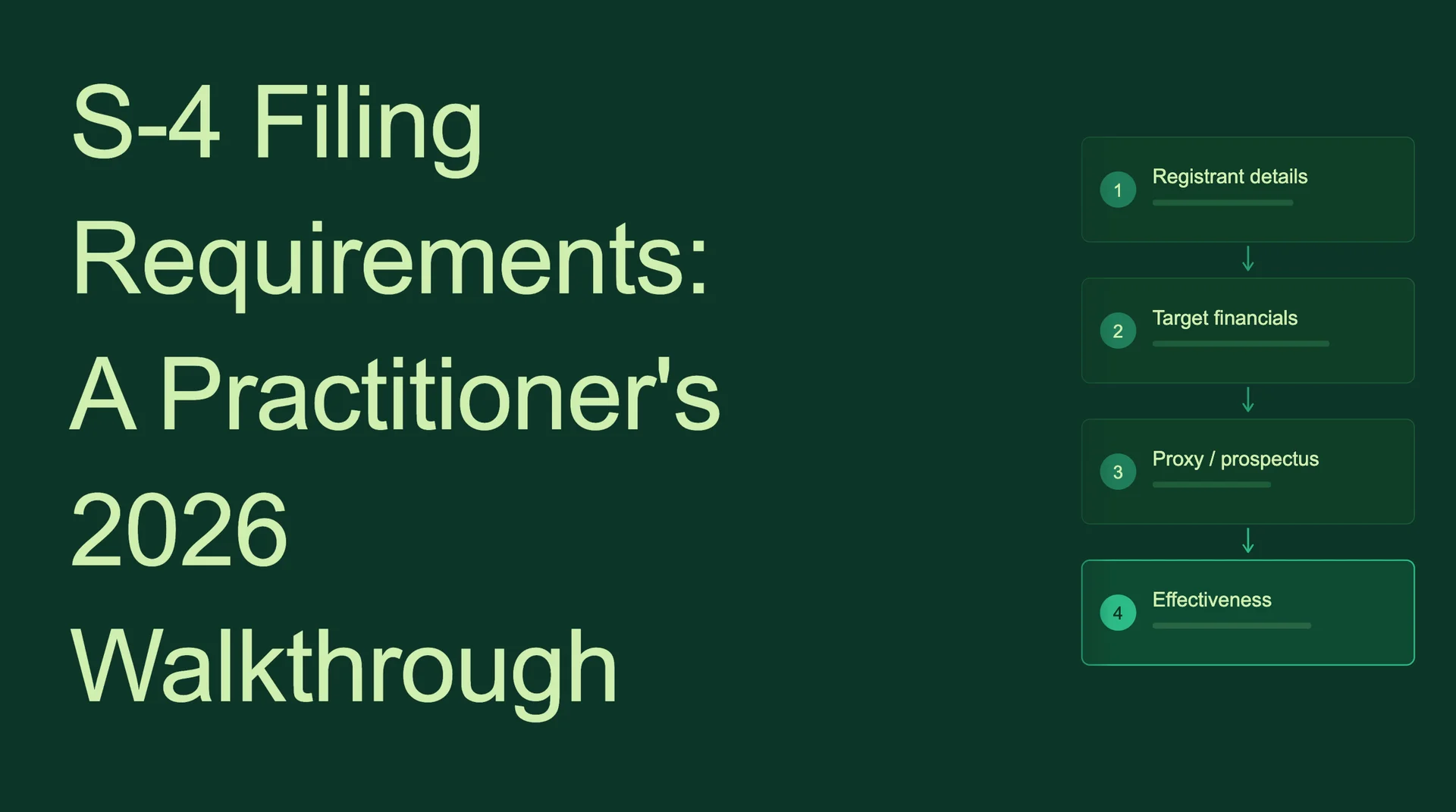
S-4 Filing Requirements: A Practitioner's 2026 Walkthrough
If you're about to run your first Form S-4, this is the guide the top-ranking pages don't write. It walks through the sequencing, the cross-references, the significance math, and the staff comment traps, in the order you'll actually hit them.
Who this is for: CFOs, controllers, general counsel, and SEC reporting managers scoping an S-4 process for a stock-for-stock merger, an exchange offer, or a de-SPAC. Assumes you already know which registration form applies to your transaction.
What Form S-4 actually is (and what the marketing pages miss)
Form S-4 is the SEC registration statement, filed under the Securities Act of 1933, used to register securities issued in business combinations, mergers, consolidations, acquisitions where the consideration is the acquirer's stock, exchange offers, reclassifications, transfers of assets, and Chapter 11 reorganizations that involve equity exchanges. When any party's shareholders vote on the deal, the S-4 doubles as a joint proxy statement/prospectus and must also satisfy the proxy rules under Section 14(a) and Regulation 14A.
Here's the part the surface-level explainers skip: S-4 is a form of cross-references, not a self-contained rulebook. Its item structure points you to Regulation S-K (narrative disclosure), Regulation S-X (financial statements and pro formas), Schedule 14A (proxy content), and Regulation M-A Items 1000 to 1016 (M&A-specific items like fairness opinions), per the SEC's promulgated form. Building an S-4 means working across four rulebooks in parallel, not filling in a template.
S-4 filing requirements: the 12 things you must scope on day one
Before anyone opens a Word doc, work through this list. Each item drives the drafting workload, the auditor's schedule, and the SEC review timeline.
- Confirm S-4 is the right form. Not S-1, not a stand-alone Schedule 14A, not Schedule TO. If you're issuing your own registered stock as consideration in a business combination, S-4 is almost always the answer.
- Determine S-3 eligibility for both the registrant and (if relevant) the target. This is the gate between long-form and short-form S-4.
- Run the Rule 3-05 significance tests on the target. Investment, asset, and income (with revenue component). This tells you what target financials must go into the S-4 and for what periods.
- Decide whether a shareholder vote is required. If yes, Regulation 14A applies and the S-4 becomes a joint proxy/prospectus.
- Identify fairness opinions and financial advisor reports. Item 18 of S-4 pulls in Item 1015 of Reg M-A, one of the most comment-heavy sections.
- Model projections and synergy claims. Non-GAAP measures inside projections trigger Reg G and Item 10(e) considerations.
- Assess whether this is a de-SPAC. The SEC's January 24, 2024 SPAC final rules, effective July 1, 2024, layer on additional disclosures and target co-registrant status.
- Calculate the Rule 457 filing fee using the FY2026 rate of $153.10 per $1,000,000 of aggregate offering amount, effective October 1, 2025 per the SEC's fee rate advisory.
- Line up the auditor comfort letter and tax opinion.
- Map board approval sequence for both companies, including record date logistics.
- Book the financial printer and iXBRL tagger.
- Plan for a 3 to 6 month SEC review with multiple comment rounds. Do not commit to a closing date until after the first comment letter.
The S-4 disclosure architecture: what each part contains
The form has two parts, and understanding the split saves weeks of drafting confusion.
Part I: the prospectus/proxy statement
This is the document that goes to shareholders. It contains everything material to the vote and the investment decision, and it's what the SEC reviews most heavily.
| Item block | What it covers | Primary cross-reference |
|---|---|---|
| Items 1 to 3 | Front cover, forepart of prospectus, risk factors | Reg S-K Items 501 to 503 |
| Items 4 to 8 | The transaction: terms, background, fairness, tax and accounting treatment | Reg M-A Items 1004, 1015; Schedule 14A |
| Items 9 to 13 | Voting and management information for both companies | Schedule 14A Items 4 to 7 |
| Items 14 to 17 | Business, financial, and pro forma information for the acquirer and the target | Reg S-K, Reg S-X Rule 3-05, Article 11 |
| Item 18 | Reports, opinions, appraisals (fairness opinions) | Reg M-A Item 1015 |
| Items 19 to 22 | Interests of experts, indemnification, undertakings | Reg S-K Items 509, 510, 512 |
Part II: information not required in the prospectus
This is the back matter the SEC sees but shareholders don't get in the mailed document: expenses of issuance, recent sales of unregistered securities, exhibits (merger agreement, opinions of counsel, comfort letters, consents), and undertakings.
Long-form vs. short-form S-4: the S-3 eligibility question
If the registrant is S-3 eligible, you can file a short-form S-4 that incorporates Exchange Act reports by reference instead of restating them. For a large accelerated filer, that difference is the difference between a 300-page document and a 700-page document.
S-3 eligibility generally requires 12 months of Exchange Act reporting, timely filing of all required reports, and a public float threshold. If the target is also S-3 eligible, target financials and MD&A can likewise be incorporated by reference. If either party is not S-3 eligible, you're drafting the full narrative in the S-4 itself.
Key takeaway: Confirm S-3 eligibility for both companies in the first week. It's the single biggest driver of drafting scope.
Rule 3-05 significance tests: what target financials go in the S-4
This is where finance teams underestimate the workload. Rule 3-05 of Regulation S-X, as amended by the SEC's 2020 final rule (effective January 1, 2021), sets three tests to measure the target's significance to the registrant: investment, asset, and income (which now includes a revenue component). You run all three and use the highest result.
The required target financial statements scale with that result:
| Highest significance | Target financials required |
|---|---|
| ≤ 20% | Generally not required in the S-4 |
| > 20% and ≤ 40% | Nine months of interim data plus most recent audited fiscal year |
| > 40% and ≤ 50% | Complete audited fiscal year, plus required interim |
| > 50% | Balance sheets for the two most recent fiscal years (audited); statements of operations, comprehensive income, cash flows, and equity for the three most recent fiscal years (audited); required interim, per Deloitte's SEC Reporting Roadmap §2.4 |
As Deloitte's roadmap puts it, "If a significant acquired business exceeds the 50 percent significance level (on the basis of any of the three tests), a registrant must include the financial statements of the business in the registration statement before they would otherwise be due on Form 8-K/A." The S-4 accelerates a filing obligation you might have thought you had 71 days post-close to satisfy.
On top of the target's own financials, Article 11 pro forma financial information is required to reflect the aggregate effects of all acquisitions being registered. For a serial acquirer, that pro forma exercise can pull in multiple prior deals.
The de-SPAC double layer
In a de-SPAC transaction, the S-4 must include the target company's financial statements and, if applicable, financial statements of the target's own significant Rule 3-05 acquirees. Two layers of Rule 3-05 analysis, one on top of the other. Catch this early or the audit timeline collapses.
The drafting sequence: a 6-month practitioner timeline
This is the sequence that actually works. Compress it at your peril.
- Weeks 1 to 2: scoping and gating decisions. Confirm form, run Rule 3-05, check S-3 eligibility, book the printer, engage outside counsel, brief the auditor on comfort letter scope.
- Weeks 3 to 6: drafting Part I core sections. Background of the merger, reasons for the merger, terms of the transaction, risk factors. This is where the deal team's memory is freshest, get it on paper before it fades.
- Weeks 5 to 8: financial statements and MD&A. Target auditor consents, comfort letter drafting, pro formas under Article 11. Parallel-track this with the narrative work.
- Weeks 7 to 9: fairness opinion disclosure. Item 18/Item 1015 requires detailed summary of the financial advisor's analyses: comparable companies, precedent transactions, DCF, and any other methodology relied on. Expect the SEC to comment on any analysis that's summarised too thinly.
- Weeks 9 to 10: internal review, board approval, file initial S-4. File with the appropriate Rule 457 fee.
- Weeks 11 to 20: SEC comment rounds. Expect the first comment letter roughly 30 days after filing. Two to four rounds is normal for a first-time S-4.
- After clearance: request effectiveness, print and mail definitive proxy/prospectus, hold the shareholder meeting, close.
Can you file an S-4 confidentially?
Confidential submission is available in limited circumstances. The SEC's non-public review process, established under the JOBS Act and expanded in 2017, applies primarily to initial Securities Act registrations by first-time filers and to certain follow-on offerings within a year of an IPO. A conventional S-4 by a seasoned public company is filed publicly. In cross-border deals or for certain foreign private issuer scenarios, confidential submission may be available, so ask outside counsel before assuming it isn't.
Filing fee calculation under Rule 457
The fee is calculated on the maximum aggregate offering price of the securities being registered, using the fee rate in effect at the time of filing. For fiscal year 2026, that rate is $153.10 per $1,000,000 of the aggregate offering amount, effective October 1, 2025.
Worked example. You're registering 10 million shares of your stock as consideration, and the market value on the measurement date is $45.00 per share. Aggregate offering amount is $450,000,000. Fee is $450 × $153.10 = $68,895. Rule 457(f) provides specific measurement rules when the securities are exchanged for target securities that are already outstanding, use the target's book value or market value depending on whether the target is public.
Regulation 14A overlay: when the S-4 is also a proxy statement
If either the registrant's or the target's shareholders vote on the deal, Rule 14a-3 requires that they receive an information statement or proxy statement containing the Schedule 14A disclosures. Rather than mail two documents, you fold Schedule 14A content into the S-4 and mail one joint proxy statement/prospectus after the SEC declares effectiveness. Practical consequences:
- The document must satisfy both the Securities Act registration rules and the Exchange Act proxy rules simultaneously. Anti-fraud provisions of Rule 14a-9 apply.
- Record date, meeting date, and mailing date must be plotted against the SEC review calendar. Set them too early and you'll blow the meeting date; set them too late and the deal drifts.
- Proxy solicitation materials filed before effectiveness go on Form 425 and must be filed the same day they're first used.
Fairness opinions and Item 1015: the biggest comment magnet
Item 18 of Form S-4 incorporates Item 1015 of Regulation M-A, which requires detailed disclosure of any report, opinion, or appraisal materially related to the transaction. The staff comments here relentlessly. Expect requests to:
- Summarise each valuation methodology (comparable companies, precedent transactions, DCF, LBO analysis) with the specific inputs, ranges, and multiples the banker used.
- Disclose the banker's compensation, contingent portions, and any prior work for either party in the last two years.
- Explain how the board considered the opinion and any conflicts.
- File the full written fairness opinion as an annex to the proxy/prospectus.
Anything summarised at a high level in the first draft will come back as a comment. Draft to the standard the staff will demand, not the standard the banker prefers.
De-SPAC disclosures after the January 2024 SPAC rules
The SEC's SPAC final rules, adopted January 24, 2024 and effective July 1, 2024, layered material new disclosure requirements on de-SPAC S-4s and proxy statements. Key changes:
- Target co-registrant status. In many de-SPAC S-4s, the target signs as a co-registrant, exposing it to Section 11 liability.
- Enhanced projections disclosure. Purpose, preparer, assumptions, and cautionary language about projections must be more explicit. The PSLRA safe harbor no longer applies to de-SPAC projections.
- Dilution disclosure. Prescribed dilution tables and scenarios.
- Sponsor compensation and conflicts. Detailed sponsor economics, promote structure, and conflicts of interest.
- Board determinations. The SPAC board must state whether it reasonably believes the de-SPAC transaction and any related financing are fair to unaffiliated security holders, and disclose the bases for that belief.
If you're running a de-SPAC S-4, budget significantly more time for these sections than a conventional merger S-4.
Common SEC staff comment areas on S-4
Based on comment-letter patterns, expect scrutiny in these seven areas. If you want to sanity-check against recent letters, our guide on searching EDGAR comment letters by form type walks through the search mechanics.
- Background of the merger. The chronology must be granular: dates of meetings, who was present, what was discussed, when advisors were engaged, when prices were exchanged.
- Reasons for the merger. Each board's reasons must be specific and tied to the fairness determination.
- Fairness opinion disclosure. As above, expect the staff to push for more detail on every methodology.
- Projections and synergies. Any non-GAAP measure in projections triggers Reg G reconciliation. Synergy claims must be supported.
- Conflicts of interest. Financial advisor conflicts, director and officer interests in the transaction, indemnification.
- Risk factors. Generic risk factors get comments. Deal-specific and integration-specific risks are what the staff wants.
- Pro forma financials. Article 11 adjustments must be factually supportable, directly attributable, and, where applicable, expected to have a continuing impact. See also our ASC 805 business combination disclosure checklist for post-close accounting.
S-4 vs. related forms: when to use what
| Form | Use when | Key trigger |
|---|---|---|
| Form S-4 | Registering securities issued as consideration in a business combination | Stock-for-stock deal, exchange offer, de-SPAC |
| Form S-1 | IPO or registration where no other form applies | First-time issuer, or seasoned issuer without S-3 eligibility |
| Schedule 14A (standalone) | Shareholder vote where no new securities are registered | All-cash merger requiring target shareholder vote |
| Schedule TO | Tender offer for cash | Cash tender offer for equity |
| Form F-4 | Business combination where the registrant is a foreign private issuer | See Form 20-F filing requirements for FPI status |
FAQ
Can an S-4 be filed confidentially?
Generally no for a seasoned public company. Confidential submission is primarily available for initial Securities Act registrations by first-time filers and for certain follow-on offerings within a year of an IPO. Cross-border deals and FPI transactions can present narrow exceptions, confirm with outside counsel.
What financial statements are required in an S-4?
The registrant's own audited financial statements per Regulation S-X, plus target financial statements scaled to Rule 3-05 significance (nine months of interim above 20%, a full audited fiscal year above 40%, and two audited balance sheets plus three audited income statement years above 50%), plus Article 11 pro forma financial information reflecting the transaction.
How long does SEC review of a Form S-4 take?
Typically 3 to 6 months from initial filing to effectiveness. The first comment letter usually arrives within 30 days, followed by two to four rounds of comments. First-time S-4 filers should not commit to a closing date until after the first comment letter has been reviewed.
What is the filing fee for a Form S-4 in 2026?
$153.10 per $1,000,000 of the aggregate offering amount, effective October 1, 2025 under the SEC's FY2026 fee rate advisory. On a $450 million offering, the fee is $68,895.
When does a Form S-4 also serve as a proxy statement?
Whenever a shareholder vote of the registrant or the target is required to approve the transaction. The S-4 then satisfies both Securities Act registration and Exchange Act Regulation 14A proxy requirements as a joint proxy statement/prospectus.
What is the difference between S-4 long-form and short-form?
A short-form S-4 is available when the registrant is S-3 eligible, and it permits substantial incorporation by reference of Exchange Act reports (10-K, 10-Q, 8-K, proxy statements) rather than restating that content in the prospectus. Long-form S-4 requires the full narrative in the document itself.
Get the sequencing right, staff the Rule 3-05 work early, and draft the fairness opinion disclosure to the standard the SEC will demand, not the standard the bankers prefer. The rest is process discipline.