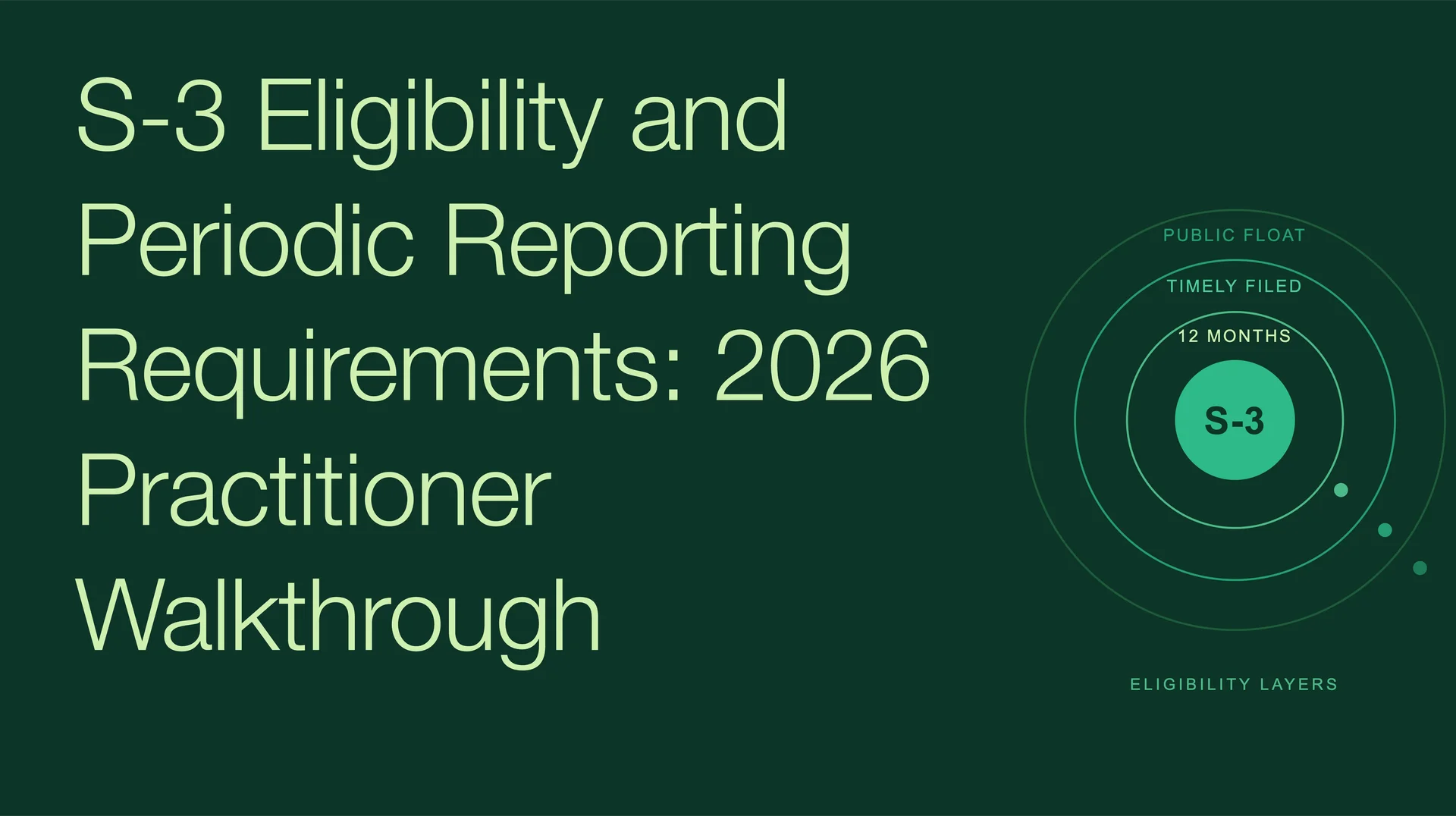
S-3 Eligibility and Periodic Reporting Requirements: 2026 Practitioner Walkthrough
Form S-3 is the fastest route to the public capital markets for a seasoned issuer. Lose eligibility on the eve of an offering and you are back to Form S-1, with weeks of additional work and a market window that may have closed. This guide walks through every gate in the current four-part registrant test, the specific periodic reporting traps that disqualify companies, and what the SEC's May 2026 Registered Offering Reform proposal changes, including a current-vs-proposed comparison table and a pre-filing checklist you can use today.
Key takeaway: Under current rules, a single late 10-K, 10-Q, or non-carved-out 8-K in the preceding 12 months disqualifies a company from Form S-3. The SEC's May 2026 proposal would introduce a seven-day grace period for one untimely filing, but those rules are not yet final.
What Are the Form S-3 Eligibility Requirements?
Form S-3 eligibility turns on four registrant requirements set out in General Instruction I.A of the form. All four must be satisfied before you file. There are also transaction-level requirements that layer on top, but the registrant test is the first gate, and the periodic reporting requirement is the one most likely to trip a company up.
The four conditions are:
- U.S. organization and principal operations. The registrant must be organized under the laws of the United States, a state, territory, or the District of Columbia, and have its principal business operations in the United States or its territories.
- Exchange Act registration or reporting obligation. The registrant must have a class of securities registered under Exchange Act Section 12(b) or 12(g), or be required to file reports under Section 15(d).
- 12-month reporting history with all material filings made. The registrant must have been subject to Section 12 or 15(d) requirements and have filed all material required under Sections 13, 14, or 15(d) for at least 12 calendar months immediately preceding the S-3 filing. This is the seasoning clock.
- Timely filing of all required reports in the preceding 12 months. All reports required during the 12 calendar months (and any portion of a month) immediately before the filing must have been filed on time, subject to specific 8-K carve-outs.
A fifth condition, often overlooked, bars eligibility if the registrant or any of its consolidated or unconsolidated subsidiaries has, since the end of the last fiscal year covered by certified financial statements in the registration statement, failed to pay dividends or sinking fund installments on preferred stock, or defaulted on installments on indebtedness for borrowed money or material leases. That is General Instruction I.A.4, and it catches companies that are technically current on filings but in financial distress.
How Long Does a Company Need to Be a Reporting Company?
The 12-month seasoning clock runs from the date the company became subject to Exchange Act reporting requirements, not from its IPO date. This distinction matters more than most practitioners realize.
A company that registered a class of securities under Section 12(b) in connection with an exchange listing starts the clock on the effective date of that registration, which may be days before the IPO closes. A company that went public through a SPAC merger and inherited the SPAC's Exchange Act registration history may already have 12 months of reporting history on day one as a combined company, depending on how the transaction was structured.
The 12-month lookback for timely filings is a separate, backward-looking window. It runs from the S-3 filing date back 12 calendar months. A company that became a reporting company 14 months ago satisfies the seasoning requirement, but if it filed a 10-Q late 8 months ago, that late filing still sits inside the timely-filing lookback window and disqualifies the form.
These two clocks are often conflated in practice. Keep them separate.
Which Reports Must Be Filed on Time for S-3 Eligibility?
Every required report in the 12-month lookback window must be timely, with one narrow set of exceptions: certain Form 8-K items are carved out of the timeliness test entirely.
The carved-out 8-K items, per General Instruction I.A.3(b), are reports required solely under:
- Item 1.01 (Entry into a material definitive agreement)
- Item 1.02 (Termination of a material definitive agreement)
- Item 1.04 (Mine safety reporting)
- Item 1.05 (Material cybersecurity incidents)
- Item 2.03 (Creation of a direct financial obligation)
- Item 2.04 (Triggering events that accelerate or increase a direct financial obligation)
- Item 2.05 (Costs associated with exit or disposal activities)
- Item 2.06 (Material impairments)
- Item 4.02(a) (Non-reliance on previously issued financial statements, auditor-initiated)
- Item 5.02(e) (Compensatory arrangements of certain officers)
These items are carved out because they are event-driven disclosures where the timing of the triggering event is outside the company's control, or where a late filing is unlikely to signal a systemic reporting failure. Note that the SEC's older small business compliance guide lists a slightly different set, omitting Items 1.04 and 1.05. The current form instructions (OMB expiry February 2029) include both. Use the current form, not the older guide.
All other required reports, including every Form 10-K, every Form 10-Q, and any 8-K required under items not on the carve-out list, must be filed on time. A late 8-K disclosing a change in auditor (Item 4.01) or a late 8-K reporting a completed acquisition (Item 2.01) will disqualify the company.
How Does Rule 12b-25 Interact with S-3 Timeliness?
Using Rule 12b-25 to extend a filing deadline does not automatically make a late report "timely" for S-3 purposes. This is one of the most consequential misunderstandings in practice.
Rule 12b-25 allows a company to file a Form NT (notification of late filing) and receive an automatic extension: 15 calendar days for a 10-K, 5 calendar days for a 10-Q. The extension is real, and the SEC will not declare the company delinquent if the report is filed within the extended period.
But General Instruction I.A.3(b) is explicit: if the company used Rule 12b-25(b) with respect to a report, that report must actually have been filed within the time period prescribed by that rule, meaning within the extension period, for the filing to count as timely under the S-3 test.
The practical consequence: if a company files a Form NT for its 10-Q and then files the actual 10-Q one day after the Rule 12b-25 extended deadline, the 10-Q is late for S-3 purposes even though the company filed a Form NT. The extension buys time, but the company must actually use that time and file within it.
For a guide on filing Form NT correctly, see How to File Form 12b-25 for Extensions.
What Is the Baby Shelf Rule and Does It Apply?
Companies with less than $75 million in public float can still use Form S-3, but face a hard cap: primary offerings on Form S-3 or F-3 are limited to one-third of public float in any rolling 12-month period. This is the baby shelf rule, introduced by SEC Release No. 33-8878.
To qualify for baby shelf access, a company must also:
- Have a class of common equity listed and registered on a national securities exchange
- Not be a shell company, and not have been one in the past 12 months
- Meet all four general S-3 registrant requirements
The one-third calculation uses this formula, per the SEC's small entity compliance guide:
Amount That Can Be Raised = (1/3 x Public Float) minus Prior Amounts Sold
Public float is calculated as: price of common equity (from within 60 days before the date of sale) multiplied by the number of shares held by non-affiliates.
For convertible securities, the calculation uses the number of underlying equity shares into which the securities are convertible, multiplied by the float price, not the market value of the convertible instrument itself. This is the piece that trips up most calculations involving convertible notes or warrants.
Worked example: A company has 10 million shares held by non-affiliates and a stock price of $6.00, giving a public float of $60 million. One-third of float is $20 million. If the company raised $8 million in a prior S-3 offering 9 months ago, it can raise up to $12 million in a new offering today. If it also has outstanding warrants convertible into 2 million shares, those are counted at $6.00 per underlying share ($12 million) against the prior amounts sold calculation if they were issued in a prior S-3 primary offering.
What Is WKSI Status and How Does It Compare?
Well-known seasoned issuer (WKSI) status is the tier above standard S-3 eligibility. WKSIs can file automatically effective shelf registration statements under Rule 462(e), meaning the registration statement is effective on filing without waiting for SEC review. They also benefit from broader offering communication flexibilities.
Under current rules, WKSI status requires either:
- $700 million or more in public float, or
- $1 billion or more in non-convertible securities issued in registered offerings in the prior three years
A company that qualifies as a WKSI uses General Instruction I.D rather than I.A. The periodic reporting requirements still apply, but the automatic effectiveness of the shelf is the key operational advantage: a WKSI can file a shelf and begin selling the same day.
For a detailed comparison of S-1 vs. S-3 and WKSI mechanics, see S-1 vs S-3 Shelf Registration: The CFO's 2026 Decision Guide.
What Happens If You Lose S-3 Eligibility Mid-Shelf?
A company that loses S-3 eligibility after filing a shelf registration statement cannot continue to take down securities under that shelf. The form instructions require that the registrant meet the eligibility conditions at the time of filing. If eligibility is lost after filing, the company must stop using the shelf.
The practical sequence:
- The company identifies the disqualifying event (typically a late filing discovered during a pre-takedown eligibility review).
- Counsel advises that the shelf is no longer available for new takedowns.
- The company must either wait for the disqualifying filing to roll out of the 12-month lookback window, or file a new Form S-1 for the intended offering.
- Any securities already sold under the shelf before the disqualifying event are generally not affected, but new sales cannot proceed.
Switching to Form S-1 mid-offering is a material capital markets disruption. An S-1 requires full disclosure, SEC review (typically 30 days for the initial review, with comments), and the offering cannot close until the S-1 is declared effective. Market windows close. Underwriters reprice.
Regaining eligibility: Once the late filing is more than 12 calendar months in the past, it falls outside the lookback window and the company can file a new S-3, assuming all other conditions are met. There is no cure mechanism other than waiting. The company cannot refile the late report to reset the clock.
The Form 10-K Part III Trap
One specific trap deserves its own section because it is widely misunderstood and the May 2026 proposal explicitly calls it out.
Many companies omit Part III information (directors, executive compensation, certain governance items) from their Form 10-K and incorporate it by reference from their definitive proxy statement, which is filed later. General Instruction G(3) to Form 10-K allows this, provided the proxy statement is filed within 120 calendar days after fiscal year end.
If the proxy statement is not filed within 120 days, the Form 10-K is considered incomplete and, for S-3 purposes, untimely. The 10-K itself becomes the disqualifying filing, even if it was filed on time as an initial submission.
Under the proposed rules (discussed below), the seven-day grace period would not apply to this situation. The 120-day proxy incorporation deadline is a hard stop.
What the SEC's May 2026 Proposal Changes
On May 19, 2026, the SEC proposed the most significant overhaul of the registered offering framework in more than 20 years. The comment period for the Registered Offering Reform proposal closed July 27, 2026. Final rules could take effect as early as 2027.
SEC Chairman Paul S. Atkins framed the intent directly: "The proposals are intended to incentivize more companies, particularly smaller and mid-sized companies, to go and stay public."
The SEC estimates that eliminating the 12-month seasoning requirement and the public float transaction requirements could increase the number of issuers eligible to offer an unlimited amount of securities on Form S-3 by more than 60%.
Current Rules vs. Proposed Rules: Key Changes
| Requirement | Current Rule | Proposed Rule |
|---|---|---|
| 12-month reporting history (seasoning) | Required (General Instruction I.A.3(a)) | Eliminated |
| $75 million public float for unlimited primary offerings | Required | Eliminated |
| Baby shelf one-third cap (sub-$75M float) | Applies | Eliminated |
| Timely filing of all required reports | Required, no grace period | Required, with one seven-day grace period per 12 months |
| WKSI automatic shelf (Rule 462(e)) | $700M float or $1B registered debt | Retained for foreign private issuers; replaced by SELI tier for domestic issuers |
| Ineligible issuers (shell companies, blank check, penny stock) | Excluded | Remain excluded |
| Part III 10-K 120-day proxy deadline | Hard stop | Hard stop (grace period does not apply) |
The Seven-Day Grace Period
The proposed rules would permit one untimely filing per 12-month period without loss of S-3 eligibility, provided the filing was made within seven calendar days of the original due date. Two important mechanics:
- The seven days run from the original due date, not from any Rule 12b-25 extended due date.
- The grace period applies to one filing only in any 12-month window. A second untimely filing, even by one day, disqualifies the company.
The SEC acknowledged that the current bright-line rule creates "a disproportionately harsh consequence for a single untimely filing during a 12-month period." The grace period is a direct response.
The New Issuer Tier Structure
The proposal replaces the WKSI framework for domestic issuers with three tiers, per Alston's analysis of the proposal:
- Form S-3-Eligible Issuers: Any reporting issuer current and timely in Exchange Act filings. Access to shelf registration regardless of float.
- Eligible Listed Issuers (ELIs): S-3-eligible issuers with at least one class of common equity listed on a national exchange. Gain WKSI-like communication benefits (Rule 163, expanded free writing prospectuses, pay-as-you-go fees).
- Seasoned Eligible Listed Issuers (SELIs): ELIs with at least 12 months of Exchange Act reporting history. Eligible for automatic shelf registration. The SEC estimates approximately 74% of Exchange Act reporting issuers would qualify as SELIs, compared with roughly 36% that currently qualify as WKSIs.
Should You File Now or Wait for the New Rules?
This is the live strategic question for capital markets teams in the second half of 2026. The answer depends on your situation.
- If you currently qualify for S-3 under existing rules and have a near-term capital need, file now. The proposed rules are not final, comment periods have closed, and there is no guarantee of the timeline to adoption. A shelf filed today under current rules is valid and usable.
- If you do not currently qualify because of the 12-month seasoning requirement and your offering is not urgent, monitoring for final rules makes sense. If adopted, the proposal would eliminate the seasoning gate entirely and you could file a shelf immediately upon rule effectiveness.
- If you have a sub-$75M float and are constrained by the baby shelf cap, the proposed elimination of that cap is significant. But again, the rules are proposed, not final.
- If you have had a recent late filing, the proposed seven-day grace period would not retroactively cure a filing that was already late under current rules. You are waiting for the 12-month lookback window to roll past the late filing regardless of which rule set applies.
The companion Filer Status Simplification proposal would also raise the large accelerated filer public float threshold from $700 million to $2 billion and introduce a 60-month IPO on-ramp before a company can become a large accelerated filer. Non-accelerated filers under the proposed framework would not be required to obtain an auditor attestation under SOX Section 404(b). These changes interact with S-3 planning because filer status affects filing deadlines, which in turn affect the timely-filing gate.
S-3 Eligibility Pre-Filing Checklist
Run through this before authorizing a shelf registration filing. Each item maps to a specific eligibility gate.
Registrant requirements (General Instruction I.A):
- Company is organized under U.S. law with principal operations in the U.S. or its territories
- Company has a class of securities registered under Exchange Act Section 12(b) or 12(g), or has a Section 15(d) reporting obligation
- Company has been subject to Exchange Act reporting for at least 12 calendar months immediately preceding the filing date, and has filed all material required under Sections 13, 14, or 15(d) during that period
- All required reports in the 12 calendar months (and any portion of a month) immediately preceding the filing date have been filed on time, excluding only the carved-out 8-K items (Items 1.01, 1.02, 1.04, 1.05, 2.03, 2.04, 2.05, 2.06, 4.02(a), 5.02(e))
- Any reports filed using Rule 12b-25 extensions were actually filed within the extension period
- No dividends or sinking fund installments on preferred stock have been missed since the end of the last fiscal year covered by certified financial statements
- No defaults on installments on indebtedness for borrowed money or material leases since the same date
- If Part III was omitted from the most recent 10-K, the definitive proxy statement or 10-K/A was filed within 120 calendar days of fiscal year end
Baby shelf check (if public float is below $75 million):
- Company has a class of common equity listed on a national securities exchange
- Company is not a shell company and has not been one in the past 12 months
- Calculate: (1/3 x current public float, using a price from within 60 days of the intended sale date) minus prior S-3/F-3 primary offering proceeds in the past 12 months. Confirm the intended offering does not exceed this amount
- For convertible securities, use underlying equity shares times float price, not the market value of the convertible instrument
WKSI check (if applicable):
- Public float equals or exceeds $700 million, OR the company has issued $1 billion or more in non-convertible securities in registered offerings in the prior three years
- No disqualifying "ineligible issuer" status (shell company, blank check company, penny stock issuer, bad actor)
FAQ
Can a company regain S-3 eligibility after a late filing? Yes, but only by waiting. Once the late filing is more than 12 calendar months before the intended S-3 filing date, it falls outside the lookback window. There is no mechanism to cure or refile a late report to accelerate this. The clock runs from the original due date of the late report.
Does every 8-K have to be filed on time for S-3 eligibility? No. Eight specific 8-K items are carved out of the timeliness test: Items 1.01, 1.02, 1.04, 1.05, 2.03, 2.04, 2.05, 2.06, 4.02(a), and 5.02(e). A late 8-K required solely under one of those items does not disqualify the company. All other 8-K items, and all 10-Ks and 10-Qs, must be timely.
What is the difference between the 12-month seasoning requirement and the 12-month timely-filing lookback? The seasoning requirement (General Instruction I.A.3(a)) looks forward from when the company became a reporting company: it must have been a reporting company for at least 12 months before filing the S-3. The timely-filing lookback (I.A.3(b)) looks backward from the S-3 filing date: all required reports in the preceding 12 months must have been filed on time. These are two separate tests with two separate 12-month windows.
If we file a Form NT under Rule 12b-25, are we safe for S-3 purposes? Only if the actual report is filed within the Rule 12b-25 extension period. Filing the NT does not by itself preserve S-3 eligibility. The report must actually be filed within the extended deadline.
What happens to our existing shelf if we lose S-3 eligibility? New takedowns under the shelf are not available. Securities already sold before the disqualifying event are generally not affected. The company must either wait for the late filing to roll out of the 12-month window and file a new S-3, or proceed with a Form S-1 for the intended offering.
Does the May 2026 proposal affect foreign private issuers? The WKSI framework would be retained for foreign private issuers, who use Form F-3 rather than S-3. The new ELI/SELI tier structure is designed for domestic issuers. FPIs should monitor the final rules for any changes to F-3 eligibility, but the core proposal is domestic-issuer focused. For F-3 and 20-F requirements, see Form 20-F Filing Requirements for Foreign Private Issuers.
When will the proposed rules take effect? The comment period for the Registered Offering Reform proposal closed July 27, 2026. If adopted in final form before year-end 2026, the rules could affect registered offerings as early as 2027, per Maynard Nexsen's analysis. No final adoption date has been announced. Plan capital markets activity under current rules until final rules are published.