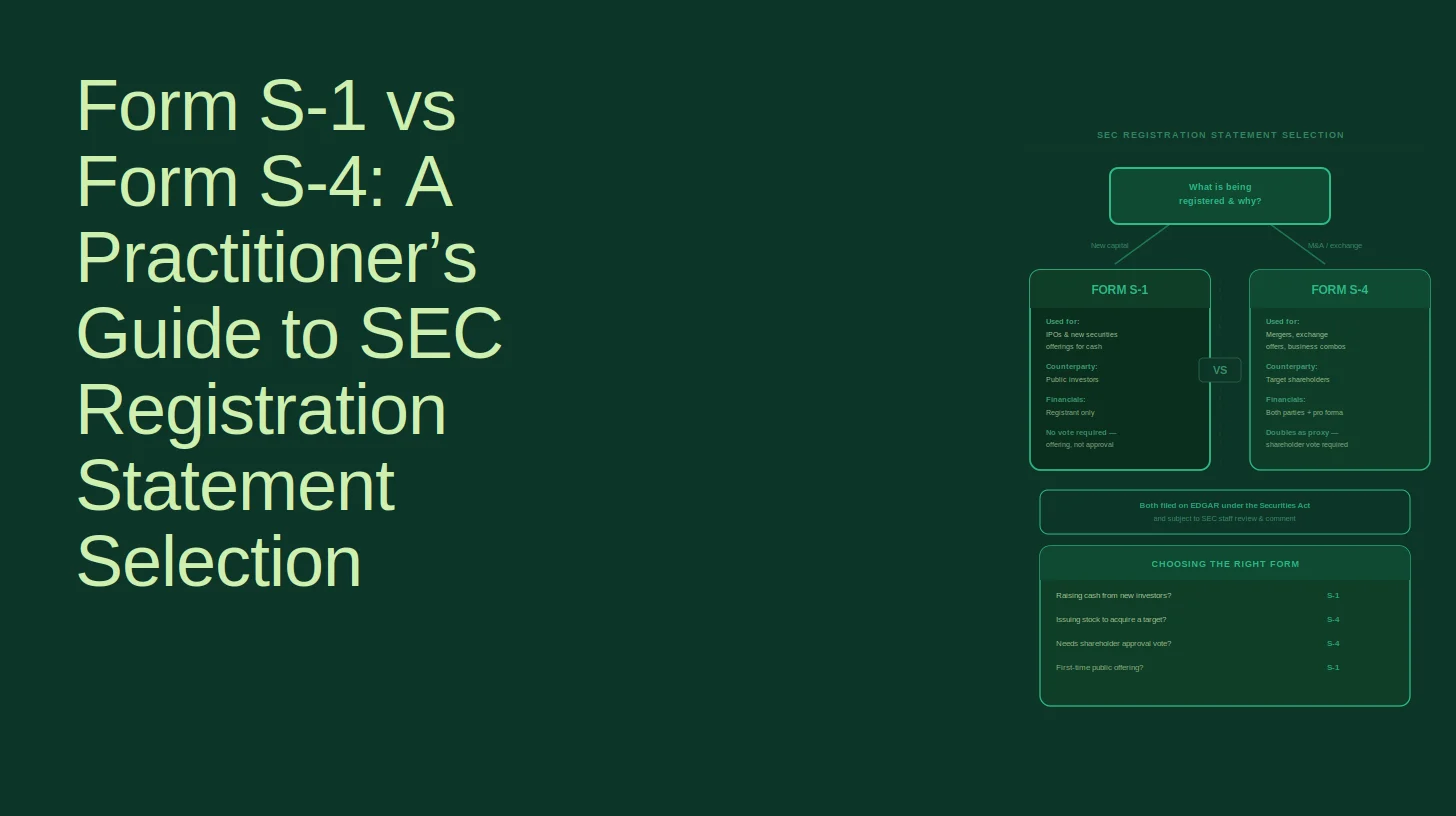
Form S-1 vs Form S-4: A Practitioner's Guide to SEC Registration Statement Selection
If your company is preparing for an IPO, you file on Form S-1. If it is issuing shares to acquire another company, you file on Form S-4. That sentence is true but dangerously incomplete. The real traps are in the edges: exchange offers, roll-up transactions, SPAC de-SPAC deals, and the financial statement cascade that catches S-4 first-timers off guard. This guide gives CFOs, M&A counsel, and SEC reporting teams the decision framework and technical detail to choose the right form, scope the financial statement work correctly, and avoid the comment letter patterns the SEC flags most often.
Key takeaway: Form eligibility is mandatory, not discretionary. The SEC's Division of Corporation Finance grants waivers from form eligibility requirements only under very limited circumstances, handled solely by the Office of Chief Counsel. You cannot choose S-1 because it is more familiar.
What Is the Fundamental Difference Between Form S-1 and Form S-4?
Form S-1 is the default registration statement for any domestic issuer when no other Securities Act form is prescribed. General Instruction I of Form S-1 states it plainly: the form "shall be used for the registration under the Securities Act of 1933 of securities of all registrants for which no other form is authorized or prescribed." That makes S-1 the form of last resort, not a form of choice. It cannot be used for foreign government securities or asset-backed securities, but it is available to all other domestic issuers regardless of their Exchange Act reporting history.
Form S-4 is a closed, enumerated form. Per PwC's SEC Reporting volume, it "is a Securities Act registration form used to register securities in connection with business combination transactions and exchange offers." The eligible transaction types are fixed:
- Mergers, consolidations, reclassifications, and transfers of assets under Rule 145(a)
- Exchange offers for securities of the issuer or another issuer
- Capital reorganizations
- Mergers where the registrant is the surviving entity and no shareholder vote is required
- Non-convertible debt or preferred securities in certain exchange offers
If your transaction is not on that list, S-4 is not available. If it is on that list, S-4 is almost certainly required.
The practical difference goes well beyond form selection. S-1 is a single-issuer document. S-4 is a dual-issuer document with a proxy overlay, significance-tested financial statement requirements for the target, and Article 11 pro forma obligations. Treating S-4 as "S-1 with merger disclosure added" is the most expensive misconception in SEC practice.
Which Form Applies to Your Transaction?
Use this decision framework before engaging outside counsel on form selection.
Transaction TypeCorrect FormNotesDomestic company IPOS-1Default form; no Exchange Act history requiredSPAC IPOS-1SPAC-specific disclosure under Items 1602-1603 of Reg S-KDirect listingS-1No underwritten offering; same formFollow-on offering (pre-S-3 eligibility)S-1S-3 requires 12+ months of Exchange Act reportingStock-for-stock merger (shareholder vote required)S-4Combined proxy/prospectus requiredStock-for-stock merger (no shareholder vote)S-4Surviving entity merger; still S-4Exchange offer (issuer's own securities)S-4Rule 145(a) transactionExchange offer (another issuer's securities)S-4 or S-1*See General Instruction III belowCapital reorganizationS-4Enumerated S-4 transaction typeRoll-up transactionS-4S-1 General Instruction IV directs to S-4SPAC de-SPAC transactionS-4Target financials required; 2024 SPAC rules applyDebt-for-equity exchangeS-4Non-convertible debt/preferred in exchange offers
*The S-1 exchange offer carve-out is narrow. See the next section.
The S-1 Exchange Offer Carve-Out (General Instruction III)
This is the overlap that confuses practitioners most. Form S-1 General Instruction III states: "If any of the securities being registered are to be offered in exchange for securities of any other issuer, the prospectus shall also include the information which would be required by Item 11 if the securities of such other issuer were registered on this Form."
This is a narrow disclosure supplement, not a license to use S-1 for business combinations. It applies when an S-1 registrant happens to be offering its securities in exchange for another issuer's securities as part of an otherwise S-1-eligible offering. It does not make S-1 a substitute for S-4 in mergers, acquisitions, or structured exchange offers that fall within Rule 145(a). When in doubt, the transaction type controls, and S-4's enumerated list governs.
Roll-Up Transactions Always Require S-4
Form S-1 General Instruction IV removes any ambiguity: "If the securities to be registered on this Form will be issued in a roll-up transaction as defined in Item 901(c) of Regulation S-K, attention is directed to the requirements of Form S-4 applicable to roll-up transactions." This is a direct cross-reference. Roll-ups use S-4, period.
Financial Statement Requirements: Where S-4 Gets Complicated
This is the section deal teams underestimate. An S-1 filer provides its own financial statements. An S-4 filer provides its own financial statements plus the target's, and potentially the target's own significant acquired businesses. That cascade has no parallel in S-1 practice.
The Target Financial Statement Requirement
Per Deloitte's Roadmap on Business Acquisitions and SEC Reporting, "the financial statement and audit requirements for a target in Form S-4 filings may be different from the requirements specified in Rule 3-05." The standard S-4 target financial statement package is:
- Balance sheets as of the two most recent fiscal years (audited)
- Statements of operations, comprehensive income, cash flows, and changes in shareholders' equity for the three most recent fiscal years (audited)
- Required interim information (unaudited), if applicable
That is a materially heavier burden than anything an S-1 filer faces for its own financials.
Significance Testing: The 20/40/50 Framework
How much target financial information is required depends on significance testing under Regulation S-X. The three tests (asset, investment, and income) produce thresholds that drive the financial statement scope:
Significance Test ResultTarget Financial Statement RequirementAny test result greater than 20% but none greater than 40%Nine months of interim financialsAny test result greater than 40%Complete fiscal year of audited financialsAny test result greater than 50%Audited financials required in the S-4 before they would otherwise be due on Form 8-K/A
Missing these thresholds is one of the most common sources of SEC comment letters on S-4 filings. Deal teams that scope financial statement work based on the 8-K/A timeline rather than the S-4 significance thresholds routinely find themselves scrambling to accelerate audits mid-transaction.
The Financial Statement Cascade
The S-4 complexity does not stop at the target. Deloitte's Roadmap identifies a further layer: financial statements of the target's own significant acquired or to-be-acquired businesses under Rule 3-05 may also be required in the S-4, "if the omission of those financial statements renders the target company's financial statements substantially incomplete or misleading."
In a complex deal, the S-4 can therefore require:
- Registrant (acquirer) audited financial statements
- Target audited financial statements (significance-tested)
- Target's own significant acquired businesses under Rule 3-05
- Article 11 pro forma financial information reflecting the combined entity
No S-1 filing requires steps 2 through 4. Budget and timeline accordingly.
Pro Forma Financial Information Under Article 11
Form S-4 business combination transactions require pro forma financial statements under Article 11 of Regulation S-X. These present the combined entity's financials as if the transaction had already closed, including transaction adjustments and, where applicable, autonomous entity adjustments. This is a significant accounting and disclosure workload with no direct S-1 equivalent (an S-1 IPO does not require pro forma statements reflecting a hypothetical combination).
Public vs. Private Targets: The Incorporation-by-Reference Efficiency
One material planning consideration: if the target is a public reporting company, its Exchange Act filings (10-Ks, 10-Qs) can often be incorporated by reference into the S-4, reducing the financial statement preparation burden significantly. PwC's SEC Reporting volume confirms this incorporation-by-reference mechanism is a key efficiency for public-target deals.
For private targets, no such shortcut exists. The target's financials must be prepared and audited specifically for the S-4 filing, often for the first time to SEC standards. In SPAC de-SPAC transactions, the private operating company target is typically undergoing its first full SEC-standard audit as part of the S-4 process. That is a major operational and timeline risk with no parallel in a traditional S-1 IPO.
The Proxy Overlay: S-4's Dual Function
Form S-4 simultaneously registers securities under the Securities Act and, when a shareholder vote is required, functions as a proxy statement under the Exchange Act. This combined proxy statement/prospectus (sometimes called a "proxy-prospectus") has no S-1 equivalent.
PwC confirms that when a transaction requires a shareholder vote, the S-4 must include proxy/consent solicitation information integrated with the prospectus, requiring compliance with both Securities Act prospectus rules and Exchange Act Schedule 14A proxy rules. The disclosure team is effectively preparing two documents in one: a registration statement and a proxy statement, each with its own regulatory framework.
This dual compliance burden affects:
- Fairness opinions: S-4 business combinations typically require disclosure of any fairness opinion obtained by the board, including the methodology and key assumptions. S-1 IPOs do not.
- Related party and conflict disclosure: The proxy overlay requires enhanced disclosure of conflicts of interest among directors, officers, and advisors on both sides of the transaction.
- Voting mechanics: The S-4 must describe the shareholder vote required, the record date, quorum requirements, and the consequences of approval or rejection.
SPAC De-SPAC Transactions on Form S-4
SPAC IPOs are filed on Form S-1. The de-SPAC transaction, when the SPAC merges with its target, is filed on Form S-4. This is not a choice; the de-SPAC is a Rule 145(a) business combination and S-4 is the required form.
Two regulatory layers now govern de-SPAC S-4 filings:
The standard S-4 framework applies in full: dual financial statements (SPAC and private target), significance testing, Article 11 pro formas, and the proxy overlay.
The SEC's 2024 SPAC rules, effective July 1, 2024, added a further layer of required disclosure specific to de-SPAC transactions, including:
- Enhanced disclosure of SPAC sponsor compensation and promote structure
- Conflicts of interest disclosure for sponsors, directors, and advisors
- Dilution disclosure showing the impact on non-redeeming shareholders
- Fairness of the transaction to non-redeeming shareholders
These requirements are layered on top of the existing S-4 framework and have no equivalent in the S-1 context. Deal teams that have not updated their S-4 templates since July 2024 are filing with stale disclosure architecture.
For the private operating company target in a de-SPAC, the S-4 filing is often the first time it has undergone a full SEC-standard audit. Scoping that audit, applying significance testing, and preparing Article 11 pro formas concurrently with transaction negotiations is the primary timeline risk in de-SPAC transactions.
SEC Review Process: S-1 vs. S-4
Both forms are subject to SEC staff review before effectiveness, but the review dynamics differ.
Form S-1 review typically generates initial comments within 30 days of submission. For emerging growth companies (EGCs) using the confidential draft registration statement (DRS) process, the first round of comments arrives before the filing goes public, giving the issuer time to resolve issues before investor-facing disclosure.
Form S-4 review is often longer and more complex. The SEC staff reviews both the registrant and target financial statements, the pro forma presentation, the proxy disclosure, and the transaction-specific disclosure (fairness opinion, conflicts, sponsor compensation in SPAC deals). Comment letters on S-4 filings frequently address:
- Completeness of target financial statements relative to significance thresholds
- Pro forma financial statement methodology and Article 11 compliance
- Adequacy of fairness opinion disclosure
- Sponsor compensation and dilution disclosure in SPAC de-SPAC transactions
- Related party transaction disclosure for both sides of the deal
The SEC's review of an S-4 is mandatory before effectiveness, meaning comments must be resolved and the registration statement declared effective before the transaction can close. Transaction timelines that do not account for multiple comment letter rounds on a complex S-4 routinely slip.
Confidential Draft Submission: What Changed in March 2025
The March 2025 expansion of draft registration statement eligibility extended confidential DRS review to additional registrant types and transaction structures, including certain S-4 filers. This is a material procedural development for deal timeline planning. Before March 2025, confidential review for S-4 filers was more limited; the expansion allows certain business combination transactions to benefit from non-public staff review before the S-4 becomes publicly visible on EDGAR.
For EGC acquirers filing on S-4, the interaction between EGC accommodations and S-4 requirements requires separate analysis. The FAST Act Section 71003 accommodation, which allows EGCs to omit financial information from draft S-1 submissions that they reasonably believe will not be required at the time of the public filing, applies to S-1 filers. Its application to S-4 draft submissions where the acquirer is an EGC is a distinct question that requires counsel review.
EGC Accommodations: S-1 vs. S-4
Emerging growth companies filing on Form S-1 benefit from a specific accommodation under Section 71003 of the FAST Act: they may omit from their filed registration statements annual and interim financial information that they "reasonably believe will not be required to be included at the time of the contemplated offering." The SEC's CFIs confirm this relief is not available to non-EGC issuers, though non-EGC S-1 filers may omit certain financial information from draft (not public) submissions under a separate staff policy.
In the S-4 context, financial statement requirements are driven by significance testing and the transaction structure, not the offering timeline. An EGC acquirer filing on S-4 cannot simply apply the FAST Act accommodation to reduce the target financial statement package. The significance thresholds govern, and the target's audit scope is set by those thresholds, not by the acquirer's EGC status.
Common SEC Comment Letter Issues Specific to S-4
S-1 filers and S-4 filers face different comment letter patterns. S-4-specific issues that S-1 teams never encounter include:
- Target financial statement completeness: The staff frequently comments when the target financial statements do not cover the periods required by significance testing, or when the audit standard applied does not meet SEC requirements.
- Article 11 pro forma deficiencies: Missing transaction adjustments, unsupported assumptions, or failure to include all required pro forma periods.
- Fairness opinion disclosure: Inadequate description of the methodology, key assumptions, or the financial analyses underlying the opinion.
- Sponsor compensation and dilution (SPAC S-4s): Post-2024 SPAC rules require granular tabular disclosure of sponsor promote economics and the dilutive effect on non-redeeming shareholders. Incomplete tables draw immediate comments.
- Target's own significant acquisitions: Failure to include Rule 3-05 financial statements for the target's own significant acquired businesses when their omission renders the target's financials misleading.
- Proxy disclosure gaps: Missing or incomplete disclosure of the board's recommendation, the vote required, and the consequences of shareholder approval or rejection.
For a deeper look at anticipating and managing SEC comment letters in M&A disclosure filings, see Anticipating SEC Comments in M&A Disclosure Filings.
FAQ
Can a seasoned public company use Form S-3 instead of S-4 for a merger?No. Form S-3 is a shelf registration form for primary and secondary offerings by seasoned issuers (12+ months of Exchange Act reporting history and, for primary offerings, a public float of at least $75 million). A seasoned issuer conducting a merger or exchange offer must still use Form S-4 for the business combination transaction. S-3 eligibility does not substitute for S-4 when the transaction type falls within S-4's enumerated list.
Does the target company need its own auditors for an S-4?Yes, in most cases. The target's financial statements included in the S-4 must be audited to PCAOB standards. For private targets, this typically means engaging auditors specifically for the S-4 filing, often the first time the target has undergone a full SEC-standard audit. For public targets, the target's existing auditors and Exchange Act filings can often be incorporated by reference, reducing the burden.
What is significance testing and why does it matter for S-4 planning?Significance testing under Regulation S-X measures the target's size relative to the registrant using three tests: asset, investment, and income. The results determine how many years of target financial statements are required in the S-4. Results above 20% but not above 40% require nine months of interim financials; above 40% requires a full fiscal year. If any test exceeds 50%, the target's audited financials must be included in the S-4 before they would otherwise be due on Form 8-K/A. Getting this wrong is one of the most common S-4 comment letter triggers.
Can an S-4 be submitted as a confidential draft registration statement?Yes, following the March 2025 DRS expansion. Certain S-4 filers, including SPAC de-SPAC transactions and other business combinations, can now submit a draft S-4 for non-public SEC staff review before the filing goes public on EDGAR. This changes deal timeline planning materially. See The March 2025 Draft Registration Statement Expansion for the full scope of the expansion.
How long does SEC review of an S-4 typically take compared to an S-1?S-1 reviews typically generate initial comments within 30 days. S-4 reviews are often longer due to the complexity of dual financial statements, pro forma requirements, and the proxy overlay. Multiple comment letter rounds are common on complex S-4 filings. Transaction timelines should budget for at least two rounds of comments and the time required to resolve them before the SEC will declare the registration statement effective.
What happens if a company files on S-1 for a transaction that requires S-4?The SEC will not grant a waiver simply because S-1 is more familiar or convenient. Per the SEC's Division of Corporation Finance CFIs, waivers from form eligibility requirements are granted only under very limited circumstances and are handled solely by the Office of Chief Counsel. Filing on the wrong form creates material deficiency risk and will require amendment, delaying the transaction.
For the broader form selection decision across S-1, S-4, and S-11, see S-1 vs S-11 vs S-4: Which SEC Registration Statement Does Your Transaction Require?. For S-1-specific IPO disclosure requirements, see Mastering S-1 Disclosures: Avoiding Critical Errors in Your IPO.