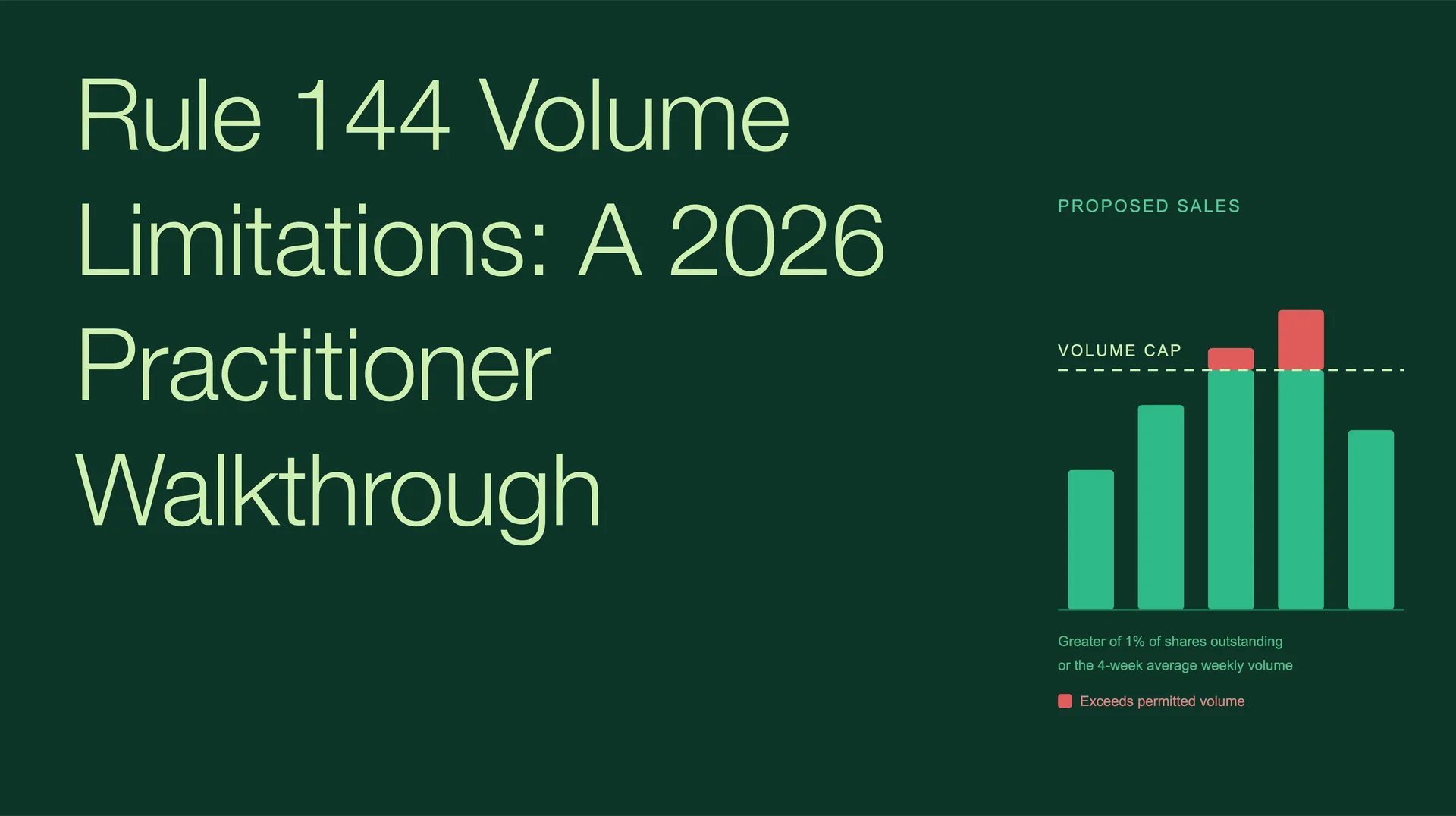
Rule 144 Volume Limitations: A 2026 Practitioner Walkthrough
If your CFO, a departing director, or a family trust is planning to sell restricted or control securities, the Rule 144 volume limitation is the calculation that gates the entire transaction. Get it wrong and you are not just outside the safe harbor, you are potentially an unregistered underwriter under the Securities Act of 1933.
This guide is for compliance officers, general counsel, equity plan administrators, and CFOs who need to calculate the cap, spot the aggregation traps, and file correctly. It does not rehash every Rule 144 condition; for the Form 144 mechanics specifically, see Finrep's Form 144 SEC Reporting Requirements: 2026 Compliance Guide.
Key takeaway: The volume cap and the Form 144 filing threshold are two different numbers. Confusing them is the most common compliance error in affiliate stock sales.
Who Is Subject to Rule 144 Volume Limitations?
The volume limitation under 17 CFR § 230.144(e) applies only to affiliates, and to any person selling on behalf of an affiliate. Non-affiliates who have satisfied the applicable holding period are entirely exempt from volume limitations, manner-of-sale requirements, and Form 144 filing obligations.
An affiliate is anyone who directly or indirectly controls, is controlled by, or is under common control with the issuer. In practice, that means officers, directors, and shareholders holding 10% or more of a class of voting securities.
Two groups often get caught off-guard:
- Former affiliates. A person who was an affiliate within the preceding 90 days remains subject to volume limitations and manner-of-sale conditions during that cooling-off window. An executive who resigned last month cannot sell freely yet.
- Non-affiliates selling on behalf of an affiliate. If a broker, trustee, or family member executes a sale for an affiliate's account, the volume cap applies to that transaction regardless of the seller's own status.
For non-affiliates, the holding period is six months for SEC-reporting issuers and one year for non-reporting issuers, both reduced from the pre-2008 thresholds of one year and two years respectively by SEC Release No. 33-8869.
The Volume Cap Formula: Two Prongs, Take the Greater
Under Rule 144(e), an affiliate may not sell, during any three-month period, more than the greater of:
- 1% of the outstanding shares of the class being sold, as shown by the most recent report or statement published by the issuer; or
- The average weekly reported trading volume during the four calendar weeks preceding the filing of Form 144 (or, if no Form 144 is required, the date of receipt of the order to execute the transaction).
The trading-volume prong is only available for securities traded on a U.S. national securities exchange or quoted on NASDAQ. For OTC securities not quoted on NASDAQ, only the 1% prong applies.
Worked Example
Suppose a company has 1,000,000 shares outstanding and average weekly trading volume of 15,000 shares over the four weeks before the Form 144 filing date.
| Prong | Calculation | Result |
|---|---|---|
| 1% of outstanding shares | 1,000,000 x 1% | 10,000 shares |
| Average weekly trading volume | 15,000 shares/week | 15,000 shares |
| Volume cap (greater of) | 15,000 shares |
The affiliate can sell up to 15,000 shares in that three-month window. If the stock were thinly traded and average weekly volume were only 7,000 shares, the 1% prong would control and the cap would be 10,000 shares.
How to Calculate the Four-Week Trading Volume
This is where compliance teams often stumble. The steps:
- Identify the reference date. If you are filing Form 144, use the filing date. If no Form 144 is required (rare for affiliates), use the date the broker receives the order.
- Count back four complete calendar weeks from that reference date. A calendar week runs Monday through Sunday; partial weeks at the boundary do not count.
- Pull reported trading volume from the exchange's official data, EDGAR, Bloomberg, or a comparable market data source. Use total reported volume across all U.S. national exchanges for that security.
- Divide total volume by four to get the weekly average.
- Exclude shares sold in a registered public offering during the four-week window from the volume figure.
For thinly traded securities, weeks with zero reported volume count as zero, they do not get dropped from the average. That is a meaningful distinction for micro-cap or recently-listed issuers.
The Aggregation Trap: Who Counts as the Same "Person"?
This is the single most common compliance failure for insiders, and it is almost entirely absent from the top-ranking articles on this topic.
Rule 144(a)(2) defines "person" expansively. All of the following are aggregated into a single three-month volume cap:
- The selling affiliate themselves
- Any relative or spouse sharing the same household (including relatives of the spouse)
- Any trust or estate in which the above persons collectively own 10% or more of the total beneficial interest, or in which any of them serve as trustee or executor
- Any corporation or other organization (other than the issuer) in which the above persons collectively own 10% or more of any class of equity securities or 10% or more of the equity interest
What this means in practice:
- A CFO's spouse sells 5,000 shares from a jointly-held family trust. Those shares count against the CFO's personal three-month cap.
- A director's LLC disposes of stock. If the director owns 10%+ of the LLC, those sales aggregate with the director's individual sales.
- Two siblings who are both directors and share a household have their sales combined into one cap.
Warning: Before any affiliate sale, your pre-clearance process must capture all sales by related persons within the same three-month window. A sale that looks compliant in isolation can become a violation once household and entity sales are added in.
The three-month period is a rolling window, not a fixed calendar quarter. If a director sells on July 28, the relevant lookback runs to April 28. A sale in late March and another in early April are in the same three-month window if they fall within 90 rolling days of each other.
The Form 144 Filing Threshold vs. the Volume Cap: Not the Same Number
These two figures are frequently conflated, and the confusion creates real compliance risk.
| Form 144 Filing Threshold | Volume Cap | |
|---|---|---|
| What it is | Trigger requiring SEC notice | Maximum shares an affiliate may sell |
| Threshold | Sales exceed 5,000 shares OR aggregate sale price exceeds $50,000 in a three-month period | Greater of 1% of outstanding shares or average weekly trading volume |
| Purpose | Public disclosure of planned insider sale | Prevent market-distorting concentrated sales |
| Source | 17 CFR § 230.144(h) | 17 CFR § 230.144(e) |
For any exchange-listed company of meaningful size, the 5,000-share / $50,000 threshold is almost always crossed before the volume cap is reached. In practice, Form 144 is required for virtually every affiliate sale of substance.
As of April 13, 2023, Form 144 filings for exchange-listed issuers must be submitted electronically through EDGAR. Paper filing is no longer available for those issuers. For non-reporting company issuers, paper filing remains an option. The broker handling the sale typically prepares and submits Form 144, but ultimate responsibility for accuracy and timeliness rests with the selling affiliate. For a full walkthrough of the EDGAR filing mechanics, see Finrep's Form 144 SEC Reporting Requirements: 2026 Compliance Guide.
Debt Securities: A Different Volume Cap
Almost every article on Rule 144 volume limitations focuses exclusively on equity. If your company has publicly traded bonds, the rule works differently.
For debt securities, the three-month volume cap under Rule 144(e)(1)(ii) is 10% of the principal amount of the tranche (or class, for non-participatory preferred stock) outstanding, not 1% of shares. The same three-month aggregation window applies.
For a CFO or treasury team managing an affiliate's holdings in the company's own bonds, this is the operative limit. The equity prongs (1% of shares or average weekly trading volume) do not apply to straight debt.
Manner-of-Sale Requirements and the QIB Exception
The volume cap does not operate in isolation. Affiliates selling equity under Rule 144 must also comply with the manner-of-sale requirements under Rule 144(f) and (g):
- Sales must be executed through a broker in an unsolicited broker transaction, directly with a market maker, or in a riskless principal transaction.
- The broker cannot solicit orders to buy the securities.
- Higher-than-normal commissions are prohibited.
One meaningful exception: sales to qualified institutional buyers (QIBs) under Rule 144A are not subject to the volume limitations or manner-of-sale requirements of Rule 144. A QIB is an institution with at least $100 million in investable assets. If the buyer qualifies, the affiliate can sell outside the Rule 144 framework entirely for that transaction.
Affiliates who also hold Section 16 reporting obligations should be aware that Rule 144 sales and short-swing profit liability under Section 16(b) run in parallel. A Rule 144-compliant sale can still trigger disgorgement if it is matched against a purchase within six months. For the full Section 16 picture, see Finrep's Short Swing Profit Rule: The 2026 Definitive Guide.
Affiliates who use Rule 10b5-1 trading plans to pre-schedule sales must also structure those plans so that no single three-month window exceeds the volume cap. A 10b5-1 plan does not override Rule 144 conditions; it simply provides an affirmative defense against insider trading claims. For plan requirements, see Finrep's Rule 10b5-1 Trading Plan Requirements: 2026 Compliance Guide.
Step-by-Step: Calculating and Documenting an Affiliate Sale
- Confirm affiliate status. Is the seller currently an affiliate, or was the seller an affiliate within the past 90 days? If yes, all volume and manner-of-sale conditions apply.
- Identify all related persons. Pull the Rule 144(a)(2) definition. List every household member, trust, estate, and controlled entity. Contact each to determine sales in the current three-month rolling window.
- Calculate the 1% prong. Pull the most recent issuer report showing shares outstanding. Multiply by 1%.
- Calculate the trading-volume prong. Identify the Form 144 filing date (or expected sale order date). Count back four complete calendar weeks. Pull reported exchange volume for each week. Sum and divide by four.
- Take the greater of the two prongs. That is the maximum shares the aggregated "person" can sell in the three-month window.
- Subtract prior sales. Deduct any shares already sold by the seller or any related person within the rolling three-month window.
- Confirm the holding period. Restricted securities of reporting-company issuers require a six-month hold from the date fully paid for. Non-reporting issuers require one year.
- Determine Form 144 obligation. If the planned sale exceeds 5,000 shares or $50,000 in aggregate sale price in the three-month period, Form 144 must be filed electronically via EDGAR at or before the time of sale.
- Obtain legend removal. Contact the transfer agent with an opinion letter from issuer's counsel confirming Rule 144 eligibility. The restrictive legend must be removed before the broker can execute.
- Execute through a compliant broker. Confirm the broker will handle the transaction as an unsolicited broker transaction and will not solicit buyers.
- Coordinate Form 4 filing. If the seller is a Section 16 insider, a Form 4 must be filed within two business days of the transaction. See Finrep's Form 3 vs Form 4 vs Form 5: 2026 SEC Insider Reporting Guide for the mechanics.
What Happens If the Volume Cap Is Exceeded?
Rule 144 is a safe harbor, not a ceiling with automatic consequences. Exceeding the volume cap means the sale falls outside the safe harbor. The seller must then establish that another exemption applies, most commonly Section 4(a)(1) (transactions by non-issuers, non-underwriters, non-dealers) or Section 4(a)(7) (private resales to accredited investors).
If no other exemption is available, the seller may be deemed an unregistered underwriter. The SEC has pursued enforcement actions and disgorgement in such cases. The rule text is explicit: "The Rule 144 safe harbor is not available to any person with respect to any transaction or series of transactions that, although in technical compliance with Rule 144, is part of a plan or scheme to evade the registration requirements of the Act."
Remedial options, rescission offers, disgorgement, or registration of the excess shares, are fact-specific and require securities counsel. The practical answer is to build the pre-clearance process described above so the cap is never inadvertently crossed.
FAQ
Does the volume cap apply to non-affiliates who received restricted stock as compensation? No. Non-affiliates who satisfy the applicable holding period (six months for reporting-company issuers, one year for non-reporting issuers) are entirely exempt from volume limitations under SEC guidance. The cap is an affiliate-only condition.
Is the three-month window a rolling period or a fixed calendar quarter? Rolling. The rule refers to "any period of three months," which means any 90-day window, not a fixed January-March or April-June quarter. A sale on March 25 and a sale on April 10 fall within the same three-month window.
Do my spouse's sales count against my volume cap? Yes, if your spouse shares your household. Under Rule 144(a)(2), all sales by relatives or a spouse sharing the same home are aggregated with the affiliate's own sales against the single three-month cap.
I left the company last month. Am I still subject to volume limitations? Yes, for 90 days after ceasing to be an affiliate. The cooling-off period under 17 CFR § 230.144 keeps former affiliates subject to volume and manner-of-sale conditions during that window.
Can I sell to a QIB and avoid the volume cap entirely? Yes. Sales to qualified institutional buyers under Rule 144A are not subject to Rule 144's volume limitations or manner-of-sale requirements. The QIB must hold at least $100 million in investable assets.
What is the volume cap for debt securities? For non-convertible debt, the cap is 10% of the principal amount of the tranche outstanding in any three-month period, not 1% of shares. This is a separate calculation under Rule 144(e)(1)(ii) that most equity-focused compliance teams overlook.
Who actually files Form 144 in practice? The broker handling the sale typically prepares and submits Form 144 on the affiliate's behalf via EDGAR. However, the selling affiliate bears ultimate responsibility for the accuracy and timeliness of the filing. Your pre-clearance process should capture all related-person sales before the broker files, so the form reflects the correct aggregate position.