ASC 820, Fair Value Measurement, is the standard that governs how companies measure the fair value of assets and liabilities, whether for financial statement purposes or for disclosure only. The standard is relevant to goodwill impairment testing (where the DCF that estimates a reporting unit's fair value requires a discount rate), to pension benefit obligations (where the discount rate drives the present value of future benefit payments), to Level 3 private equity and credit instrument valuations (where internal models use discount rates derived from market yields), and to business combination purchase price allocations (where assets and liabilities are measured at fair value as of the acquisition date).
All of these fair value measurements use Treasury yields, directly or indirectly, as key inputs. A 19 basis point increase in the 10-year Treasury yield in a single week is a material movement in those inputs, and the timing, which occurred on July 8, one week after the June 30 balance sheet date, creates a specific technical question about which rate applies to which measurement.
The confirmed fact: per Motley Fool and Forbes reporting on July 8, 2026, the 10-year Treasury yield rose to approximately 4.57%, up from 4.38% the prior week, following Trump's declaration that the Iran ceasefire was over and the resulting oil price spike and Fed rate hike repricing.
What Happened to 10-Year Treasury Yields on July 8, 2026 and Why It Matters for Fair Value
The July 8, 2026 Treasury yield movement was a direct consequence of the same Iran ceasefire collapse documented in the earlier blogs in this cluster. When oil prices surged more than 6% following Trump's Ankara statement, financial markets simultaneously repriced the Federal Reserve's likely response. The CME FedWatch Tool showed a September 2026 rate hike probability of 68.8%, up from 62% the prior day. The 10-year Treasury yield moved from approximately 4.38% to 4.57% on July 8, a 19 basis point increase in a single session.
To contextualise this movement: the Federal Reserve has held the federal funds rate at 3.50 to 3.75% since December 2025. The 10-year Treasury yield at 4.57% reflects the market's expectation that the short rate will move higher and that long-term inflation expectations have increased. The Motley Fool reporting on the Forbes article covering Fed rate hike probabilities confirmed these specific data points.
The broader context of the yield environment for the year: the 10-year Treasury started 2026 near pre-conflict levels, rose during the Iran war escalation in Q1 as inflation expectations increased, fell modestly during the ceasefire period, and then spiked again on July 8. For Q2 balance sheet purposes, the relevant yield as of June 30 is the rate that prevailed at the June 30 ceasefire period, before the July 8 spike. The June 30 10-year Treasury yield was approximately in the 4.30 to 4.45 range, reflecting the ceasefire-induced relief from rate hike expectations that preceded the July 8 collapse.
The July 8 spike to 4.57% is material as a subsequent event: it occurred after the balance sheet date, and the question for each specific ASC 820 measurement is whether the rate applicable to that measurement is the June 30 rate or whether the July 8 rate is relevant to the Q2 disclosures and assessments.
What Is ASC 820 and Which Q2 2026 Measurements Use Treasury Yields as Inputs?
ASC 820 establishes a framework for measuring fair value. Fair value is defined as the price that would be received to sell an asset or paid to transfer a liability in an orderly transaction between market participants at the measurement date.
The measurement date is the date on which the fair value is measured. For balance sheet items, the measurement date is the balance sheet date, June 30, 2026. For disclosures about fair value, the measurement date is also June 30.
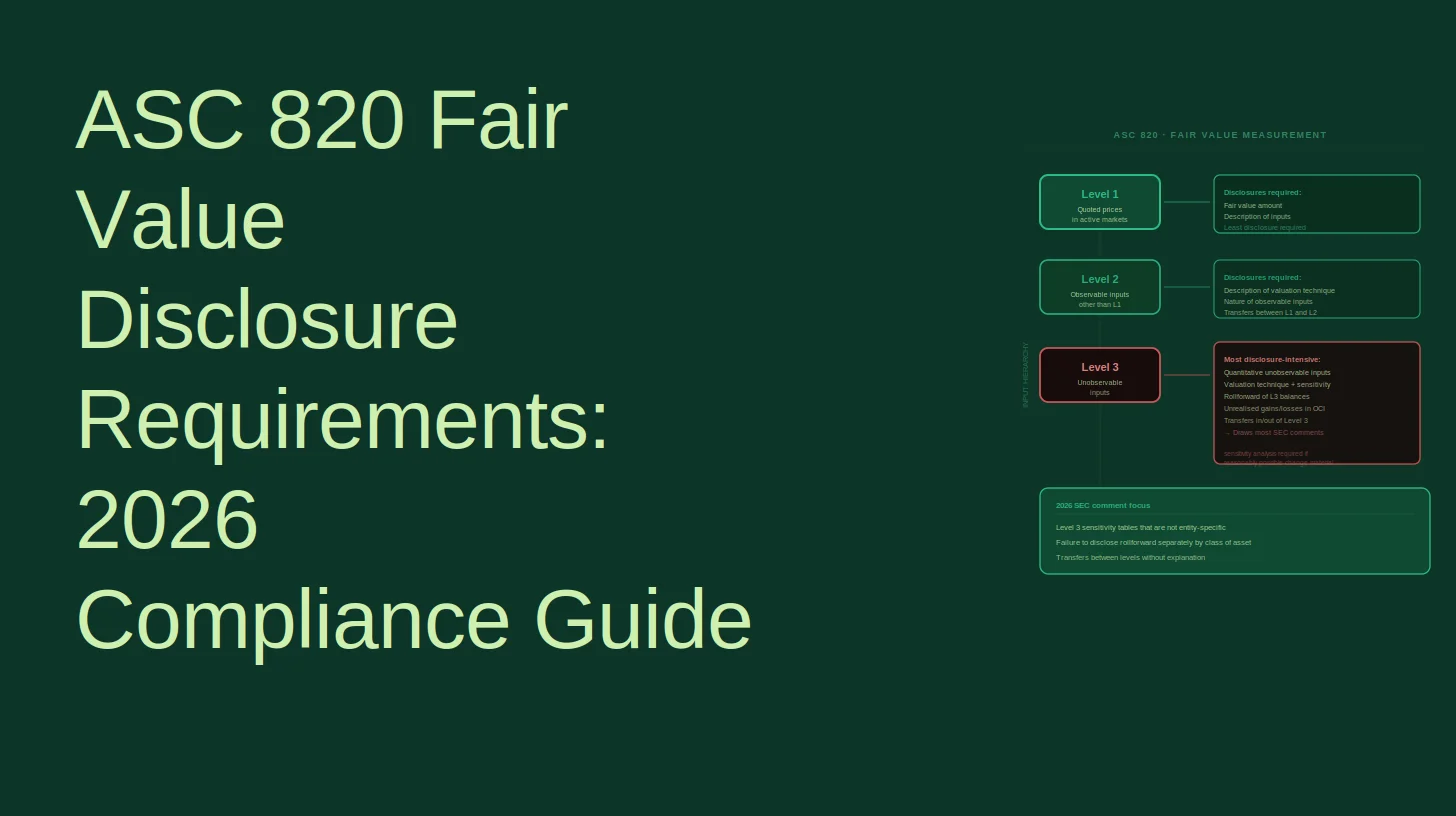
ASC 820 organises fair value measurement inputs into a three-level hierarchy:
Level 1: quoted prices in active markets for identical assets or liabilities. No estimation is required. For publicly traded equity securities or on-the-run Treasury securities, the Level 1 price is directly observable.
Level 2: inputs other than Level 1 that are observable for the asset or liability, either directly or indirectly. Market interest rates, credit spreads, and yield curves that are observable for comparable instruments are Level 2 inputs. Many fixed income securities and derivative instruments are measured using Level 2 inputs.
Level 3: unobservable inputs that reflect the company's own assumptions about what market participants would use to price the asset or liability. Discounted cash flow models that use management's assumptions about future cash flows, growth rates, and risk-adjusted discount rates are typically Level 3 measurements.
The four categories of fair value measurement that use Treasury yields as inputs, and that are most affected by the July 8 yield spike, are:
Goodwill impairment testing (ASC 350-20): the DCF model that estimates a reporting unit's fair value uses a weighted average cost of capital (WACC) as the discount rate. The WACC is typically built up from the risk-free rate (the Treasury yield for the appropriate duration) plus an equity risk premium and company-specific risk adjustments.
Pension benefit obligations (ASC 715-30): the projected benefit obligation is the present value of all future benefit payments to employees and retirees, discounted at a rate that reflects the yields on high-quality corporate bonds with maturities consistent with the expected timing of benefit payments. Those corporate bond yields are correlated with Treasury yields.
Level 3 private equity and credit instrument valuations: private equity investments, leveraged loans, private credit, and other instruments without active market prices are typically valued using discounted cash flow models or market comparable approaches that incorporate market discount rates derived from observable yields including Treasury yields.
Business combination purchase price allocations (ASC 805): assets and liabilities acquired in a business combination are measured at fair value as of the acquisition date. Intangible assets are often valued using an income approach that requires a discount rate; contingent consideration liabilities are measured at fair value; and acquired debt is measured at current market rates.
Fair Value Input #1: Goodwill Impairment DCF, How a 19bp Discount Rate Increase Changes Your Reporting Unit Fair Value
The goodwill impairment DCF is the most widely applicable fair value measurement affected by Treasury yield movements for non-financial companies. Under ASC 350-20, the quantitative goodwill impairment test requires the company to estimate the fair value of the reporting unit and compare it to the carrying amount. Where the fair value is estimated using a DCF model, the discount rate is a critical input.
The discount rate in the goodwill impairment DCF is typically the WACC, calculated as the after-tax cost of debt multiplied by the debt-to-capital weight plus the cost of equity multiplied by the equity-to-capital weight. The cost of equity is typically estimated using the Capital Asset Pricing Model: risk-free rate plus beta multiplied by the equity risk premium.
The risk-free rate in the CAPM is the Treasury yield at the appropriate duration for the cash flows being discounted. For an indefinite-life goodwill test where cash flows extend in perpetuity, the 10-year Treasury yield is the most commonly used risk-free rate proxy.
The mathematical sensitivity of a DCF value to discount rate changes is governed by the duration of the cash flows. For a reporting unit with a terminal value that represents a large portion of total value (which is typical for goodwill impairment DCFs where near-term free cash flows are modest relative to the long-term earnings potential), a 19 basis point increase in the discount rate can reduce the calculated fair value by 3% to 8% depending on the growth rate assumptions and the proportion of value in the terminal value.
Concretely: a reporting unit with a DCF fair value of $1 billion using a 9.5% WACC might see its fair value estimate decline to approximately $960 million to $975 million if the WACC increases by 19 basis points to 9.69%, holding all other assumptions constant. For a reporting unit with $950 million of carrying amount and $1 billion of fair value (5% headroom), that 19 basis point rate increase might eliminate the headroom entirely.
This sensitivity matters for Q2 2026 because the goodwill impairment triggering event assessment and any interim quantitative test use the rate environment at June 30, 2026. If the 10-year Treasury yield at June 30 was approximately 4.38% (the pre-July-8 level) and the company's WACC used in the most recent annual test reflected a similar risk-free rate, the triggering event assessment at June 30 uses the June 30 rate, not the July 8 rate.
However, if the company is performing an interim quantitative impairment test and is issuing the Q2 financial statements in August 2026 when the 10-year yield is 4.57%, the question of which rate to use in the measurement requires careful analysis. The measurement date is June 30. The rate input should reflect market conditions at June 30, not at the filing date. But the company must be consistent: if the measurement date is June 30 and the rate at June 30 was approximately 4.38% to 4.45%, that is the rate to use in the quantitative test.
Fair Value Input #2: Pension Benefit Obligation, What the Yield Curve Shift Means for Your ASC 715 Discount Rate
For companies with defined benefit pension plans, the quarterly measurement of the pension benefit obligation requires a discount rate that reflects the yields on high-quality fixed income investments with maturities consistent with the expected timing of benefit payments.
ASC 715-30-35-44 specifies that the assumed discount rate shall reflect the rates at which the pension benefits could be effectively settled. The most common methodology in practice is to construct a yield curve from AA-rated corporate bond yields and use that curve to discount the projected benefit obligation cash flows. The resulting single equivalent discount rate reflects the term structure of the pension payments and the credit quality of the investment-grade corporate bond market.
Corporate bond yields and Treasury yields are correlated, though not identical. The spread between AA corporate bonds and Treasuries (the credit spread) fluctuates based on credit conditions. In a risk-off environment (which the Iran ceasefire collapse created), credit spreads may widen, partially offsetting the reduction in the pension obligation from higher Treasury yields. In a risk-on environment, credit spreads tighten.
The net effect of the July 8 Treasury yield move on the pension discount rate depends on two variables: the movement in the Treasury yield itself (up 19 basis points) and the movement in credit spreads (which may have widened on July 8 given the flight-to-safety dynamics of the day). The combined effect on the AA corporate yield curve is what matters for the pension obligation.
For Q2 2026 pension obligation measurements, the relevant date is June 30, 2026. The pension obligation is remeasured at each annual measurement date, but remeasurement is also required when a significant event occurs (such as a plan amendment, curtailment, or settlement). Absent such a triggering event, the Q2 10-Q typically does not include a full pension remeasurement. The Q2 pension disclosures instead show the quarter-to-date service cost, interest cost, and expected return on plan assets, with the obligation remeasured at year-end December 31.
For companies that do remeasure at Q2 (because of a triggering event), the discount rate used must reflect the AA corporate yield curve as of June 30, 2026. The July 8 yield spike does not affect the June 30 pension measurement. It is relevant information for the Q3 2026 measurement if rates remain at 4.57% or higher through September 30.
Fair Value Input #3: Level 3 Private Equity and Credit Instrument Valuations at June 30
For companies, funds, and investment entities that carry Level 3 investments in their financial statements, the June 30, 2026 fair value measurements require a discount rate that reflects market conditions at that date.
Level 3 instruments include private equity investments valued using a market approach or income approach, leveraged loans and private credit instruments that lack active market pricing, real assets valuations, and other illiquid or bespoke financial instruments. For income approach valuations, the discount rate is typically built up from the risk-free rate plus relevant risk premia (credit spread, liquidity premium, equity risk premium for private equity).
The 10-year Treasury yield at June 30, 2026, approximately 4.38% to 4.45%, is the appropriate risk-free rate input for Level 3 income approach valuations with long-duration cash flows as of that date. The July 8 spike to 4.57% occurred after the measurement date and is not incorporated in the June 30 measurement.
However, the July 8 movement raises a practical question for valuation teams completing their Q2 measurements: what Treasury yield was in effect on June 30? For companies that complete their Level 3 valuations in July (as many do, given the time required for illiquid asset valuations), the current rate at the time of calculation is 4.57%, not the June 30 rate. The valuation team must ensure that their models use the June 30 rate for the June 30 measurement, not the rate at the time they happen to be building the model.
This is a process control issue as much as an accounting issue. The valuations team should have a documented procedure for confirming the measurement date inputs, specifically that Treasury yields, credit spreads, and other market-observable inputs are sourced as of June 30 rather than as of the calculation date. Where the calculation date and the measurement date differ by more than a few days, the gap creates risk of using stale or incorrect rate inputs.
The July 8 yield spike also affects the fair value disclosure under ASC 820-10-50-2, which requires disclosure of the sensitivity of Level 3 measurements to changes in unobservable inputs. Where the discount rate is a significant unobservable input, the sensitivity disclosure should describe the relationship between the discount rate and the fair value: for example, that a 25 basis point increase in the discount rate would reduce the fair value of the investment by approximately $X million. The July 8 yield move is exactly the kind of post-balance-sheet-date rate movement that investors need context to understand when reading Level 3 sensitivity disclosures.
Fair Value Input #4: Business Combinations Completed in Q2, What the Post-Close Rate Movement Means for Purchase Price Allocation
Companies that completed acquisitions in Q2 2026, the three months ended June 30, must present purchase price allocations in the Q2 10-Q that reflect the fair value of acquired assets and assumed liabilities as of the acquisition closing date.
For business combinations that closed in April or May 2026, the measurement date for the purchase price allocation is the closing date, during the period when the 10-year Treasury yield may have been materially different from both June 30 and July 8. Companies that closed acquisitions in late March or early April 2026, during the peak of the Iran conflict oil price spike, would have had higher Treasury yields at their acquisition date than at June 30 (because the ceasefire announcement in mid-April and June brought rates down somewhat from the war-period highs).
The specific ASC 820 issues for Q2 business combination measurements:
Intangible asset valuations. Customer relationships, trade names, technology, and other identified intangible assets acquired in a business combination are typically valued using a multi-period excess earnings method or a relief-from-royalty method, both of which require a discount rate. The discount rate must reflect the risk-free rate at the acquisition date.
Contingent consideration. If the acquisition agreement included an earnout or other contingent consideration, it is measured at fair value as of the acquisition date. The fair value of the contingent consideration uses a discount rate reflecting the risk of the contingent payment stream, which is anchored to the acquisition-date rate environment.
The ASC 805 measurement period for Q2 acquisitions extends up to one year from the closing date. Adjustments to the preliminary purchase price allocation made during the measurement period must reflect information that provides evidence about conditions that existed at the acquisition closing date. A Treasury yield change after the closing date does not cause a retroactive adjustment to the purchase price allocation. It is forward-looking information, not evidence about conditions at the closing date.
For Q2 10-Q purposes, where the preliminary purchase price allocation is disclosed, the 10-Q should state clearly that the preliminary allocation reflects the acquisition-date fair value measurements and that the measurement period remains open pending completion of the valuation analyses.
What Is the June 30 vs July 8 Timing Problem: Do You Use the June 30 Rate or the Filing Date Rate?
This is the single most practically important question in the ASC 820 analysis following the July 8 yield spike, and it has a clear answer: for balance sheet measurements, you use the June 30 rate.
ASC 820-10-20 defines the measurement date as the date on which the fair value is required to be measured. For financial statements prepared as of June 30, 2026, every fair value measurement in those financial statements uses market conditions prevailing on June 30, 2026, not market conditions at the filing date in August 2026.
This principle is consistently applied and consistently documented in the ASC 820 framework. The definition of fair value as "the price that would be received to sell an asset or paid to transfer a liability in an orderly transaction between market participants at the measurement date" contains the phrase "at the measurement date" explicitly. The fair value is not the price at the measurement date plus subsequent developments. It is the price at that specific date.
For the goodwill impairment DCF, the WACC should reflect the risk-free rate at June 30. For the pension obligation, the discount rate should reflect the AA corporate yield curve at June 30. For Level 3 instruments, the discount rate inputs should reflect market conditions at June 30. For business combination valuations, the acquisition-date rate is used.
The filing date rate (4.57% on July 8, and whatever rate prevails in August when the 10-Q is filed) is not used in the balance sheet measurements. It is, however, relevant in two specific ways.
First, it informs the subsequent event analysis under ASC 855. If the July 8 rate movement is material and represents a new condition (not evidence of conditions that existed at June 30), it may require subsequent event disclosure.
Second, it informs the MD&A forward-looking disclosure. If the current rate environment at the filing date in August is materially different from the June 30 rate, the MD&A known trends section should address the implications of the current rate environment for future fair value measurements.
What Is a Subsequent Event for an ASC 820 Measurement at June 30?
Under ASC 855-10-25-1, subsequent events are events or transactions that occur after the balance sheet date but before the financial statements are issued. They are evaluated to determine whether they are adjusting events (Type 1) or non-adjusting events (Type 2).
A Type 1 (adjusting) subsequent event provides additional evidence about conditions that existed at the balance sheet date. If a subsequent event reveals that a fair value measurement made at June 30 was based on incorrect information that was available but not known at June 30, the financial statements are adjusted.
A Type 2 (non-adjusting) subsequent event represents a new condition that arose after the balance sheet date. It does not adjust the financial statements but may require disclosure if material.
The July 8, 2026 Treasury yield spike to 4.57% is a Type 2 non-adjusting subsequent event relative to the June 30 balance sheet date. The rate movement did not reveal any error in the June 30 measurement. It represents new market conditions created by the Iran ceasefire collapse, which is a new event occurring after the balance sheet date.
As a Type 2 event, the July 8 yield spike does not change the June 30 fair value measurements. A company that measured goodwill at June 30 using a WACC reflecting a June 30 10-year Treasury rate of approximately 4.38% to 4.45% does not revise that measurement to reflect the July 8 rate.
However, if the July 8 yield spike is of such significance that non-disclosure would make the financial statements misleading, ASC 855-10-50-2 requires disclosure of the nature of the subsequent event and an estimate of its financial effect (or a statement that such an estimate cannot be made). For companies with significant fair-value-sensitive assets and liabilities, particularly those with Level 3 instruments measured at June 30 whose values would be materially different at the filing date's rate environment, that disclosure should be considered.
What Must Your Q2 2026 10-Q Disclose About Rate-Sensitive Fair Value Measurements?
The Q2 2026 10-Q fair value disclosures under ASC 820-10-50 have specific requirements for Level 3 measurements that are rate-sensitive, and those requirements interact with the July 8 subsequent event in specific ways.
Required disclosures for Level 3 measurements:
Quantitative information about significant unobservable inputs. ASC 820-10-50-2(bbb) requires disclosure of the quantitative information about the significant unobservable inputs used in Level 3 measurements. For DCF-based measurements, this includes the discount rate and the growth rate assumptions. The disclosure should present the range of discount rates used if multiple Level 3 instruments are in the category, and the weighted average where applicable.
Sensitivity of the fair value to changes in unobservable inputs. ASC 820-10-50-2(e) requires disclosure of a description of the valuation processes used and a narrative description of the sensitivity of the fair value measurement to changes in unobservable inputs. For rate-sensitive measurements, this should describe the directional relationship: higher discount rates reduce the fair value estimate, and a 25 to 100 basis point change in the discount rate produces an estimated dollar impact of approximately $X million.
The July 8 rate spike makes the sensitivity disclosure particularly important for Q2 2026. A company that discloses that its Level 3 goodwill impairment DCF uses a WACC of 9.5% as of June 30, and that a 25 basis point increase would reduce the estimated fair value by $X million, is providing investors with the context they need to understand that the current rate environment (with the 10-year at 4.57%) would imply a higher WACC than was used in the June 30 measurement.
For goodwill impairment specifically: where a triggering event analysis was performed and the conclusion was that no triggering event existed, the MD&A critical accounting estimate disclosure should address the rate sensitivity of the goodwill DCF and describe the effect of the post-quarter rate movement on the headroom at the most recent quantitative test.
For pension obligations: where the Q2 pension cost and obligation disclosures are presented, the 10-Q should note the current rate environment and the expected effect of any remeasurement at Q3 if rates remain at the July 8 level through September 30.
Frequently Asked Questions
How do rising Treasury yields affect ASC 820 fair value measurements?
Treasury yields affect fair value measurements by changing the discount rates used in income approach (DCF) valuations. A higher risk-free rate increases the WACC or other discount rates used to present-value future cash flows, which reduces the calculated fair value of those cash flows. The magnitude of the fair value reduction depends on the duration and growth profile of the cash flows: longer-duration, lower-growth cash flows are more sensitive to discount rate changes than shorter-duration, higher-growth cash flows.
Does the July 8 Treasury yield spike affect my June 30 goodwill impairment DCF?
No. The measurement date for the June 30 goodwill impairment DCF is June 30, 2026. The WACC and risk-free rate inputs must reflect market conditions at June 30, not at the July 8 date of the yield spike. The July 8 yield increase is a subsequent event that does not adjust the June 30 measurement. It should be disclosed as a subsequent event if material and addressed in the MD&A sensitivity disclosure for the goodwill impairment DCF.
What discount rate should I use for my Q2 2026 pension obligation under ASC 715?
Where remeasurement is required at June 30, the discount rate should reflect the AA-rated corporate bond yield curve as of June 30, 2026. For most companies, a formal pension remeasurement is not required at Q2 absent a triggering event (plan amendment, curtailment, or settlement). The regular Q2 pension cost disclosures use rates established at the prior annual measurement date (December 31, 2025).
Do Level 3 fair value measurements use the June 30 or the filing date Treasury yield?
The June 30 Treasury yield. The measurement date for Q2 Level 3 fair value measurements is June 30, 2026. The valuation models must source Treasury yield inputs as of June 30, even when the valuation calculations are performed in July or August. This is a process control requirement: the inputs used in the model must be dated to the measurement date, not to the calculation date.
Is the July 8 Treasury yield spike a subsequent event for Q2 10-Q purposes?
Yes, as a Type 2 non-adjusting subsequent event under ASC 855. The rate spike arose from a new condition (the Iran ceasefire collapse on July 8), not from evidence about conditions that existed at June 30. It does not adjust the June 30 financial statements but may require disclosure under ASC 855-10-50-2 if the financial effect is material, and should be addressed in the MD&A forward-looking sensitivity discussion.
Key Takeaways
- On July 8, 2026, following Trump's declaration that the Iran ceasefire was over, the 10-year Treasury yield rose to approximately 4.57% from 4.38% the prior week, a 19 basis point increase in a single session. This is a subsequent event relative to the June 30, 2026 balance sheet date.
- ASC 820 fair value measurements that use Treasury yields as inputs, including the goodwill impairment DCF WACC, pension benefit obligation discount rate, Level 3 instrument valuations, and business combination purchase price allocations, must use market conditions at the measurement date: June 30, 2026, not July 8.
- For the goodwill impairment DCF, the June 30 10-year Treasury yield (approximately 4.38% to 4.45%) is the risk-free rate input. A 19 basis point increase in the WACC can reduce a reporting unit's calculated fair value by 3% to 8%, potentially eliminating headroom for reporting units near the impairment threshold.
- For pension obligations, the discount rate as of June 30 reflects the AA corporate yield curve on that date. Formal Q2 remeasurement is typically not required absent a triggering event. The July 8 rate movement affects the Q3 remeasurement if rates remain elevated.
- For Level 3 valuations, valuation teams working in July must source Treasury yield inputs as of June 30, not as of their calculation date. This is a process control requirement distinct from accounting judgment.
- The July 8 yield spike is a Type 2 non-adjusting subsequent event under ASC 855. It does not change the June 30 fair value measurements but may require disclosure if material, and should be addressed in the MD&A sensitivity disclosures for rate-sensitive fair value measurements.
- The Q2 10-Q Level 3 fair value disclosures should include quantitative information about discount rate inputs at June 30 and sensitivity analysis showing the approximate fair value impact of a 25 to 100 basis point discount rate change. In the context of the July 8 rate movement, those sensitivity disclosures provide investors with the analytical framework to understand the current rate environment's implications.