Reg FD Meaning, Mechanics, and 2026 Compliance Playbook
Regulation FD is the rule that says: if you tell a Wall Street analyst something material, you have to tell everyone at the same time. That sounds simple. The DraftKings enforcement action in September 2024 proved it isn't.
This guide is for IROs, General Counsel, CFOs, and compliance officers at U.S.-listed companies who need to understand precisely what Reg FD requires, where the materiality line sits, and how to build a program that holds up in 2026, when CEO social media posts, AI-drafted content, and third-party PR firms have made the compliance surface far larger than it was in 2000.
Key takeaway: Reg FD is not just a policy to adopt. It is an operational discipline that must cover every channel, every agent, and every person who speaks for your company to investors.
What Reg FD Means and Why It Exists
Regulation FD (Fair Disclosure) was adopted by the SEC on August 10, 2000 and became effective October 23, 2000. It is codified at 17 CFR Part 243, Rules 100 through 103. The Commission voted 3-1 to adopt it, over the objections of large brokerage firms who predicted a chilling of information flow.
The problem it solved was real. Before Reg FD, selective disclosure to analysts was largely legal. Under the Supreme Court's Dirks v. SEC framework, insider trading liability required the tipper to receive a personal benefit, meaning most analyst briefings fell outside the law's reach. The SEC's 2000 adopting release put it plainly:
"Issuer selective disclosure bears a close resemblance in this regard to ordinary 'tipping' and insider trading. In both cases, a privileged few gain an informational edge, and the ability to use that edge to profit, from their superior access to corporate insiders, rather than from their skill, acumen, or diligence."
The rule generated more than 6,000 comment letters, the vast majority from individual investors supporting it. It has been in effect for nearly 26 years and remains one of the most durable SEC disclosure rules of the modern era.
The Core Rule: What Reg FD Actually Prohibits
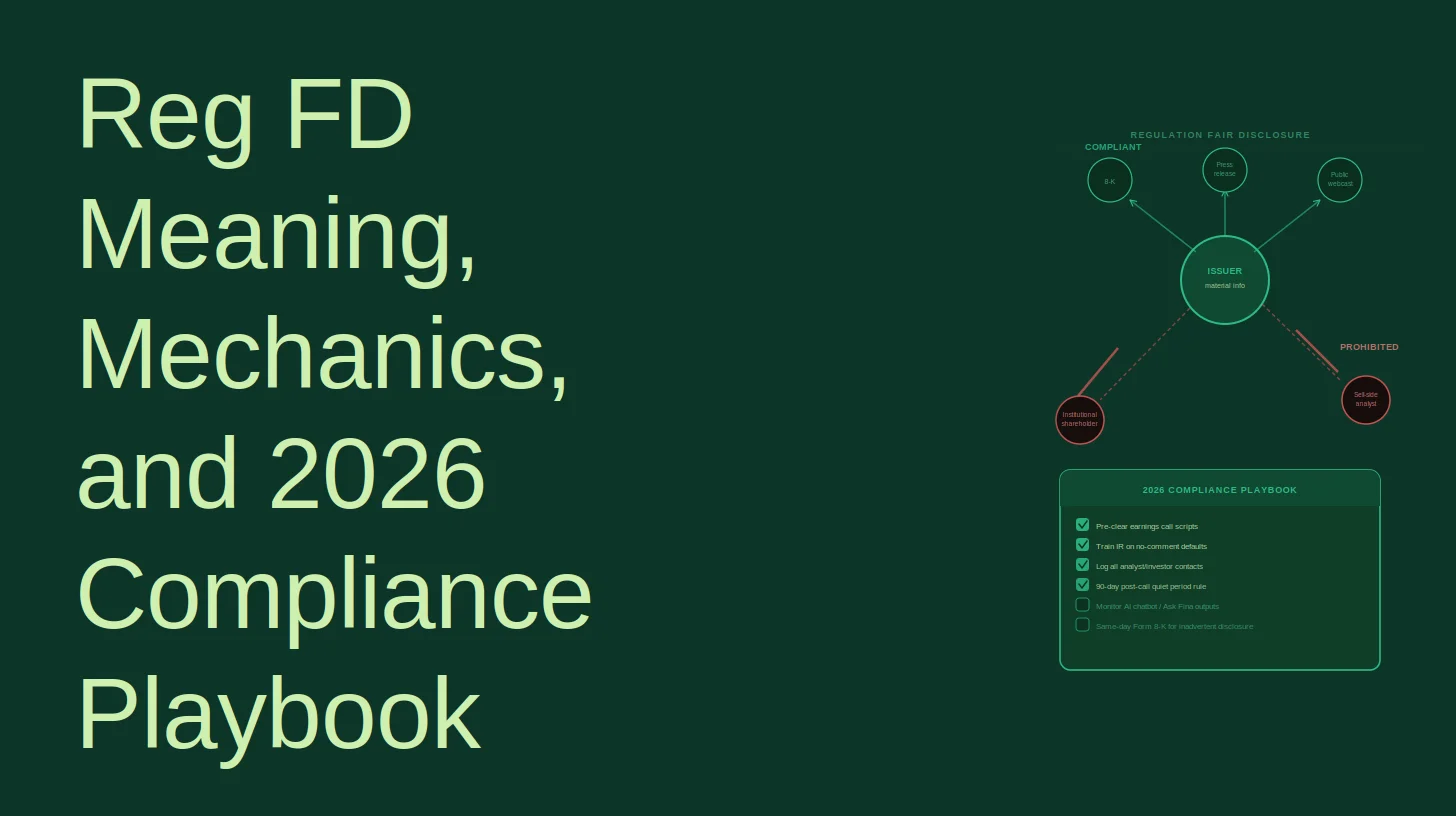
The basic mechanism: whenever an issuer, or a person acting on its behalf, discloses material nonpublic information (MNPI) to a covered person, the issuer must simultaneously (for intentional disclosures) or promptly (for non-intentional disclosures) make the same information available to the general public.
Three elements determine whether Reg FD is triggered:
- Who made the disclosure (a covered person acting on behalf of the issuer)
- What was disclosed (MNPI)
- Who received it (a covered recipient)
All three must be present. If any element is absent, Reg FD does not apply.
Who Are the Covered Persons Making Disclosures?
Reg FD applies to "senior officials" of the issuer and any other person who regularly communicates with market professionals or security holders on the issuer's behalf. Senior officials include:
- Directors
- Executive officers (as defined in Exchange Act Rule 3b-7)
- Investor relations officers and public relations officers
- Any other officer, employee, or agent who regularly communicates with securities market professionals or security holders
The last category is where companies get caught. A third-party PR firm posting on the CEO's behalf is a "person acting on behalf of the issuer." The DraftKings case confirmed this without ambiguity.
Who Are the Covered Recipients?
The rule applies when MNPI is disclosed to:
- Broker-dealers and their associated persons
- Investment advisers and their associated persons
- Investment companies and their affiliated persons
- Any holder of the issuer's securities where it is reasonably foreseeable that the holder may trade on the information
Note what is not on this list: customers, suppliers, employees (in their capacity as employees), and ordinary business counterparties. Reg FD does not restrict ordinary-course business communications.
What Counts as Material Nonpublic Information
Reg FD does not create a new materiality standard. It inherits the existing test from TSC Industries v. Northway (1976) and Basic Inc. v. Levinson (1988): information is material if there is a substantial likelihood that a reasonable investor would consider it important in making an investment decision, or if it would have significantly altered the "total mix" of available information.
In practice, materiality is a judgment call. The SEC's 2003 Special Study found that the primary concern among issuers was uncertainty around the materiality line, particularly for:
- Earnings guidance confirmations
- Product-related non-financial information
- Plant and factory tours
Some categories are almost always material: quarterly earnings data before public release, significant M&A activity, major contract wins or losses, and changes in senior leadership. Others require judgment.
The Guidance Confirmation Trap
One of the most common Reg FD mistakes is confirming prior guidance in a one-on-one investor meeting. The SEC's Division of Corporation Finance C&DIs are explicit:
"A statement by an issuer that it has 'not changed,' or that it is 'still comfortable with,' a prior forecast is no different than a confirmation of a prior forecast."
A confirmation is only safe if it conveys no additional material information beyond the original forecast. The materiality of a confirmation depends on the time elapsed since the original forecast, intervening events, and whether the confirmation implies updated performance data. When in doubt, treat it as a new disclosure.
The Mosaic Theory: What You Can Say to Analysts
An issuer may review and comment on an analyst's financial model privately without triggering Reg FD, provided it does not communicate MNPI in doing so. Correcting historical facts that are a matter of public record, or sharing "seemingly inconsequential data" that a skilled analyst pieces together with public information, does not violate Reg FD. This is the "mosaic theory" boundary.
However, using a model review call as a vehicle to selectively communicate MNPI, whether expressly or through coded language, does violate the rule. The line is: public facts and corrections are fine; forward-looking or performance data that is not yet public is not.
Intentional vs. Non-Intentional Disclosure: The Timing Rules
This is the most operationally important distinction in Reg FD, and it is consistently underexplained.
| Disclosure Type | Definition | Timing Requirement |
|---|---|---|
| Intentional | The person making the disclosure knows, or is reckless in not knowing, that the information is both material and nonpublic | Public disclosure must be simultaneous |
| Non-intentional | The person did not know (and was not reckless in not knowing) that the information was material and nonpublic at the time of disclosure | Public disclosure must be prompt |
"Prompt" is defined precisely: as soon as reasonably practicable, but in no event later than 24 hours after a senior official learns of the non-intentional disclosure, or before the commencement of the next NYSE trading day, whichever is later.
The 24-hour clock starts when a senior official learns of the disclosure, not when the disclosure occurs. This matters for escalation protocols: if a junior IR staffer inadvertently discloses MNPI on a call and does not immediately escalate to a senior official, the clock does not start, but the window for cure is narrowing.
Key takeaway: For non-intentional disclosures, the question is not whether you violated Reg FD, it is whether you cured the violation within the prompt disclosure window. Deleting the post, as DraftKings discovered, does not count as curing it.
How to Make a Compliant Public Disclosure
Reg FD's public disclosure requirement can be satisfied by any method "reasonably designed to effect broad, non-exclusionary distribution." The SEC's adopting release identifies the following as acceptable:
- Filing a Form 8-K with the SEC (Item 8.01)
- Furnishing a Form 8-K (Item 7.01)
- Issuing a press release through a widely circulated news or wire service
- Holding a conference call or webcast that is open to the public and adequately publicized in advance
- Any other method or combination of methods reasonably designed for broad distribution
For earnings calls and investor days, "adequately publicized" has a specific meaning. The advance notice must include the date, time, subject matter, and call-in or access information. A replay and transcript should be made available. These are not optional courtesies; they are the mechanics that make the disclosure compliant.
For the Form 8-K mechanics, including the critical difference between filing under Item 8.01 (which triggers liability for false statements) and furnishing under Item 7.01 (which does not), see our detailed guide on the Reg FD and Form 8-K interaction.
The DraftKings Case: What It Means for Your IR Program
On September 26, 2024, the SEC charged DraftKings with violating Reg FD after its outside PR firm posted statements on the CEO's personal X (Twitter) and LinkedIn accounts disclosing that the company continued to see "really strong growth" in existing states, before the company had publicly disclosed its Q2 2023 financial results. DraftKings agreed to pay a $200,000 civil penalty.
Four facts make this case the most instructive Reg FD enforcement action since Netflix:
- The disclosure was made by a third-party PR firm, not a company employee. The SEC held DraftKings fully responsible.
- The posts were removed within approximately 30 minutes. The SEC still found a violation because no prompt public disclosure was made.
- The posts violated DraftKings' own social media policy. Internal policy compliance did not prevent the SEC from finding a violation.
- DraftKings did not make any public announcement until August 2, 2023, six days after the July 27 posts, when it issued its Q2 earnings release. The SEC treated that release as evidence of the materiality of the original posts.
As part of the settlement, the SEC required DraftKings to provide Reg FD training to all employees with corporate communications responsibilities within 30 days. This signals that the SEC views ongoing training, not just policy adoption, as a core compliance requirement.
The Third-Party Agent Problem
The DraftKings case has significant vendor management implications. Every PR firm, IR agency, social media manager, and external communications partner that acts on your behalf is a "person acting on behalf of the issuer" for Reg FD purposes. Your contracts with these vendors should:
- Require them to follow your Reg FD policy
- Prohibit them from posting any content about company performance without prior written approval from a designated spokesperson
- Require immediate escalation if a potential violation occurs
- Include Reg FD training as an onboarding requirement
Having a policy is not enough. DraftKings had one. The SEC charged them anyway.
Social Media, AI Content, and the 2026 Compliance Surface
The SEC's 2013 guidance following the Netflix/Reed Hastings Facebook post established the framework that still governs today. Netflix's stock rose from $70.45 at the time of Hastings' post to $81.72 at the close of the following trading day, a move the SEC cited as evidence of materiality.
The rule is straightforward: a social media channel can be a compliant disclosure channel only if investors have been pre-notified that the company will use that specific channel to disseminate material information. As George Canellos, then Acting Director of the SEC's Division of Enforcement, stated:
"Most social media are perfectly suitable methods for communicating with investors, but not if the access is restricted or if investors don't know that's where they need to turn to get the latest news."
A CEO's personal X or LinkedIn account is not, by default, a pre-notified disclosure channel. To make it one, the company must affirmatively alert investors, typically through its IR page, press releases, and a Form 8-K, that the account will be used for material disclosures.
AI-Generated Content: The Emerging Risk
No existing Reg FD guidance directly addresses AI-generated content or automated social media scheduling tools, but the legal analysis is clear. If an AI tool drafts and schedules a post that contains MNPI, and that post goes live before a public disclosure, the issuer has violated Reg FD. The fact that a machine generated the content is not a defense.
Practical controls for AI and automation:
- All AI-drafted content about company performance must be reviewed and approved by a designated spokesperson before posting
- Automated scheduling tools must be blocked from posting during quiet periods
- Any AI tool with access to internal financial data must be treated as a potential MNPI vector
- Audit logs of AI-generated content approvals should be maintained
Key Exclusions and Safe Harbors
Not every private communication triggers Reg FD. The SEC's adopting release identifies four key exclusions:
1. The Confidentiality Agreement Safe Harbor
You can share MNPI privately if the recipient expressly agrees to maintain the information in confidence. This is stricter than it sounds. An acknowledgment that the recipient will not use the information in violation of securities laws is not sufficient. The agreement must expressly require confidentiality.
Additional points practitioners often miss:
- The recipient can still face insider trading liability if they trade on the information, even with a valid confidentiality agreement
- The issuer should monitor whether the recipient is actually maintaining confidentiality
- M&A due diligence processes typically rely on this exclusion, but the NDA must be properly drafted
2. Registered Public Offerings
Road show materials and communications in connection with a registered public offering are excluded from Reg FD. Road shows in unregistered offerings, or road shows conducted while the issuer is not in registration, are subject to Reg FD unless participants expressly agree to maintain confidentiality.
3. Credit Rating Agency Disclosures
Disclosures to credit rating agencies (Moody's, S&P, Fitch) for the purpose of determining credit ratings are excluded, but only if the resulting ratings are publicly available. This exclusion is practically important for companies in active rating processes or covenant discussions.
4. Ordinary-Course Business Communications
Communications to customers, suppliers, or employees in their ordinary business capacity, not in their capacity as investors, are excluded. A product briefing to a major customer is not a Reg FD event. A briefing to the same person who also holds your stock, about your upcoming earnings, is.
Does Reg FD Apply to Your Company?
Reg FD applies to issuers that have a class of securities registered under Exchange Act Section 12 or are required to file reports under Section 15(d). Key scope questions:
| Entity Type | Subject to Reg FD? |
|---|---|
| U.S. public company (Section 12 registrant) | Yes |
| Section 15(d) filer | Yes |
| Foreign private issuer | No (expressly excluded) |
| Private company | No |
| Closed-end investment company | Yes |
| Open-end investment company (mutual fund) | No |
Foreign private issuers are expressly excluded. In practice, many voluntarily comply, particularly those with U.S.-listed ADRs, but they are not legally required to do so.
Board Members and ESG Shareholder Engagement
Reg FD applies to any communication between a director and a shareholder. As activist and ESG investors increasingly seek direct board access to discuss climate strategy, governance, and sustainability metrics, this is a live compliance gap.
The NACD's guidance frames it well:
"Reg FD is not a barrier to communication with investors. At the most fundamental level, Reg FD does not prevent directors from listening to shareholder concerns, and listening is an important aspect of high-quality communication."
Directors can listen. They can discuss publicly available information. They cannot disclose MNPI, including unpublished sustainability metrics, climate targets, or governance changes that have not yet been publicly announced. Board members engaging in direct shareholder outreach, including ESG-focused engagement, should receive Reg FD training before those conversations occur.
Quiet Periods: What They Are and What They Are Not
A "quiet period" is a company-imposed practice, not a Reg FD requirement. Companies typically impose quiet periods in the weeks before earnings releases, during which designated spokespersons refrain from discussing financial results or guidance with analysts and investors.
Quiet periods serve a practical purpose: they reduce the risk of inadvertent Reg FD violations when performance data is being finalized but has not yet been disclosed. But they are a risk management tool, not a legal safe harbor. A company that violates Reg FD during a quiet period has violated Reg FD. A company that violates Reg FD outside a quiet period has also violated Reg FD. The quiet period does not define the legal obligation; Reg FD does.
Enforcement: Penalties and How the SEC Pursues Cases
Reg FD does not create a private right of action. Only the SEC can enforce it, through:
- Administrative proceedings
- Civil injunctive actions
- Civil money penalties
This was a deliberate design choice. The SEC chose a non-fraud disclosure rule rather than pursuing selective disclosure as insider trading, specifically to avoid a flood of private litigation.
Penalties in practice range from cease-and-desist orders with no monetary penalty to six-figure civil fines. DraftKings paid $200,000. Earlier cases include Siebel Systems (2004), Schering-Plough (2003), and Flowserve (2005), all of which resulted in civil penalties and provided the enforcement template the SEC still uses today.
Reg FD is also separate from Rule 10b-5. A Reg FD violation does not automatically create insider trading liability, and curing a Reg FD violation does not eliminate any insider trading exposure that may have arisen from the same disclosure. If an executive discloses MNPI in a private conversation and a Rule 10b5-1 trading plan is in place, the Reg FD violation and any insider trading analysis are independent questions.
2026 Reg FD Compliance Checklist
Use this as an audit framework for your current program.
Policy and governance
- Written Reg FD policy, reviewed and updated within the last 12 months
- Designated spokespersons list, reviewed and updated
- Escalation protocol for potential non-intentional disclosures (who to call, how fast)
- Quiet period schedule communicated to all covered persons before each earnings cycle
Training
- Annual Reg FD training for all directors, executive officers, IR staff, and PR/communications personnel
- Onboarding training for new hires in covered roles
- Training extended to all third-party PR firms, IR agencies, and external communications partners
- Training records maintained
Social media and digital channels
- Approved disclosure channels formally designated and communicated to investors (via IR page, press releases, and Form 8-K)
- CEO and executive personal social media accounts reviewed: are they pre-notified disclosure channels or not?
- Automated scheduling tools blocked from posting during quiet periods
- AI-generated content review and approval workflow in place
- Third-party PR firm posting approval process documented
Earnings calls and investor meetings
- Earnings calls open to the public via webcast with advance notice including date, time, subject, and dial-in information
- Replay and transcript published promptly after each call
- One-on-one investor meeting scripts reviewed for guidance confirmation risk
- Analyst model review call protocols documented
Confidentiality agreements
- NDA template reviewed: does it expressly require confidentiality (not just a no-trading pledge)?
- M&A due diligence NDA process reviewed for Reg FD compliance
- Credit rating agency disclosure process documented
Incident response
- Clear protocol for when a potential non-intentional disclosure is identified
- 24-hour prompt disclosure clock tracked from the moment a senior official learns of the disclosure
- Outside counsel contact list maintained for immediate consultation
- Form 8-K furnishing process ready to execute within hours, not days
FAQ
Is a press release Reg FD compliant? Yes, if it is distributed through a widely circulated news or wire service. A press release posted only on the company website, without wire distribution, may not satisfy the "broad, non-exclusionary distribution" standard on its own.
Is Regulation FD the same as insider trading? No. Reg FD is a disclosure rule, not a fraud rule. It prohibits selective disclosure regardless of trading intent. Insider trading under Rule 10b-5 requires proof of fraud and scienter. A Reg FD violation can occur without any insider trading, and insider trading can occur without a Reg FD violation. The two rules interact but are legally distinct.
Does Reg FD apply to private companies? No. Reg FD applies only to issuers with securities registered under Exchange Act Section 12 or required to file reports under Section 15(d). Private companies are not subject to Reg FD.
Can we share MNPI with an analyst if they sign an NDA? Yes, but the NDA must expressly require the analyst to maintain the information in confidence. A pledge not to violate securities laws is not sufficient. The analyst can still face insider trading liability if they trade on the information.
What is Reg FD training? Reg FD training is instruction provided to directors, officers, IR staff, and communications personnel on what the rule requires, what triggers a violation, how to make compliant public disclosures, and what to do if a potential violation occurs. The SEC required DraftKings to complete such training within 30 days of its 2024 settlement, signaling that training is a compliance expectation, not just a best practice.
Does Reg FD apply to foreign private issuers? No. Foreign private issuers are expressly excluded from Reg FD. Many voluntarily comply, but there is no legal obligation.
What happens if we delete a social media post that contained MNPI? Deleting the post does not cure a Reg FD violation. The DraftKings posts were removed within 30 minutes, and the SEC still found a violation. The cure is prompt public disclosure of the same information, not removal of the original post.
For a deeper look at how Form 8-K mechanics interact with Reg FD cure obligations, including when to file versus furnish, see our guide on the Reg FD and Form 8-K catch-22. For compliance officers building out a broader regulatory reporting program, the RegTech stack guide covers the tools that support real-time disclosure monitoring.