Today, August 11, 2026, is the hard filing deadline for large accelerated filers and accelerated filers. By end of business today, the Q2 2026 10-Q filing season is effectively closed. SEC Corp Finance staff begins its review cycle immediately.
The Q2 2026 filing season was the most complex in recent memory. The concurrent new disclosure obligations included: the Iran war ceasefire collapse on July 8 as a subsequent event, the OBBBA's first full half-year income tax provision, the SEC's tariff quantification standard from OCA at SEC Speaks 2026, the new Code TT and Code TP W-2 reporting requirements and their ASC 740 nondeductibility implications, the Peirce statement on crypto vaults, the Atkins materiality speech on July 9, and the first year of ASU 2023-09 effective for most calendar-year filers.
Every team that filed today is asking the same question: did we get it right? More specifically: what will the SEC comment on?
The answer is predictable to a significant degree. SEC comment letter focus areas are documented and searchable on EDGAR. The patterns from Q2 2025 comment letters, combined with the confirmed Q2 2026 focus areas described by OCA and SEC Speaks presenters, and the specific new disclosure obligations of this quarter, produce a clear list of the six most likely comment targets.
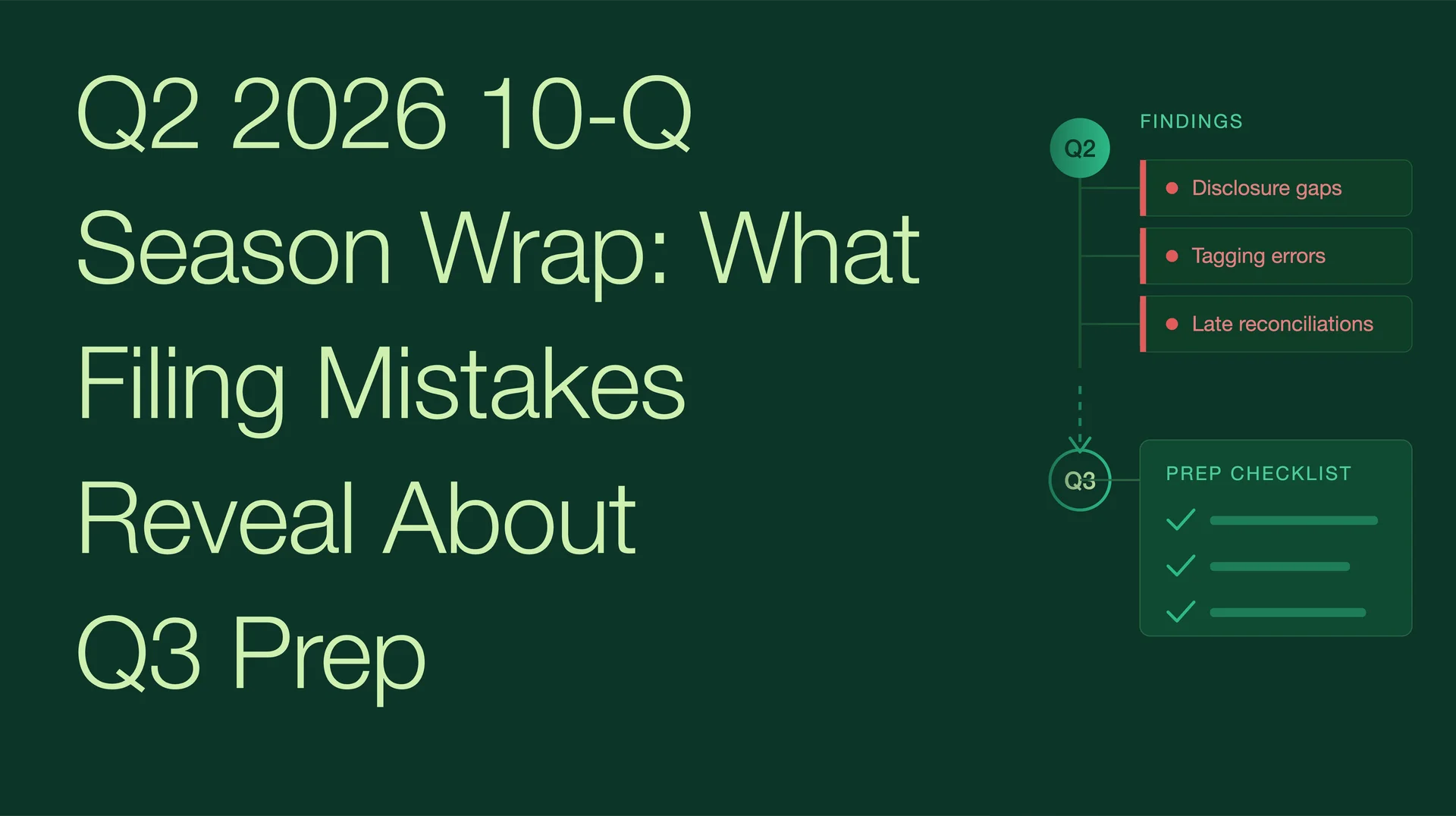
This post covers each of the six mistakes, what the SEC will look for, and what your team needs to do before Q3 close in 90 days.
What the Q2 2026 10-Q Season Looked Like: The Most Complex Filing Quarter in Recent Memory
Three structural features made Q2 2026 more complex than any recent comparable quarter.
New geopolitical material: the Iran war oil price cycle, the June 17 MOU ceasefire, the July 8 ceasefire collapse, the oil price spike to $75-78 per barrel WTI, and the Federal Reserve's rate hike repricing all occurred within the quarter or immediately after the balance sheet date. Companies with any material exposure to oil prices, logistics costs, interest rates, or Strait of Hormuz trade routes had to assess each development individually for ASC 450 contingency, ASC 855 subsequent event, Item 303 known trends, and Item 105 risk factor treatment. Many of those assessments were made under extreme time pressure in the final days before filing.
New statutory complexity: the OBBBA, effective January 1, 2026, created the first full half-year of ASC 740 provision work under a substantially new tax law. Section 174A, 100% bonus depreciation, Section 163(j) EBITDA restoration, NCTI, CAMT changes, and the expanded Section 162(m) aggregation each required separate provision memo analysis. Q2 was also the first quarter in which Code TT and Code TP W-2 amounts began generating visible nondeductible wage permanent differences in the ASC 740 provision for companies with large hourly and tipped workforces.
New SEC regulatory signals: SEC Chair Atkins's July 9 materiality speech told companies directly that non-material boilerplate must be removed. OCA confirmed at SEC Speaks 2026 that tariff costs must be separately quantified in MD&A. The comment letter trend data through March 31, 2026 confirmed that MD&A and non-GAAP comments increased more than 10% even as total comment volume declined.
The combination of these three structural features means the Q2 2026 review cycle will be among the most active in recent memory for substantive comment letters on disclosure content, not just tagging or formatting issues.
Common Mistake #1: Generic Tariff MD&A Language Without Quantification
The most common substantive MD&A deficiency in Q2 2026 filings is the same deficiency that has generated comments since tariff disclosures became a focus area in 2025: naming tariffs as a cost driver without separately quantifying the tariff contribution to the period-over-period change in each material affected line item.
The SEC comment letter pattern, confirmed from OCA statements at SEC Speaks 2026 and from the SEC comment letter trends blog in this cluster: the staff asks companies to revise MD&A to separately quantify the contribution of tariff costs to the period-over-period change in cost of goods sold or other affected metrics, separate from other cost drivers such as volume changes, labour costs, or foreign exchange.
The specific Q2 2026 language that will generate comments:
"Revenue decreased due to lower volume and continued tariff headwinds." Attribution without quantification.
"Cost of goods sold increased primarily due to tariff costs and elevated logistics expense." Multiple drivers without separate attribution.
"We continue to face uncertainty related to tariffs and trade policy." Risk factor language included in MD&A results of operations without any reference to actual tariff costs incurred.
The language that satisfies the comment letter standard: "Cost of goods sold increased $X million in Q2 2026 compared to Q2 2025. The increase was driven by approximately $Y million in Section 301 tariff costs on components sourced from [jurisdiction], approximately $Z million in higher logistics costs, and approximately $W million in other cost increases."
If your Q2 filing used the former structure and not the latter, the SEC comment letter on MD&A quantification is probable. The Q3 MD&A must use the quantified structure from the first draft.
Common Mistake #2: Iran War Risk Factors Copied From Q1 Without Updating for the July 8 Ceasefire Collapse
The July 8, 2026 ceasefire collapse is a subsequent event that occurred after the June 30 balance sheet date but before the August 11 filing date. Under ASC 855 and Item 303, material subsequent events that could affect investors' assessment of the company must be disclosed in the 10-Q.
The specific mistake: risk factors and MD&A sections that were drafted in early July, when the ceasefire was still in effect and Brent crude was at approximately $73 per barrel, and that were not updated to reflect the July 8 collapse, the oil price spike, the Treasury yield movement to 4.57%, and the CME FedWatch hike probability reaching 68.8%.
A risk factor filed today that says "the current ceasefire in the Iran conflict may not be sustained" is factually inaccurate if the ceasefire collapsed on July 8. A disclosure that describes the oil price environment as reflecting ceasefire-induced stability is similarly inaccurate for the period after July 8.
The SEC will look for consistency between the risk factor section, the MD&A discussion of current conditions, and any subsequent event footnote. A subsequent events footnote that correctly discloses the July 8 ceasefire collapse and oil price spike, combined with risk factors that still describe the Iran war as an uncertain future risk rather than a current operating fact, is an internal inconsistency that will generate an SEC comment.
The Q3 lesson: risk factor drafting should not begin from the prior quarter's template without a systematic review of every time-sensitive factual statement. Any risk factor that describes the probability or timing of a future event that has since occurred must be updated to reflect the current facts. For Q3 2026, the relevant events to check include: the current status of the Iran war and any further ceasefire developments, the Federal Reserve's actual rate decisions between August and September, and any changes in the tariff environment following the August IEEPA ruling.
Common Mistake #3: OBBBA Tax Provision Footnotes That Don't Separately Identify Each of the Six Changed Provisions
The OBBBA income tax provision is new for every company as of 2026. For most companies, Q2 2026 is the first time the OBBBA-adjusted provision has been reviewed by external auditors and, subsequently, by the SEC staff.
The specific disclosure deficiency: an ASC 740 footnote that discloses the effective tax rate and the rate reconciliation without separately identifying the OBBBA-specific reconciling items. A footnote that attributes a 3-percentage-point reduction in the effective tax rate to "changes in tax law" without identifying which OBBBA provisions drove the change does not satisfy the disclosure requirements of ASC 740-10-50.
The six OBBBA provisions that most commonly produce material reconciling items requiring separate disclosure:
Section 174A domestic R&E immediate expensing: if the company has material R&E costs that were previously capitalised under TCJA and are now immediately deducted, the rate reconciliation must show the impact.
100% bonus depreciation: the accelerated depreciation deduction produces a taxable income difference from book income that flows through the current period's DTA/DTL and affects the effective tax rate.
Section 163(j) EBITDA restoration: for companies with significant interest expense that was previously disallowed under the EBIT-based limitation, the EBITDA restoration reduces the disallowance and increases the current-year deduction.
NCTI replacing GILTI: companies with foreign operations must reflect the NCTI calculation rather than GILTI, which may produce a materially different rate impact than prior years.
CAMT: any company with adjusted financial statement income exceeding $1 billion that paid CAMT in 2026 must disclose the CAMT expense and the resulting minimum tax credit DTA.
Code TT and Code TP nondeductible wages: the permanent differences from nondeductible overtime and tip wages under Sections 225 and 224 must appear as separate reconciling items in the rate reconciliation if material.
If your Q2 rate reconciliation lumped these into a single "other" category or attributed them generically to "tax law changes," the SEC comment will ask for disaggregation. For Q3, each material OBBBA-specific reconciling item must be identified by name in the rate reconciliation table.
Common Mistake #4: Non-GAAP Metrics Without Equal or Greater Prominence for the Nearest GAAP Equivalent
Non-GAAP prominence violations remain the second-most-common SEC comment letter issue, per the PwC comment letter trends analysis through March 31, 2026. The Q2 2026 filing season introduced a specific new variant: companies whose Adjusted EBITDA (or similar non-GAAP metric) was far higher than GAAP net income due to OBBBA-related items being excluded from non-GAAP as non-recurring.
The OCA SEC Speaks 2026 statement is the relevant authority: tariff costs should not be excluded from non-GAAP measures as non-recurring items. CAMT expense, similarly, has been flagged by practitioners as a recurring item that should not be categorically excluded from non-GAAP. Companies that excluded these items from their non-GAAP reconciliation in Q2 will receive comment letters requesting either reinstatement or a substantive explanation of why the items qualify as non-recurring under the SEC's C&DI 100.01 standard.
The prominence violation that is most commonly missed: the earnings press release presents Adjusted EBITDA before GAAP net income, or presents it in a larger font or with greater visual emphasis. The 10-Q itself is less directly subject to the prominence rule (which primarily applies to earnings releases), but the press release prominence violation triggers the comment, and the comment references the 10-Q reconciliation.
For Q3: review the Q2 press release and 10-Q non-GAAP section for every instance where Adjusted EBITDA, adjusted EPS, or any other non-GAAP metric appeared before or with greater emphasis than GAAP net income. Build the Q3 press release template with GAAP net income as the first and largest financial metric, and confirm that each adjustment in the non-GAAP reconciliation has been reviewed against C&DI 100.01 for the non-recurring characterisation.
Common Mistake #5: ASU 2023-09 Rate Reconciliation Tables With Insufficient Quantitative Threshold Documentation
ASU 2023-09, Income Taxes: Improvements to Income Tax Disclosures, is effective for annual periods beginning after December 15, 2024, meaning it applies to calendar-year companies for the fiscal year ending December 31, 2025, with the Q2 2026 10-Q being the second interim period under the new standard.
The specific ASU 2023-09 disclosure change that most commonly generates questions: the new quantitative threshold requirement for the rate reconciliation table. Under ASU 2023-09, companies must now separately report each reconciling item that is equal to or greater than 5% of the amount computed by multiplying pretax income by the applicable statutory rate. Items below the 5% threshold may be aggregated into an "other" category, but the threshold must be applied and documented.
The most common Q2 2026 implementation error: companies that adopted ASU 2023-09 in their Q1 2026 filing applied the standard to their annual 2025 rate reconciliation but did not update their Q2 2026 interim rate reconciliation to apply the same quantitative threshold consistently. The Q2 interim reconciliation should apply the same disclosure standard as the annual reconciliation.
A specific Q2 2026 complication: the OBBBA created new reconciling items in Q2 2026 that were not present in Q1 2026 or in the prior year's rate reconciliation. The threshold calculation must be performed as of each reporting period on the items present in that period. A company that had no material CAMT expense in Q1 but has material CAMT expense in Q2 must assess whether the Q2 CAMT item crosses the 5% threshold and requires separate disclosure in the Q2 rate reconciliation.
For Q3: build the Q3 rate reconciliation threshold test into the provision model at the start of the quarter. Confirm that each OBBBA-specific item (Section 174A, 163(j), NCTI, CAMT, Code TT/TP permanent differences) is tracked separately in the provision model so the threshold test can be applied at Q3 close without retroactive reconstruction.
Common Mistake #6: iXBRL Tagging Deficiencies, Cybersecurity Tags and Cover Page Custom Elements
The two most common iXBRL tagging deficiencies in Q2 2026 filings, based on the SEC's deficiency notice pattern and the White and Case 2026 annual reporting guide:
Cybersecurity boolean element missing or wrong taxonomy. The CYD 2024 taxonomy requires the boolean element for material cybersecurity incident disclosure regardless of whether a material incident occurred. A value of false (no material incident in Q2) is a required tag. The most common error: the tag is omitted because no incident occurred, or the CYD 2023 taxonomy is used instead of CYD 2024. Both produce deficiency notices.
Cover page DEI tag inconsistencies. The Document and Entity Information block must reflect the current filing period's data. The EntityCommonStockSharesOutstanding element must reflect shares as of the filing date (August 11), not the quarter-end date (June 30). The DocumentFiscalPeriodFocus must say Q2. If the filing template was built from a Q1 submission without updating these elements, the DEI tags are factually incorrect.
For companies that received EDGAR deficiency notices on Q2 filings: the deficiency must be corrected through an amendment (10-Q/A) filing. The SEC's deficiency notice process for iXBRL errors is separate from the comment letter process and is handled by the EDGAR Office of Filings and Information Services. The correction timeline for a deficiency notice is typically 10 business days.
For Q3 preparation: add a dedicated final-mechanics review step to the Q3 close calendar. The mechanics review should be a separate agenda item from the disclosure committee's content review, assigned to the filing team rather than to disclosure counsel, and scheduled for the day before the Q3 filing date (November 10, 2026 for large accelerated filers). The iXBRL validation against the EDGAR viewer at efts.sec.gov is the only validation that confirms what investors will actually see when they access the filing on SEC.gov.
What SEC Corp Finance Will Focus On When It Reviews Q2 Filings in August and September
The SEC's Division of Corporation Finance typically completes initial review within 30 to 60 days of filing. For the Q2 2026 filings submitted today, initial comment letters will arrive in September and October 2026.
Three specific content areas are most likely to generate SEC comment activity in the Q2 2026 review cycle, based on the documented comment letter trends through March 31, 2026 and the specific new disclosure obligations of Q2 2026.
Tariff quantification and Iran war subsequent events. The SEC has documented that tariff disclosures were an emerging focus area in 2025 comment letters, and OCA confirmed at SEC Speaks 2026 that generic tariff language without quantification is inadequate. The Iran war subsequent event is the first major geopolitical event that occurred between the balance sheet date and the filing date in a filing cycle where the SEC staff has specifically flagged geopolitical known trends as a comment target.
OBBBA income tax provision disaggregation. The Q2 2026 provision is the first full half-year of OBBBA-adjusted provision for calendar-year filers. The SEC staff will examine rate reconciliation tables for adequate identification of OBBBA-specific items, and will be particularly attentive to companies where the effective tax rate changed materially from prior year without clear explanation.
Non-GAAP exclusion of tariff and OBBBA-related items. The OCA's non-recurring item guidance from SEC Speaks 2026 will be applied to Q2 filings that excluded tariff costs, CAMT expense, or other recurring OBBBA-related items from non-GAAP measures.
For IR and legal teams preparing response capacity: SEC comment letter response windows are typically 10 business days from receipt of the letter. The responses to Q2 2026 comment letters will be due in October and November 2026, overlapping with the Q3 2026 close and filing preparation. Building comment letter response capacity into the Q3 calendar, rather than treating it as an unexpected interruption, is the lesson that every team that received a Q2 comment letter should carry forward.
What Must Change in Your Q3 2026 Close Process Before September 30
Q3 close begins in approximately 50 days. The following six changes to the close process address the six mistakes directly.
For tariff quantification: build a tariff cost attribution table into the Q3 close deliverables. The table should track tariff costs by affected line item (cost of goods sold, logistics cost, capex where applicable), by tariff type (Section 301, Section 232, IEEPA), and by jurisdiction. This table is the source data for the MD&A quantification and must be ready at close rather than assembled retroactively during MD&A drafting.
For geopolitical risk factors: schedule a standing geopolitical event review meeting for the final week of Q3 (the week of September 29) to confirm that every time-sensitive factual statement in the risk factors and MD&A reflects conditions as of the final review date, not as of when the sections were first drafted.
For OBBBA provision disaggregation: require the Q3 provision model to track each of the six OBBBA-specific items separately from general deferred tax movements. The model must be able to produce, at close, the dollar amount of each item and whether it crosses the ASU 2023-09 5% threshold for separate disclosure.
For non-GAAP reconciliation: in the Q3 press release template, place GAAP net income as the first metric in the financial highlights. Review each non-GAAP adjustment against C&DI 100.01 before finalising the reconciliation. Confirm with external counsel that no recurring item (including tariff costs, CAMT expense, and Code TT and Code TP permanent differences) is characterised as non-recurring.
For ASU 2023-09: confirm the Q3 rate reconciliation applies the same 5% threshold test as the annual 2025 rate reconciliation. If Q3 OBBBA items cross the threshold for the first time in Q3 (because of catch-up adjustments or new provisions), confirm those items are separately named in the rate reconciliation.
For iXBRL mechanics: schedule the EDGAR viewer validation as a separate checklist step in the final mechanics review, two days before the Q3 filing date. Include the cybersecurity boolean element check and the DEI cover page tag review as named items on the mechanics checklist.
Frequently Asked Questions
When is the Q2 2026 10-Q deadline for large accelerated filers?
Today, August 11, 2026. Non-accelerated filers have until August 14. Filings submitted after midnight Eastern Time on August 11 receive an August 12 filing date and are technically late, subject to Form 12b-25 extension protocol if filed before midnight.
What are the most common SEC comment letter topics in Q2 2026?
Based on the documented comment letter trend data through March 31, 2026 and the specific new obligations of Q2 2026: MD&A tariff quantification, Iran war subsequent event disclosure, OBBBA provision disaggregation in the rate reconciliation, non-GAAP prominence and non-recurring characterisation, ASU 2023-09 rate reconciliation threshold application, and iXBRL cybersecurity and cover page tagging.
Does the SEC issue comment letters about tariff disclosures?
Yes. OCA confirmed at SEC Speaks 2026 that tariff costs must be separately quantified in MD&A and should not be excluded from non-GAAP measures as non-recurring items. The Deloitte and White and Case 2026 reporting guides also confirmed tariff disclosures as an emerging comment focus area. The most common comment requests that companies quantify the specific dollar contribution of tariff costs to each affected MD&A line item.
How long does a company have to respond to an SEC comment letter?
The SEC typically allows 10 business days from the date of the comment letter to respond. Extensions may be requested and are often granted for a single extension period. Companies that cannot provide a substantive response within the initial period should request an extension before the response deadline.
When is the Q3 2026 10-Q deadline for large accelerated filers?
November 10, 2026 for large accelerated filers. Non-accelerated filers have November 14. Q3 close begins September 30, giving teams approximately 40 days from quarter-end to file.
What is ASU 2023-09 and why does it affect Q2 10-Q disclosures?
ASU 2023-09, Income Taxes: Improvements to Income Tax Disclosures, requires enhanced rate reconciliation disclosures for annual periods beginning after December 15, 2024. For calendar-year companies, it first applied to the December 31, 2025 annual report and continues to apply to all interim periods in 2026. The key new requirement is a quantitative threshold test for separately identifying rate reconciliation items equal to or greater than 5% of pretax income times the applicable statutory rate.
Key Takeaways
- The Q2 2026 10-Q filing season was the most complex in recent memory: simultaneous new disclosure obligations from the Iran war, OBBBA first full half-year, tariff quantification standards, Code TT and TP nondeductibility, Atkins materiality speech, and ASU 2023-09 implementation.
- The six most common Q2 2026 mistakes that will generate SEC comment letters: generic tariff MD&A language without quantification, stale Iran war risk factors not updated for the July 8 ceasefire collapse, OBBBA rate reconciliation items not separately identified, non-GAAP prominence violations or incorrect non-recurring characterisation, ASU 2023-09 threshold test not applied to Q2 interim rate reconciliation, and iXBRL cybersecurity boolean and DEI cover page tag deficiencies.
- SEC Corp Finance comment letters on Q2 2026 filings will arrive in September and October 2026, overlapping with Q3 close. Building comment letter response capacity into the Q3 calendar now prevents that overlap from becoming a crisis.
- Q3 close begins September 30, 2026. The Q3 filing deadline for large accelerated filers is November 10. Six process changes that directly address the six Q2 mistakes: tariff attribution table at close, geopolitical risk factor review in the final close week, OBBBA-specific provision tracking, GAAP-first non-GAAP press release template, ASU 2023-09 threshold test in the provision model, and dedicated EDGAR viewer mechanics validation two days before filing.
- The OCA guidance from SEC Speaks 2026, the comment letter trends through March 2026, and the specific new Q2 2026 disclosure obligations together point to a more active Q2 review cycle than in recent prior years. Companies that addressed the six areas in their Q2 filings are well-positioned. Companies that did not have 90 days to fix the Q3 version.