
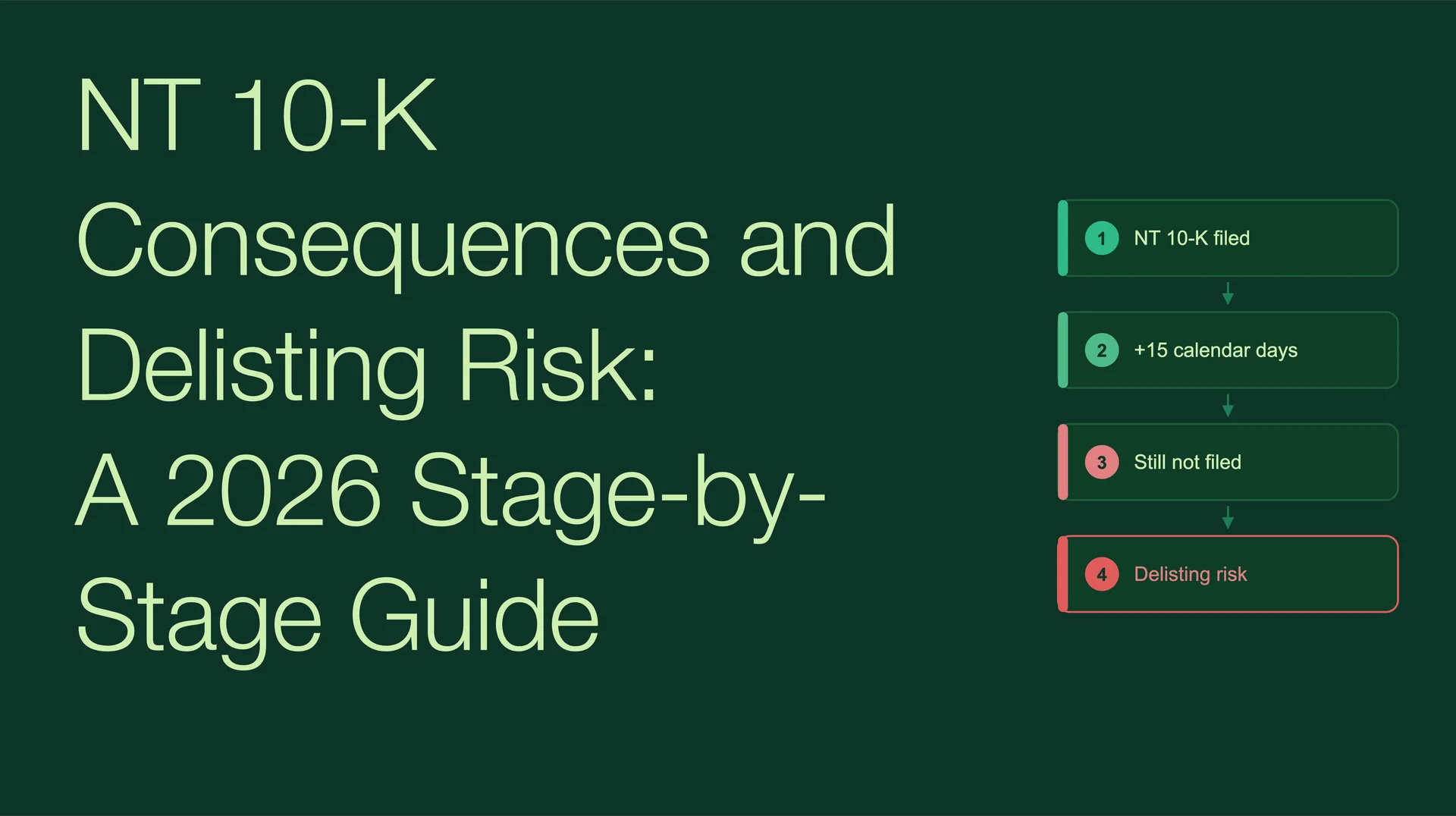
NT 10-K Consequences and Delisting Risk: A 2026 Stage-by-Stage Guide
If your company just filed an NT 10-K, or is deciding whether to, the next 15 days will define your exposure across four simultaneous fronts: SEC compliance, stock exchange listing standards, capital markets access, and debt covenants. Most guidance collapses these into a vague warning about "delisting risk." This guide separates them precisely, stage by stage, and flags which filer profiles face the sharpest consequences at each step.
Key takeaway: Filing an NT 10-K on time buys 15 calendar days and avoids SEC penalties, but it does not insulate you from exchange deficiency notices, S-3 lockout, or covenant defaults, all of which operate under independent rules.
What Is an NT 10-K and How Does Rule 12b-25 Work?
An NT 10-K is a formal notification, filed on Form 12b-25, that your company cannot file its annual report on time. Filing it no later than one business day after the original 10-K due date triggers an automatic 15-calendar-day grace period. No SEC approval is required. The extension is self-executing.
The form requires three disclosures:
- The specific reason the filing could not be made on time.
- Whether the company expects to file within the grace period.
- Whether any significant change in results of operations is anticipated.
One critical caveat appears on the face of every NT 10-K: "Nothing in this form shall be construed to imply that the Commission has verified any information contained herein." The SEC is not endorsing your stated reason or your assertion that you will file on time.
Also worth noting: you cannot file a second NT 10-K to extend the grace period further. The 15-day window is a one-time, automatic grant under Rule 12b-25. If you cannot file within 15 days, the 10-K is late, full stop.
The Three Phases of NT 10-K Consequences
The consequence profile has three distinct phases. Where you land determines how many fires you are fighting simultaneously.
| Phase | Trigger | SEC Status | Exchange Status | Capital Markets | Debt Risk |
|---|---|---|---|---|---|
| Phase 1: Within grace period | NT 10-K filed on time; 10-K filed within 15 days | Compliant | No deficiency notice | S-3 use: conditional | Low (review covenants) |
| Phase 2: Grace period missed | 10-K not filed by Day 15 | Delinquent | Deficiency notice issued | S-3 blocked for 12 months | Elevated (covenant default possible) |
| Phase 3: Prolonged non-filing | 10-K still missing after exchange cure period | Enforcement risk | Delisting proceedings | All public offerings blocked | High (acceleration risk) |
Phase 1: Inside the Grace Period (Days 1-15)
If you file the NT 10-K by Day 1 and the actual 10-K by Day 15, the SEC treats the annual report as timely filed. No SEC-imposed penalty applies.
But "SEC-compliant" is not the same as "consequence-free." Three risks remain live even inside the grace period:
- Exchange listing standards operate independently. Nasdaq Rule 5250(c)(1) and NYSE Section 802.01E both require timely periodic filings. The exchanges watch EDGAR in real time and may issue informal inquiries even during the grace period, particularly for repeat late filers.
- S-3 shelf eligibility is conditional. SEC staff guidance (C&DI 135.06) allows continued use of an existing Form S-3 during the grace period only if the company has no disclosure concerns and the prospectus meets Section 10(a)(3) currency requirements. For companies running active ATM programs, this requires an immediate legal review, not an assumption of continuity.
- Debt covenants may already be tripped. Credit agreements and bond indentures frequently contain affirmative covenants requiring delivery of financial statements within specified periods and ongoing compliance with SEC reporting obligations. Depending on exact contract language, even a filing within the grace period can technically constitute a breach. Review your credit agreement the day you decide to file the NT 10-K, not after.
Phase 2: Grace Period Missed (Day 16 Onward)
This is where the consequence cascade begins in earnest. According to research on 2,115 first-time late filers, 25% of NT 10-K filers miss the 15-day grace period, meaning one in four companies that file an NT 10-K ends up here.
Exchange deficiency notices are issued. The timing and cure mechanics differ by exchange:
| Exchange | Deficiency Notice | Cure Period | Public Disclosure Required? |
|---|---|---|---|
| Nasdaq | Issued promptly after grace period expires under Rule 5250(c)(1) | Up to 180 days total from original filing deadline | Yes, Nasdaq requires public disclosure of the notice |
| NYSE | Public announcement of non-compliance under Section 802.01E | Up to 12 months from filing deadline (discretionary) | Yes, NYSE announces publicly |
| NYSE American | Similar to NYSE but cure timelines can be shorter for smaller issuers | Discretionary, generally faster than main NYSE | Yes |
The Nasdaq deficiency notice disclosure creates a second negative market event layered on top of the original NT 10-K filing. Two public announcements of non-compliance, within days of each other, compound the reputational damage significantly.
S-3 shelf eligibility is lost. A company that has not filed all required SEC reports for the prior 12 months cannot use Form S-3. Missing the grace period immediately disqualifies you from the short-form registration statement. That means:
- Existing shelf registrations cannot be used for new takedowns.
- ATM programs relying on S-3 must be suspended.
- Planned follow-on equity raises are blocked.
- WKSI (Well-Known Seasoned Issuer) status, which enables automatic shelf registration, is forfeited. Regaining WKSI status requires 12 months of timely filings after the delinquency is cured, a significant capital markets setback for high-growth issuers.
For growth-stage companies with active equity programs, the S-3 lockout is often more immediately painful than the delisting risk, which has a longer cure timeline. Yet it is almost never discussed in standard NT 10-K guidance.
Debt covenant default risk escalates. Once the filing is formally late, lenders have clearer grounds to issue a default notice under reporting covenants. Acceleration of debt becomes a live risk. If you have undrawn capacity on a revolving credit facility, consider whether drawing it before a potential default notice is the right move, and get outside counsel's view quickly.
Phase 3: Prolonged Non-Filing and SEC Enforcement
If the annual report remains unfiled beyond the exchange cure period, delisting proceedings begin. The Form 25 triggers the delisting, which becomes effective 10 days after filing under Nasdaq Listing Rule 5810(b).
Simultaneously, the SEC's Division of Corporation Finance pursues delinquent filers under Exchange Act Section 13(a) and Rule 13a-1. The SEC can:
- Place the company on its public Delinquent Filer list.
- Bring civil enforcement actions and seek injunctions.
- Administratively revoke the company's registration under Exchange Act Section 12(j).
- In egregious cases, refer matters for criminal prosecution.
All public securities offerings are blocked. Rule 144 resales and Form S-8 (employee stock plans) are also affected. The company is effectively locked out of every capital markets mechanism that requires current SEC reporting.
How the Market Reacts: What CFOs and IR Teams Need to Know
Even a "clean" NT 10-K filed within the grace period causes a statistically significant stock price drop. Research on 2,115 first-time late filers documents an average stock price decline of 1.96% on the NT 10-K filing date, even among the 86% of companies that declared they would file within the grace period.
The market does not take management's word for it. As the researchers note, "investors are able to see through management assertions that turn out to be false" regarding filing within the grace period, which explains why even companies that ultimately comply still see negative reactions on the NT filing date.
The reason cited for the delay matters enormously:
| Reason for Delay | Average Total Delay | Market Reaction |
|---|---|---|
| Accounting problems | 41 days | Significantly more negative |
| Corporate events (e.g., turnover) | 13 days | Less severe |
| Uncertain or other reasons | 11 days | Less severe |
Accounting-related delays signal deeper financial reporting risk. A delay attributed to audit complexity from a revenue surge (as Marathon Digital Holdings cited in March 2022, where revenue grew 3,353% from $4.4 million to $150.5 million) reads very differently to the market than a delay attributed to "accounting staff needing additional time" with no further explanation.
NT 10-K filings appear on EDGAR in real time. There is no quiet way to file one. Financial data services and news wires pick it up within minutes.
How the Risk Profile Differs by Filer Type
The assigned angle here matters: the consequence cascade hits different company profiles at different points and with different severity.
Large Accelerated Filers
These companies have a 60-day filing window, the tightest deadline. A transition to large accelerated filer status, as Marathon Digital experienced, can itself be a driver of NT 10-K filings when companies do not adjust their close calendar in advance. The 30-day shortening of the deadline is a real operational shock. Large accelerated filers also typically have active S-3 shelf programs and ATM facilities, so the capital markets lockout in Phase 2 is acutely painful.
Growth-Stage Companies with Active Equity Programs
For companies relying on at-the-market offerings or planned follow-on raises, the S-3 lockout in Phase 2 is the most immediate financial consequence, often more pressing than the delisting timeline. If a capital raise was planned within the next 90 days, the NT 10-K filing date is the moment to pause that program and assess whether the grace period will be met.
Smaller Reporting Companies and NYSE American Issuers
Smaller companies listed on NYSE American face potentially faster delisting timelines than main NYSE issuers. The cure period is shorter and more discretionary. Smaller reporting companies also tend to have thinner audit resources, making accounting-related delays more common and the 41-day average total delay more likely to apply.
Companies with Leveraged Capital Structures
For companies with significant debt, the covenant angle is the first call to make. Credit agreements vary widely in how they define a reporting default and whether they include grace periods or cure rights. Some agreements require lender consent to waive a reporting covenant breach; others trigger cross-default provisions that accelerate other debt. The NT 10-K filing date is the moment to pull the credit agreement and read the reporting covenants, not the moment to assume the lender will not notice.
What to Do in the First 48 Hours After Filing an NT 10-K
- Pull your credit agreement. Read the reporting covenants and any cross-default provisions. Determine whether the NT 10-K filing itself, or only a missed grace period, constitutes a breach.
- Assess your S-3 and ATM status. If you have an active shelf or ATM program, get securities counsel's view on whether you can continue using it during the grace period under C&DI 135.06.
- Prepare your investor communication. The NT 10-K is already on EDGAR. Investors, analysts, and short sellers are reading it. A proactive communication, explaining the specific operational reason for the delay and the expected filing date, is better than silence. The reason you cite in the NT 10-K sets the market's interpretive frame.
- Convene the audit committee. The audit committee should be briefed immediately. If the delay involves accounting complexity or a potential restatement, outside counsel should be engaged before any public communication to assess Regulation FD obligations. If the reason for delay involves material non-public information, the company faces simultaneous NT 10-K and Reg FD considerations.
- Set a hard internal deadline. The 15-day grace period is not a target, it is a ceiling. Build in buffer. Every day past Day 10 that the 10-K is not filed increases the probability of missing the grace period and triggering Phase 2.
- Do not assume a second extension is available. It is not. Rule 12b-25 provides one automatic extension. There is no mechanism for a second NT 10-K on the same period.
NT 10-K vs. NT 10-Q: Key Differences
The grace period mechanics and miss rates differ materially between annual and quarterly filings:
| Feature | NT 10-K | NT 10-Q |
|---|---|---|
| Grace period | 15 calendar days | 5 calendar days |
| Miss rate (grace period) | 25% of filers | 51% of filers |
| Average stock price reaction | -1.96% | -2.93% |
| Audit requirement | Audited statements | Unaudited (reviewed) |
The shorter grace period for quarterly filings explains the higher miss rate. But the NT 10-K miss rate of 25% is not trivial. One in four companies that files an NT 10-K ends up in Phase 2. For context on how the SEC views periodic reporting obligations more broadly, see our complete guide to SEC Forms 10-K, 10-Q, and 8-K.
For the mechanics of actually completing and submitting the Form 12b-25, see our step-by-step guide to filing Form 12b-25.
FAQ
Does filing an NT 10-K automatically trigger a Nasdaq or NYSE deficiency notice? No, not automatically during the grace period. The deficiency notice is triggered if the company fails to file the actual 10-K within the 15-day grace period. However, exchanges monitor EDGAR and may make informal inquiries, particularly for repeat late filers.
Can we still use our S-3 shelf registration after filing an NT 10-K? Conditionally, during the grace period only. SEC staff guidance (C&DI 135.06) permits continued use of an existing S-3 if the company has no disclosure concerns and the prospectus meets Section 10(a)(3) currency requirements. Once the grace period is missed, S-3 eligibility is lost until 12 months of timely filings are re-established.
Will our lenders declare a default if we file an NT 10-K? It depends on your credit agreement's exact language. Some reporting covenants are tripped by any failure to deliver financial statements within specified periods; others track the SEC's grace period. Pull the agreement immediately and get counsel's view before assuming you are safe.
How long does Nasdaq give us to cure a late filing deficiency? Up to 180 days total from the original filing deadline under Nasdaq Listing Rule 5250(c)(1). The company must submit a compliance plan, and Nasdaq staff reviews it. If the plan is not accepted or the 10-K is not filed within the cure period, delisting proceedings begin.
What reasons for delay are viewed most negatively by the market? Accounting problems. When accounting reasons are cited, the average total delay is 41 days, more than three times longer than operational or transitional delays, and the market reaction is significantly more negative because accounting delays signal deeper financial reporting risk.
Can the SEC take enforcement action just because we filed an NT 10-K? Not for the NT 10-K filing itself, provided the actual 10-K is filed within the grace period. Enforcement risk arises when the 10-K remains unfiled beyond the grace period, at which point the SEC's Division of Corporation Finance can pursue delinquent filer actions under Exchange Act Section 13(a) and, in serious cases, seek to revoke registration under Section 12(j).