Newly Public Company XBRL Obligations: 2026 Compliance Timeline
Your S-1 closes, the stock starts trading, and your IPO counsel moves on to the next deal. What they often don't leave behind is a clear answer to this question: when exactly does your Inline XBRL obligation begin, what must you tag, and what happens if you miss it?
This guide maps the full XBRL compliance timeline to the IPO lifecycle, covers the expanding universe of non-financial disclosures now requiring tags, and explains the downstream consequences that make this more than a technical footnote.
Key takeaway: The S-1 itself is exempt from XBRL. Your clock starts with your first Form 10-Q after the IPO, and the phase-in is complete, meaning every newly public company, regardless of size, must comply from day one.
Does the S-1 or F-1 IPO Registration Statement Require XBRL?
No, the IPO registration statement is explicitly exempt from the XBRL interactive data requirement. SEC Release No. 33-9002, which established mandatory XBRL in 2009, carved out IPO registration statements as a deliberate concession to newly public companies.
The exemption has a precise boundary, though. Once a price or price range has been determined and the financial statements are changed in a subsequent S-1 amendment, the interactive data exhibit is required for those amended financial statements. Pre-pricing amendments are exempt; the final post-pricing amendment is not.
For foreign private issuers, the same logic applies: an F-1 for an FPI that is not currently an SEC reporting company is exempt, but subsequent filings after the first annual report on Form 20-F or 40-F are not.
When Does the First XBRL Obligation Arise After the IPO?
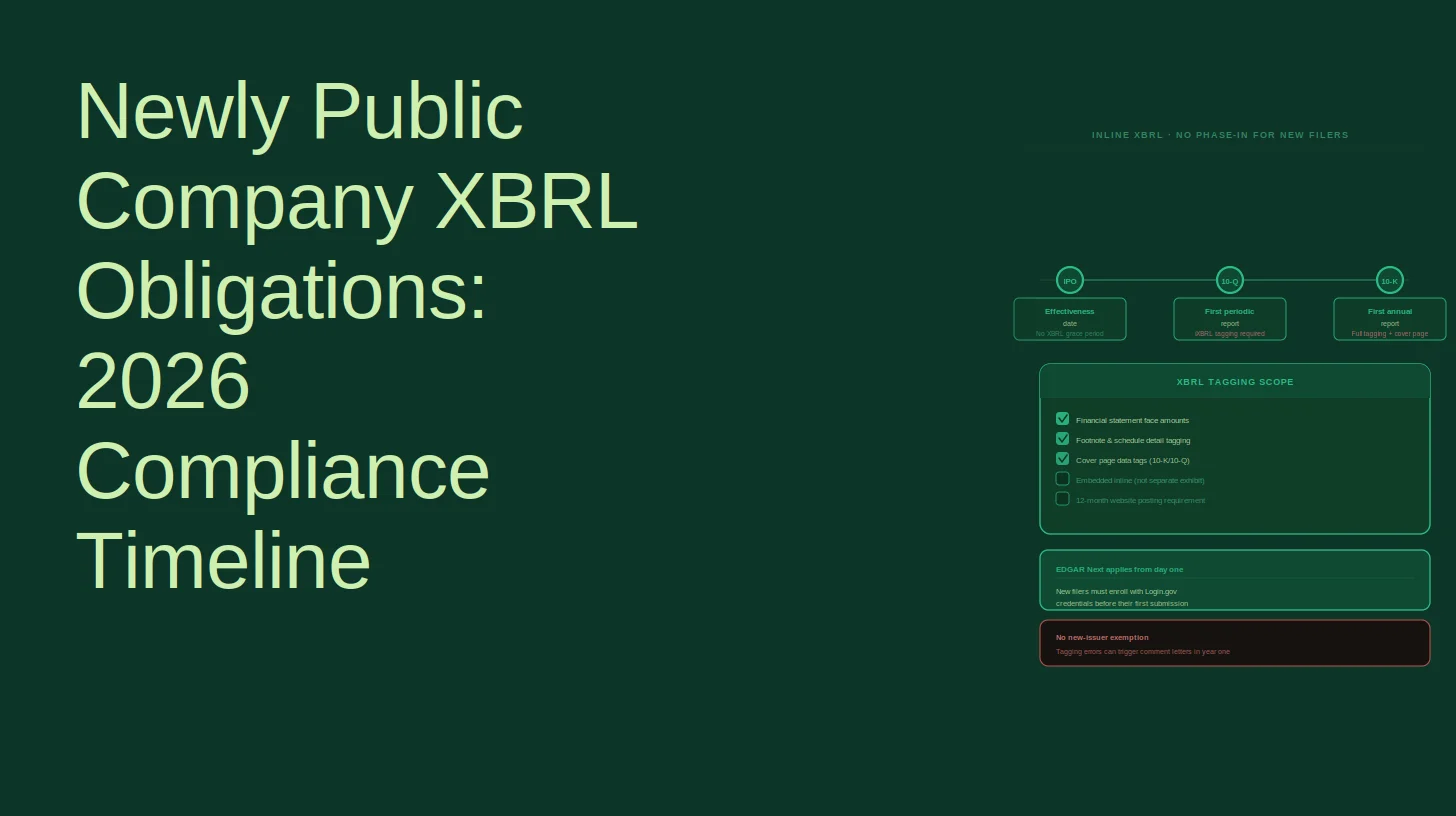
For domestic filers, the trigger is the first Form 10-Q filed for a fiscal period ending on or after the applicable compliance date. Not the first 8-K. Not the first S-1 amendment. The first quarterly report.
The 2018 Inline XBRL amendments (Release No. 33-10514) completed their phase-in on June 15, 2021. Every operating company, including smaller reporting companies and non-accelerated filers, has been fully subject to Inline XBRL since that date. There is no grace period for new entrants.
The practical implication: a company that prices its IPO in, say, Q1 2026 and has a March 31 fiscal quarter end must file its first Form 10-Q with full Inline XBRL tagging. There is no ramp-up period.
The XBRL Compliance Timeline Mapped to the IPO Lifecycle
StageFilingXBRL Required?What to TagPre-IPOS-1 / F-1 (pre-pricing amendments)NoN/APricingS-1 / F-1 post-pricing amendmentYes, for financial statements included directlyFinancial statements in the documentPost-IPO, first quarterForm 10-QYes, full Inline XBRLCover page, financial statements, footnotes (block text in first year historically, but detail-level now required)Post-IPO, first annual reportForm 10-KYes, full Inline XBRLCover page, financial statements, footnotes at detail level, auditor informationFirst proxy seasonProxy / annual reportYes, for specific disclosuresPay-versus-performance, insider trading policies, option grant practicesFirst annual report with cybersecurity disclosuresForm 10-KYes, after one-year phase-inItem 106 cybersecurity risk management and governance disclosures
For foreign private issuers, the equivalent trigger is the first annual report on Form 20-F or Form 40-F. Certain revised financial statements in a Form 6-K must also be filed in Inline XBRL if the FPI has an effective Form F-3 shelf registration statement.
What Is Inline XBRL, and How Is It Different From the Old Model?
Inline XBRL embeds machine-readable tags directly into the HTML filing document, producing a single file that is both human-readable and machine-readable. Before the 2018 amendments, filers submitted a separate XBRL exhibit alongside the main HTML document. That separate-exhibit model is gone.
The practical benefit for filers is reduced risk of inconsistency between the narrative filing and the XBRL data, since they now live in the same document. For investors and data users, clicking on any tagged data point in the EDGAR Inline XBRL Viewer surfaces the underlying accounting guidance, narrative definitions, and reporting period information without any specialized software.
One housekeeping point worth flagging: the 2018 amendments also eliminated the requirement for operating companies to post XBRL data on their corporate websites, effective September 17, 2018. If your IR team is still maintaining a separate XBRL data page, you can stop.
What Must Be Tagged in the First 10-Q vs. the First 10-K?
The scope of required tagging differs between the first quarterly and first annual report.
Form 10-Q (first post-IPO quarterly report):
- Cover page information
- Financial statements (balance sheet, income statement, cash flow, equity)
- Footnotes and schedules
Form 10-K (first post-IPO annual report):
- Everything required in the 10-Q, plus
- Auditor information
- Detail-level quantitative tagging within footnotes and schedules
That last point deserves emphasis. In the early years of XBRL (2009 to 2011), filers were permitted to tag footnotes as a block of text in their first year, then move to detail-level tagging in year two. That transition is long complete. Every newly public company must comply with detail-level footnote tagging from its first 10-K. Controllers who have heard that "footnotes are just block text" are working from outdated information.
For the taxonomy, domestic filers use the FASB US GAAP Financial Reporting Taxonomy, which FASB updates annually to reflect new and amended accounting standards. You must use the most current version applicable to your filing period. FPIs using IFRS as issued by the IASB are subject to the same Inline XBRL requirements and use the IFRS taxonomy.
The Creeping Expansion: Non-Financial Disclosures That Now Require XBRL Tags
This is where most IPO checklists go silent, and where newly public companies get surprised in their first proxy season.
As TheCorporateCounsel.net observed, the SEC has adopted a "drip, drip" approach to expanding Inline XBRL: adding tagging mandates through individual rulemakings rather than requiring it for all disclosures at once. The result is a growing list of non-financial disclosure tagging obligations that sit outside the core financial-statement rules.
As of 2026, the following non-financial disclosures require Inline XBRL tagging:
- Insider trading policies and procedures (Item 408(b) of Regulation S-K)
- Option grant practices (Item 402(x) of Regulation S-K)
- Pay-versus-performance disclosures (Item 402(v) of Regulation S-K), including for smaller reporting companies as of 2025
- Cybersecurity disclosures (Item 106 of Regulation S-K), after a one-year phase-in from the rule's effective date
A newly public company that completes its IPO in 2026 will encounter the pay-versus-performance and insider trading policy tagging requirements in its first proxy statement or annual report. The cybersecurity tagging requirement applies to Item 106 disclosures in the 10-K, covering both material incident disclosures and annual risk management and governance narratives.
The legal authorities for these requirements are codified in Item 601(b)(101) of Regulation S-K, Forms 20-F, 40-F, and 6-K under the Exchange Act, Rule 405 of Regulation S-T, and the EDGAR Filer Manual. Non-compliance with the EDGAR Filer Manual is itself a legal violation under Regulation S-T, not just a technical deficiency.
What Happens If You Miss the XBRL Filing Deadline?
A missing or late XBRL exhibit has immediate and serious consequences for your capital markets access.
As TheCorporateCounsel.net states directly: "If a company does not file interactive data exhibits on a timely basis, the company will be deemed to not be current with its Exchange Act reports for purposes of eligibility for Form S-3, Form S-8 and other forms, and will be deemed not to have available current public information for purposes of Rule 144."
For a newly public company, that means:
- Form S-3 shelf registration becomes unavailable, blocking follow-on equity offerings and ATM programs until the deficiency is cured
- Form S-8 becomes unavailable, preventing you from registering shares for employee equity compensation plans
- Rule 144 "current public information" status is lost, which affects resales by selling shareholders and insiders who relied on that status
The cure is straightforward: file an amendment that includes the required interactive data files. But the damage to a follow-on offering timeline or an insider's planned sale can be real. The better answer is to build XBRL review time into the post-IPO reporting calendar before the first 10-Q deadline, not after.
Custom Extensions: When to Use Them and When to Avoid Them
Use standard taxonomy elements wherever possible. Extensions attract SEC comment letters and reduce the comparability of your data.
XBRL tagging works by selecting the appropriate element from the FASB US GAAP Financial Reporting Taxonomy for each financial statement line item. When a company uses a non-standard line item with no matching taxonomy element, it may create a company-specific "extension" element.
Extensions are legitimate and sometimes necessary. The problem is overuse. Excessive extensions are one of the primary error categories flagged in the SEC's September 2023 Sample Letter to Companies Regarding Their XBRL Disclosures, which is the current staff benchmark for tagging quality. That letter is required reading before your first 10-Q filing.
The practical discipline: before creating an extension, verify that no standard element in the current taxonomy covers the concept. If one exists but the label doesn't perfectly match your line item description, you can use the standard element and customize the label. Reserve extensions for genuinely novel line items.
How to Determine Your Filer Status for XBRL Purposes
The three-tier phase-in (large accelerated filers by June 2019, accelerated filers by June 2020, all others by June 2021) is now complete. Every operating company is subject to the same Inline XBRL requirement. So does filer status still matter for XBRL?
Yes, but indirectly. Filer status affects the complexity and scrutiny of your XBRL review, not the requirement itself.
- A large accelerated filer (public float of $700 million or more as of the last business day of its most recently completed second fiscal quarter) typically has more complex financial statements, more footnote disclosures, and more taxonomy elements to map. The review burden is higher.
- A non-accelerated filer (public float below $75 million, or a newly public company in its first year) has a lighter taxonomy footprint but faces the same legal obligation.
For a newly public company, filer status determination is complicated by the fact that you may not know your float until after the IPO. The SEC's filer status rules use the float as of the last business day of the most recently completed second fiscal quarter. A company that IPOs in Q1 will not have a second-quarter float measurement until after the IPO, which means it enters as a non-accelerated filer by default for its first reporting period. If you want to understand the full filer status framework and what it means for your reporting obligations beyond XBRL, the SEC's 2026 filer status overhaul is worth reviewing alongside this guide.
For a broader look at how EGC, SRC, and non-accelerated filer status interact at the IPO stage, see Micro-Cap, SRC, EGC, NAF: The Four Words Every Pre-IPO CFO Confuses.
Build vs. Buy: Structuring Your XBRL Process
Most newly public companies outsource XBRL tagging entirely to a filing agent or XBRL vendor. That is a reasonable starting point, but it does not transfer legal responsibility. Management retains full accountability for the accuracy of the interactive data filed with the SEC.
A workable post-IPO XBRL governance structure looks like this:
- Assign internal ownership. The SEC Reporting Manager or Controller should own the XBRL process, not outside counsel or the printer. Legal can advise on scope; finance must verify accuracy.
- Select a vendor before the first 10-Q deadline. Filing agents (Donnelley Financial Solutions, Workiva, Toppan Merrill) and standalone XBRL tools all support Inline XBRL. Evaluate based on taxonomy update speed, error-checking capability, and integration with your filing workflow.
- Use the EDGAR Renderer/Previewer. The SEC provides a free EDGAR Renderer/Previewer tool that displays how your XBRL submission will appear on the SEC's website and flags errors and warnings before you file. Run every filing through it.
- Review the September 2023 SEC Sample Letter. The SEC's sample comment letter on XBRL disclosures identifies the most common tagging deficiencies. Use it as a pre-filing checklist.
- Build in review time. The first 10-Q XBRL review typically takes longer than expected. Build at least two to three business days of XBRL-specific review into your close calendar before the filing deadline.
For a deeper look at the specific tagging errors that draw SEC comment letters, see XBRL Tagging Errors That Trigger SEC Review.
FAQ
When did the SEC start requiring XBRL?The original mandatory XBRL rules were adopted in Release No. 33-9002, effective April 13, 2009, with a three-year phase-in by filer size. The current Inline XBRL format replaced the separate-exhibit model under Release No. 33-10514, adopted June 28, 2018, with phase-in completed June 15, 2021.
Is XBRL once applicable, always applicable?Yes. Once a company becomes subject to the Inline XBRL requirement, it remains subject to it for all subsequent periodic reports. There is no mechanism to exit the requirement short of deregistering from SEC reporting obligations. Filer status changes (for example, moving from non-accelerated to accelerated filer) do not change the XBRL obligation itself, though they affect the complexity of the taxonomy mapping required.
Does a newly public company need to post XBRL data on its corporate website?No. The 2018 Inline XBRL amendments eliminated the website-posting requirement for operating companies, effective September 17, 2018. You do not need to maintain a separate XBRL data page on your investor relations website.
Do foreign private issuers face the same XBRL obligations?Yes, with parallel form requirements. FPIs must file cover page and financial statement information (including footnotes, schedules, and auditor information) in Inline XBRL in annual reports on Form 20-F and Form 40-F, and in certain non-IPO registration statements. Certain revised financial statements in a Form 6-K must also be filed in Inline XBRL. FPIs using IFRS as issued by the IASB are subject to the same requirements as domestic filers using US GAAP.
What taxonomy should a newly public domestic company use?The FASB US GAAP Financial Reporting Taxonomy, updated annually by FASB. Use the version current as of your filing period. FPIs using IFRS use the IFRS taxonomy.
Are pro forma financial statements or acquired company financials subject to XBRL?No. The interactive data exhibit is not required for pro forma financial statements or for financial statements of acquired companies provided under Rules 3-05, 3-09, 3-14, and 3-16 of Regulation S-X. In a business combination, XBRL is required for the acquiring company's financials, not the target's.