
Between the 1990s and when Atkins returned to the SEC as Chairman, the number of companies listed on US exchanges fell by approximately 40 percent. That statistic is the foundation of his "Make IPOs Great Again" agenda, a phrase he has used repeatedly across public statements since taking office.
On May 19 and 20, 2026, the SEC proposed two formal rulemakings that translate that agenda into specific regulatory proposals: Release No. 33-11418, which would simplify public offering rules and modify EGC accommodations, and Release No. 33-11419, which would reform filer status categories. Atkins described these at Stanford on May 28 as proposals that would broaden SOX 404 auditor attestation exemptions to approximately 81 percent of public companies, up from a much narrower group today.
Atkins has been developing these ideas across multiple speeches since taking office. The "minimum number of years" language for the IPO on-ramp extension appeared in his March 13, 2026 speech at the Investor Advisory Committee. The April 30, 2026 speech to a capital formation forum described "a regulatory IPO on-ramp that does not automatically terminate five years after a company becomes public." The May 20 statement on the formal proposals confirmed the target: an expanded on-ramp that lasts a minimum of five years.
This post covers what the existing JOBS Act IPO on-ramp provides, what Atkins's proposals would change, how the filer status reform interacts with the on-ramp, and what companies planning 2026 or 2027 IPOs should factor into their planning.
What Is the JOBS Act IPO On-Ramp and How Does It Work Today?
The Jumpstart Our Business Startups Act of 2012 created the "Emerging Growth Company" category and an associated set of disclosure accommodations that allow newly public companies to phase into full SEC reporting obligations rather than being subject to all of them from their first day as a public company.
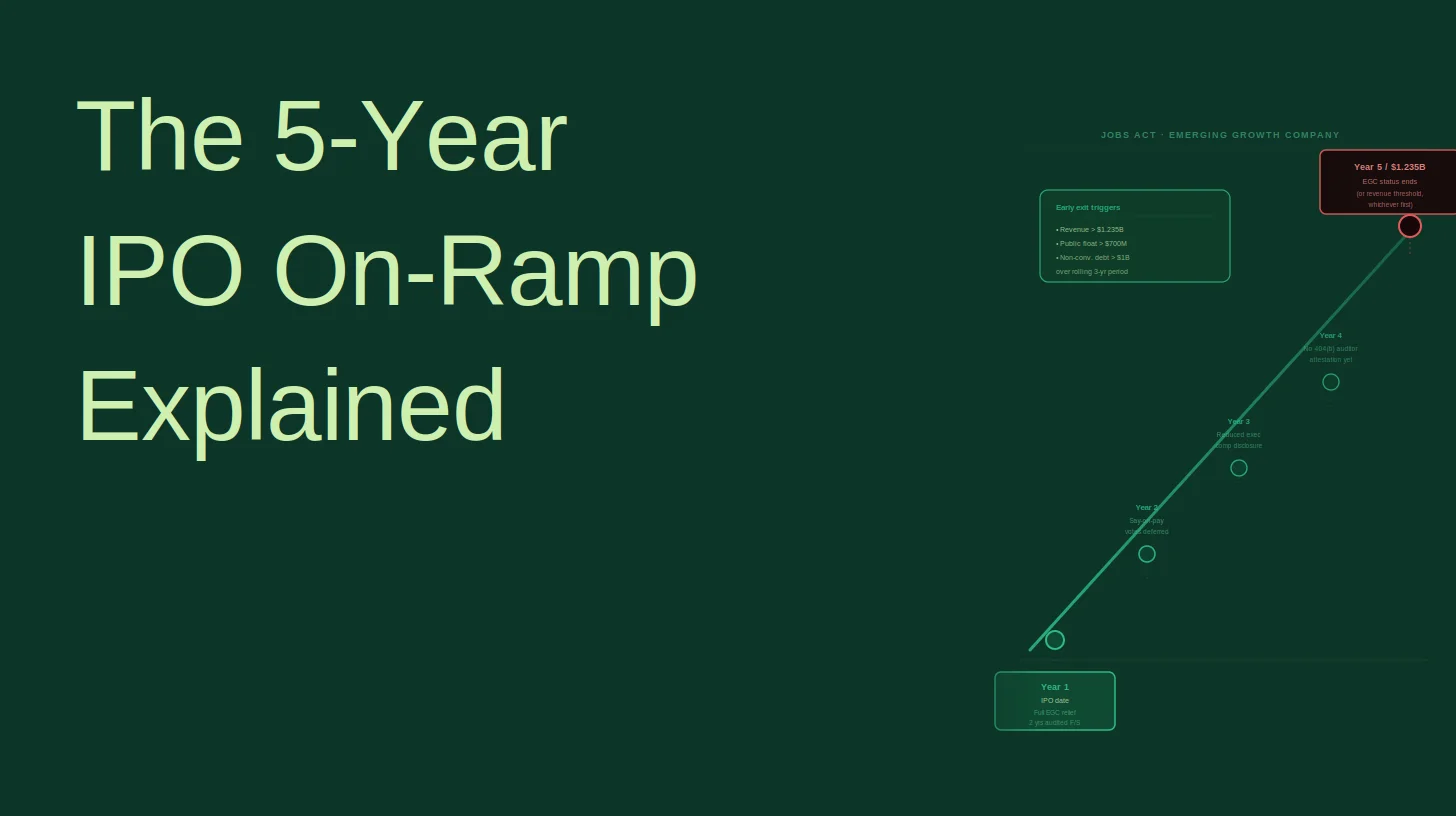
A company qualifies as an EGC if its annual gross revenues are less than $1.235 billion (indexed for inflation) during its most recently completed fiscal year. EGC status begins when the company first sells common equity securities pursuant to an effective Securities Act registration statement and ends on the earlier of: the last day of the fiscal year in which the company had annual gross revenues of $1.235 billion or more, the last day of the fiscal year following the fifth anniversary of the company's IPO, the date on which the company has issued more than $1 billion in non-convertible debt during a three-year period, or the date on which the company becomes a large accelerated filer.
The five-year limit, or the revenue, debt, or filer status trigger if earlier, is the "IPO on-ramp" Congress created. During the EGC period, companies can take advantage of reduced disclosure obligations including:
Exemption from the SOX 404(b) auditor attestation requirement for internal controls over financial reporting. Non-EGC large accelerated filers must obtain an external auditor's attestation on their ICFR assessment. EGCs are exempt from this requirement regardless of their size.
Reduced executive compensation disclosure. EGCs are not required to include a compensation discussion and analysis section and need only provide compensation tables for three named executive officers rather than five.
Extended adoption period for new PCAOB accounting standards. EGCs can delay adoption of new PCAOB auditing standards until those standards are applicable to non-issuers (private companies).
Scaled financial statement requirements. EGCs may present only two years of audited financial statements in their registration statement rather than three.
Confidential draft registration statement review. EGCs can submit their registration statement to SEC staff for review on a confidential basis before public filing.
The problem Atkins identifies with the current structure: a company that goes public and crosses the large accelerated filer threshold (currently $700 million in public float) before five years have elapsed loses EGC status regardless of how recently it went public. A company that raises $700 million or more in its IPO may be on the on-ramp for its first quarterly report and off it by its second annual report. That acceleration eliminates much of the benefit the on-ramp was designed to provide.
What Did Atkins Propose Changing in His July 22 Speech?
The July 22, 2026 Harvard Law-posted speech was delivered at the Small Business Capital Formation Advisory Committee meeting. Atkins reported on the May 2026 formal proposals and outlined the agenda going forward. He specifically listed extending the IPO on-ramp as one of the ongoing items on his reform agenda: "re-calibrating disclosure requirements for smaller public companies, reconsidering reporting cadence, enhancing Form S-3 eligibility, revising the criteria to qualify as a well-known seasoned issuer, extending the IPO on-ramp, and modernizing filer status categories."
The formal proposals published on May 19 and 20 are the most specific statement of what the on-ramp extension would do. The May 20 statement on the filer status proposal confirmed: "The Filer Status Proposal also builds on the success of the IPO on-ramp that Congress created through the JOBS Act in 2012. Congress's IPO on-ramp provides for disclosure scaling and other accommodations for a maximum of five years following a company's IPO. Through its more harmonized public company categories, the proposed amendments create an expanded IPO on-ramp that lasts a minimum of five years."
The key phrase is minimum of five years. The current on-ramp lasts a maximum of five years (subject to earlier termination). The proposed on-ramp would last at least five years, with the period potentially extending further depending on the company's characteristics under the revised filer status categories.
Atkins's March 13 speech at the Investor Advisory Committee had introduced the concept: "allowing companies to remain on the on-ramp for a minimum number of years, rather than forcing them off as soon as the first year after the initial offering, could provide companies with greater certainty and incentivize more IPOs, especially among smaller companies."
The core policy concern: a company that crosses the large accelerated filer threshold quickly, because its IPO was successful and its public float exceeded $700 million, loses EGC benefits even if it has only been public for one or two years. Under the proposed reform, the on-ramp extension would prevent that forced exit, giving companies a minimum period to build the compliance infrastructure required for full SEC reporting obligations.
What Is the Current EGC Period and When Do Companies Age Off?
The five-year EGC period runs from the IPO date, but in practice many companies exit EGC status before five years because of the revenue, filer status, or debt issuance triggers.
The large accelerated filer trigger is the most common accelerated exit. A company becomes a large accelerated filer when its aggregate worldwide market value of its voting and non-voting common equity held by non-affiliates is $700 million or more as of the last business day of its most recently completed second fiscal quarter. For a company that goes public at a valuation above $700 million, which includes most companies that choose to list on a national exchange in the current market, the large accelerated filer test may be satisfied within 12 months of the IPO date.
Once a company becomes a large accelerated filer, it is no longer an EGC regardless of when it went public. It must comply with all full disclosure requirements, including SOX 404(b) auditor attestation, within the first audit period after becoming a large accelerated filer.
The revenue trigger is the other common early exit. A company that generates gross revenues exceeding $1.235 billion in any fiscal year loses EGC status at the end of that year. For technology companies with rapid revenue growth, this trigger can also be reached within the first three to four years of being public.
The Yahoo Finance reporting on Atkins's IPO agenda, confirmed in the brief, captured the regulatory problem he is addressing with a specific quote: a company with $250 million in revenues faces the same disclosure burden as a company with $25 billion in revenues once EGC status is lost. That symmetry, which exists because the disclosure requirements for large accelerated filers apply uniformly regardless of company size, is what the filer status reform proposals are designed to address.
What Would an Extended On-Ramp Mean for SOX 404 Auditor Attestation?
The SOX 404(b) auditor attestation requirement is the most expensive and operationally demanding compliance obligation that newly public companies encounter when they exit the EGC on-ramp. Under Section 404(b) of Sarbanes-Oxley, a large accelerated filer must include in its annual report on Form 10-K an attestation by its registered public accounting firm on the company's assessment of internal control over financial reporting.
The cost of the 404(b) attestation is significant. For companies without mature internal audit functions and ICFR documentation, preparing for the first 404(b) opinion can require 12 to 18 months of control design, testing, and remediation work, as well as significant incremental audit fees. Companies that exit EGC status after a successful IPO before they have had time to build this infrastructure face a compressed timeline for 404(b) compliance.
The Atkins filer status proposal directly addresses this. The May 28 Stanford speech confirmed: "As a result, more companies would receive relief from some of the most onerous SEC requirements, including the obligation to obtain an auditor attestation of internal control over financial reporting. Currently, that benefit is reserved for newly public and smaller companies. Filer status reform would broaden it to approximately 81 percent of public companies, including certain seasoned and mid-sized issuers. The proposal would also build on the IPO on-ramp concept that Congress created by extending the length of time that companies can potentially remain on the on-ramp and be exempt from the auditor attestation requirement."
The proposed 81 percent figure is significant. Under the current regime, approximately 67 percent of public companies are non-accelerated or smaller reporting companies exempt from 404(b). The proposed reform would expand that relief to approximately 81 percent, by raising the threshold at which the 404(b) requirement applies. The mechanism is the revised filer status categories in the May 19 proposal, which would raise the large accelerated filer public float threshold from $700 million to $2 billion under one version of the proposal.
For a company planning an IPO in 2026 or 2027, the practical implication depends on its expected post-IPO public float. If the company expects to have a post-IPO float below $2 billion, the proposed rule change would potentially exempt it from 404(b) entirely for a longer period than the current $700 million threshold would allow. If the company expects a post-IPO float above $2 billion, the 404(b) exemption under the current EGC on-ramp would eventually expire regardless of the threshold change.
What Would an Extended On-Ramp Mean for Executive Compensation Disclosure?
EGC status provides two executive compensation disclosure accommodations that are distinct from the SOX 404(b) exemption.
First, EGCs are not required to include a Compensation Discussion and Analysis section in their proxy statement or annual report. The CD&A is a narrative section that explains the company's compensation philosophy, the decisions the compensation committee made regarding each element of executive pay, and how those decisions relate to the company's performance. For companies that prefer not to disclose the reasoning behind their compensation decisions in detail, the CD&A exemption is valuable.
Second, EGCs are required to provide compensation tables for only three named executive officers (the principal executive officer and the two other most highly compensated executive officers) rather than the five required for non-EGC companies.
If the on-ramp is extended to a minimum of five years, these accommodations would be available for the full five-year minimum period regardless of whether the company becomes a large accelerated filer before that time. Under current law, a company that becomes a large accelerated filer in year two of its public life must immediately comply with full executive compensation disclosure requirements, including the CD&A and five-officer compensation tables, at its first proxy statement after losing EGC status.
For compensation committees and IR teams at companies planning IPOs, the extended on-ramp means more time to build the compensation benchmarking, disclosure infrastructure, and Say-on-Pay shareholder engagement process that full executive compensation disclosure requires before those requirements become mandatory.
How Does the Proposed $2 Billion Filer Status Reform Interact With the On-Ramp?
The May 19, 2026 filer status proposal (Release No. 33-11419) would revise the categories of SEC reporting companies and the thresholds that determine when a company moves from one category to another. The current categories are: large accelerated filer (LAF), accelerated filer (AF), smaller reporting company (SRC), and non-accelerated filer (NAF).
The proposal would raise the LAF threshold from the current $700 million public float to $2 billion. This change alone would move a significant number of companies from the LAF category to a lower category with reduced disclosure obligations.
The interaction with the IPO on-ramp is specific. Under the current regime, a company that goes public and achieves a $700 million float within 12 months becomes a LAF, loses EGC status (because EGC is only available to non-LAF companies), and immediately faces the full LAF disclosure burden. Under the proposed combined reform:
If the LAF threshold is raised to $2 billion, companies with post-IPO floats between $700 million and $2 billion would be accelerated filers (or potentially non-accelerated filers depending on where additional thresholds are set), not large accelerated filers.
If the on-ramp is extended to a minimum of five years, a newly public company would remain on the on-ramp for at least five years even if it quickly achieves a float that would have previously triggered LAF status under the old $700 million threshold.
The combined effect of both proposals: a company that goes public in 2027 with a post-IPO float of $1.5 billion would, under the proposed reforms, remain on the on-ramp for at least five years (rather than losing EGC status in year one under current law), would not be subject to 404(b) auditor attestation during that period (assuming the 404(b) exemption extends to the revised threshold), and would have reduced executive compensation disclosure obligations through the full minimum on-ramp period.
These are proposed rules and have not been finalised. The comment period for the May 2026 proposals may still be open, and the final rules, if adopted, may differ from the proposals. Companies should monitor sec.gov for final rule announcements.
What Does This Mean for Companies Planning a 2026-2027 IPO: Should You Wait?
The honest answer for most companies considering IPOs in the next 12 months is that the regulatory trajectory favours going public sooner, not waiting for the rules to be finalised.
The directional signal from Atkins's agenda is clear: the disclosure burden and compliance cost for newly public companies is going down, not up. The proposals that have been formally issued support that directional signal. If the filer status reform is adopted, companies going public in 2027 or 2028 will face less onerous initial compliance obligations than companies that went public in 2024 or 2025. That trend benefits companies that wait. But companies that go public before the rules are finalised also benefit from the current EGC on-ramp, which provides meaningful accommodations for up to five years under current law.
The specific analysis a company planning a 2026 or 2027 IPO should perform:
What is the expected post-IPO public float? If it is expected to be above $2 billion, the proposed filer status reform may not change the company's large accelerated filer classification under the proposed threshold. The extended on-ramp would still help, but the 404(b) exemption may still expire on the proposed timeline.
How long will the company's revenues remain below $1.235 billion? If revenue is expected to cross that threshold within three years of the IPO, EGC status would be lost regardless of other on-ramp reforms. Revenue growth management is not a realistic IPO planning tool, but the revenue trajectory is a relevant factor in assessing how long the on-ramp benefits will actually last.
Is the company prepared for the reporting obligations it will face as a new public company regardless of which on-ramp reform is adopted? EGC status provides accommodations, but does not eliminate the obligation to prepare quarterly and annual reports, maintain adequate disclosure controls and procedures, and comply with SOX 302 certification requirements from the first filing.
The SpaceX IPO context reinforces this last point. SpaceX's first 10-Q, covering Q2 2026 and due August 14, must address seven major new disclosure obligations even though SpaceX went public only seven weeks ago. The scale of those obligations demonstrates that the reporting burden for a newly public company, even one with EGC accommodations, is substantial. The extended on-ramp would help with 404(b) and executive compensation disclosure, but would not change the quarterly reporting cadence or the material disclosure obligations.
What Does SpaceX's August 14 First 10-Q Tell Us About First-Year Reporting Burden?
SpaceX (SPCX) went public June 12, 2026 at $135 per share. Its first-ever Form 10-Q, covering Q2 2026, is due August 14. Our breakdown of the SpaceX first 10-Q covers the seven major disclosure obligations SpaceX faces in that first quarterly filing: three-segment ASC 280 reporting, xAI goodwill and intangibles assessment under ASC 350, Tesla-SpaceX related party disclosures under Item 404, Starship development cost capitalisation accounting, the Anthropic $1.25 billion per month contract revenue recognition, non-GAAP Adjusted EBITDA reconciliation under Regulation G, and the going concern assessment for the $20 billion bridge loan maturing September 2027.
Each of these obligations exists because SpaceX is now a public reporting company. None of them is reduced by EGC status. SpaceX is not an EGC because its revenues in recent fiscal years substantially exceeded the $1.235 billion threshold. Its first 10-Q faces the full disclosure burden of a large accelerated filer from its very first quarterly report.
The SpaceX example illustrates an important boundary of the on-ramp discussion. The EGC accommodations are designed to phase in specific requirements like 404(b) and CD&A. They do not phase in the core disclosure obligations: the financial statement requirements under Regulation S-X, the MD&A requirements under Item 303, the risk factor requirements under Item 105, and the earnings reporting cadence. Those apply from the first periodic report regardless of EGC status.
For smaller companies that would qualify as EGCs, the on-ramp extension provides real value in the 404(b) and executive compensation contexts. But the broader disclosure burden of being a public company, including the quarterly and annual reporting cycle, the SOX 302 certification, and the SEC comment letter exposure, applies regardless of on-ramp status.
Frequently Asked Questions
What is the SEC's IPO on-ramp?
The IPO on-ramp is the set of disclosure accommodations that Congress created in the JOBS Act of 2012 for companies that qualify as Emerging Growth Companies. EGC accommodations include exemption from the SOX 404(b) auditor attestation requirement, reduced executive compensation disclosure, scaled financial statement requirements, an extended adoption period for PCAOB accounting standards, and the ability to submit draft registration statements to SEC staff confidentially. EGC status lasts for up to five years from IPO or until the company exceeds certain revenue, float, or debt thresholds.
What did Atkins propose changing about the IPO on-ramp?
Atkins's formal proposals, published in SEC Release No. 33-11419 on May 19, 2026, would create an expanded on-ramp lasting a minimum of five years rather than the current maximum of five years with potential early termination. The proposal would also raise the large accelerated filer public float threshold from $700 million to $2 billion, which would extend the period during which companies are exempt from SOX 404(b) auditor attestation. The combined effect is to broaden SOX 404(b) exemption to approximately 81 percent of public companies, up from the current level.
What is an Emerging Growth Company?
An EGC is a company that first sold common equity in a registered IPO and has annual gross revenues of less than $1.235 billion. EGC status provides disclosure accommodations during the IPO on-ramp period. A company loses EGC status when its revenues exceed $1.235 billion, when it becomes a large accelerated filer (currently when public float exceeds $700 million), when it issues more than $1 billion of non-convertible debt in three years, or at the five-year anniversary of its IPO.
When does a company lose EGC status?
On the earliest of: the last day of the fiscal year in which revenues exceeded $1.235 billion, the last day of the fiscal year after the fifth anniversary of the IPO, the date non-convertible debt issuances exceed $1 billion in three years, or the date the company becomes a large accelerated filer. For companies that go public at high valuations, the large accelerated filer trigger often causes early exit from EGC status before the five-year period.
Does the proposed on-ramp extension affect SOX 404 auditor attestation requirements?
Yes. A central purpose of the on-ramp extension proposal is to preserve the 404(b) auditor attestation exemption for a minimum of five years. Combined with the proposed increase in the large accelerated filer threshold from $700 million to $2 billion, the proposals would extend 404(b) exemption to approximately 81 percent of public companies, including many mid-sized companies that currently face the attestation requirement shortly after going public.
Key Takeaways
- SEC Chair Atkins's "Make IPOs Great Again" agenda has produced two formal proposals: SEC Release No. 33-11418 and No. 33-11419, both published May 19-20, 2026, proposing to extend the IPO on-ramp and reform filer status categories.
- The current JOBS Act IPO on-ramp provides EGC accommodations for a maximum of five years. The proposed reform would create an expanded on-ramp lasting a minimum of five years, preventing forced early exit due to the large accelerated filer trigger.
- EGC accommodations include exemption from SOX 404(b) auditor attestation, reduced executive compensation disclosure (no CD&A, three rather than five named executive officers), scaled financial statements, and extended PCAOB accounting standard adoption timelines.
- The proposed filer status reform would raise the large accelerated filer public float threshold from $700 million to $2 billion. Combined with the extended on-ramp, approximately 81 percent of public companies would be exempt from 404(b) auditor attestation, up from the current level.
- Between the 1990s and Atkins's return to the SEC, the number of companies listed on US exchanges fell approximately 40 percent. Atkins has described every IPO as "an invitation for individuals to participate in the prosperity of the next generation of American enterprise."
- These are proposed rules, not final rules. Companies planning 2026-2027 IPOs should monitor sec.gov for final rule announcements and factor both the current EGC regime and the proposed extended regime into their planning.
- The EGC on-ramp, extended or not, does not reduce the core periodic reporting obligations, SOX 302 certification requirements, or SEC comment letter exposure. SpaceX's August 14 first 10-Q, with seven major new disclosure obligations, illustrates that the reporting burden for a newly public company is substantial regardless of EGC status.