IFRS S1 and S2 Disclosure Requirements: The Complete 2026 Guide
If your organisation is preparing its first IFRS S1 and S2 disclosures, or auditing an existing programme, this guide gives you the specific requirements, not another four-pillar summary. It maps what you must disclose, what you may defer, and what the standards actually say about the hard questions, Scope 3, scenario analysis, connectivity to financial statements, and the 'undue cost or effort' escape valve.
Key takeaway: IFRS S1 and IFRS S2 were issued by the ISSB on 26 June 2023 and are effective for annual reporting periods beginning on or after 1 January 2024. They are not self-executing: your jurisdiction must adopt or endorse them before they are mandatory for you. But the direction of travel is clear, IOSCO, whose members regulate more than 95% of the world's securities markets, endorsed both standards in July 2023.
What Are IFRS S1 and S2, and How Do They Fit Together?
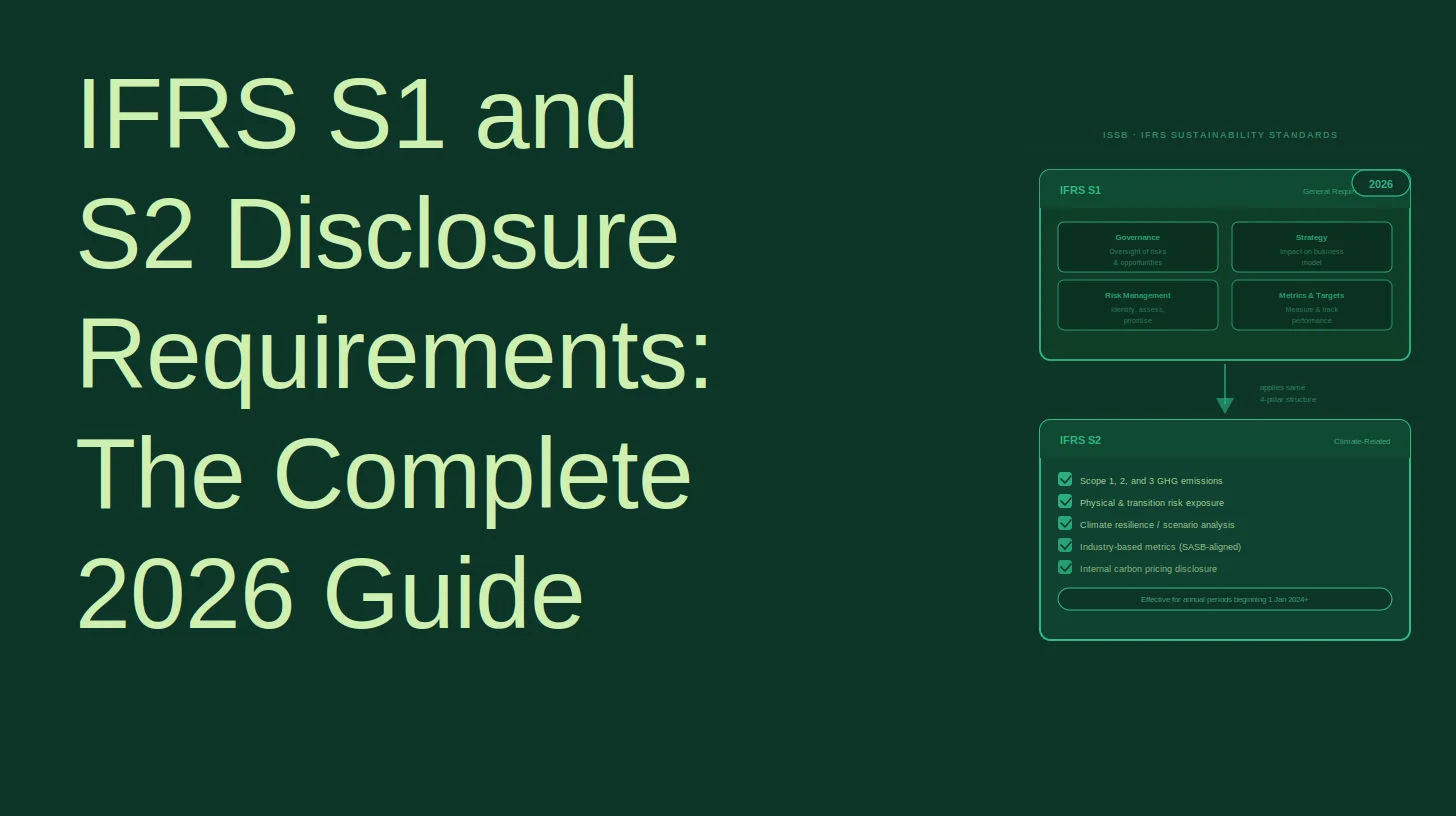
IFRS S1 is the general framework. It requires entities to disclose material information about all sustainability-related risks and opportunities, not just climate, that could reasonably be expected to affect cash flows, access to finance, or cost of capital over the short, medium, or long term. Think of it as the IFRS Conceptual Framework equivalent for sustainability reporting.
IFRS S2 is a topic-specific standard that applies the same structure to climate. It mandates disclosure of physical risks, transition risks, climate-related opportunities, scenario analysis, and quantitative GHG emissions across all three scopes. As EY's June 2025 update puts it: "IFRS S1 is designed to be applied in conjunction with IFRS S2, which is a topic-based standard that specifies disclosures relating to climate."
Both standards are investor-focused. The primary users are existing and potential investors, lenders, and other creditors, not the public, regulators, or affected communities. That single-materiality lens is the defining difference from the EU's CSRD/ESRS regime (more on that below).
The Four Disclosure Pillars: What Each Actually Requires
Both IFRS S1 and IFRS S2 organise requirements around four core content pillars derived from the TCFD framework. Here is what each pillar requires in practice.
Pillar 1: Governance
Entities must disclose the governance body or individual responsible for oversight of sustainability-related (and specifically climate-related) risks and opportunities. The disclosure must cover:
- How that body is informed about sustainability risks and opportunities
- How frequently it reviews relevant information
- How sustainability performance is factored into remuneration policies
- Management's role in assessing and managing sustainability risks
For IFRS S2 specifically, this means naming the board committee or executive responsible for climate oversight, not just stating that "the board oversees climate risk." Vague attribution is one of the most common deficiencies in first-cycle disclosures.
Pillar 2: Strategy
This is the most disclosure-intensive pillar. Under IFRS S2's strategy requirements, entities must disclose:
- Climate-related risks and opportunities identified over short, medium, and long time horizons (with those horizons defined)
- Effects on business model and value chain, including upstream suppliers and downstream customers, per Deloitte's IAS Plus analysis
- Effects on strategy and decision-making, including any climate transition plan (if no plan exists, that fact must be disclosed)
- Current and anticipated effects on financial position, financial performance, and cash flows
- Climate resilience, assessed using scenario analysis
The transition plan disclosure is worth pausing on. IFRS S2 requires entities to disclose milestones and targets used to monitor progress, and how the plan interacts with overall strategy and financial planning. A high-level net-zero commitment with no milestones does not satisfy this requirement.
Pillar 3: Risk Management
Entities must describe:
- Processes to identify and assess sustainability-related risks and opportunities, including the inputs and parameters used
- Processes to prioritise those risks relative to other business risks
- Processes to monitor and manage them
- Whether and how those processes are integrated into the entity's overall risk management framework
For IFRS S2, this includes distinguishing between physical risks (acute events like floods; chronic changes like sea-level rise) and transition risks (policy, legal, technology, market, reputational). The standard requires disclosure of the location of assets subject to physical climate risks and quantification of financial exposure, which requires integrating geospatial data and climate science into the reporting process.
Pillar 4: Metrics and Targets
This is where IFRS S2 gets most specific. The standard requires disclosure of seven cross-industry climate metrics:
MetricWhat to DiscloseAbsolute GHG emissionsScope 1, 2, and 3 in metric tonnes CO2eGHG emissions intensityPer unit of physical or economic output (disclose both numerator and denominator)Transition risk exposureAmount and % of assets or activities vulnerablePhysical risk exposureAmount and % of assets or activities vulnerableClimate-related capital deploymentCapital expenditure and investment toward climate risks/opportunitiesInternal carbon pricePrice per tonne CO2e applied, scope of application (required even if no net-zero target is set)Remuneration linkageHow climate considerations are factored into executive pay
On top of the cross-industry metrics, IFRS S2 requires industry-based disclosures using 68 SASB industry standards now maintained by the IFRS Foundation. Entities operating across multiple industries must apply the relevant SASB standards for each.
GHG Emissions: What IFRS S2 Actually Requires
The default methodology is the GHG Protocol Corporate Standard. Entities may use an alternative only if required by their jurisdiction or if it provides more useful information, and they must disclose which methodology they used.
Scope 3 covers all 15 categories of upstream and downstream value chain emissions per the GHG Protocol. The requirement to disclose Scope 3 is one of the most operationally demanding aspects of IFRS S2, particularly for entities with complex global supply chains. The ISSB's Transition Implementation Group (TIG) has addressed questions on Scope 3 measurement, including what constitutes "reasonable and supportable information without undue cost or effort" (see the transition reliefs section below).
For Scope 2, entities must apply the location-based method and may also apply the market-based method. Both must be disclosed if the market-based method is used.
Climate Scenario Analysis: How the IFRS S2 Requirement Actually Works
Scenario analysis is required under IFRS S2, not merely recommended, as under IFRS S1 for non-climate topics. This is one of the starkest differences between the two standards.
What the standard requires:
- Use climate-related scenarios consistent with the information available to the entity
- Disclose the scenarios used, key assumptions, time horizons, and results
- Include at least one scenario consistent with limiting warming to 1.5°C, where such a scenario is relevant to the entity
What the standard does not require:
- Specific named scenarios (IEA NZE, NGFS, IPCC RCP/SSP are all permissible but not mandated)
- Quantitative financial modelling (qualitative scenario narratives can satisfy the requirement, though regulators are increasingly expecting quantification)
- A fixed set of time horizons (entities define their own short, medium, and long term)
In practice, most entities subject to IFRS S2 are using a combination of the IEA Net Zero Emissions by 2050 scenario (for the 1.5°C pathway) and at least one higher-warming scenario (e.g., IEA Stated Policies Scenario or an NGFS scenario). The key disclosure gap in first-cycle reports has been insufficient explanation of how scenario results connect to financial statement estimates, which brings us to connectivity.
The Connectivity Requirement: The Most Demanding Aspect of IFRS S1
IFRS S1 requires entities to explain how sustainability-related risks and opportunities are reflected in financial statement line items, estimates, and assumptions. This "connectivity" requirement has no direct equivalent in prior voluntary frameworks and is the aspect most frequently missing from first-cycle disclosures.
In practice, connectivity means:
- If climate transition risk affects the useful life of a fossil-fuel asset, the impairment assessment under IAS 36 must reflect that risk, and the sustainability disclosure must say so
- If physical climate risk affects inventory valuations or insurance costs, those effects should be traceable between the sustainability report and the financial statements
- Assumptions used in scenario analysis should be consistent with assumptions used in goodwill impairment testing or deferred tax asset recoverability assessments
The ISSB's TIG has confirmed that connectivity does not require entities to restate financial statements, but it does require explicit cross-referencing and narrative explanation. Auditors are increasingly scrutinising this linkage as part of assurance engagements.
Materiality Under IFRS S1: Single vs. Double
IFRS S1 uses single materiality: information is material if omitting, misstating, or obscuring it could reasonably be expected to influence decisions of primary users (investors, lenders, creditors). The definition is identical to the IFRS Accounting Standards materiality definition.
This contrasts directly with CSRD/ESRS double materiality, which requires disclosure of both financial materiality (impact on the entity) and impact materiality (the entity's impacts on people and the environment). An entity subject to both regimes must run two separate materiality assessments, they cannot substitute one for the other.
A practical implication: an entity's water usage may be material under CSRD/ESRS impact materiality (because of environmental harm) but immaterial under IFRS S1 (because it does not affect investor decisions). Under IFRS S1, that entity would not be required to disclose water data. Under CSRD/ESRS, it would.
IFRS S1 also permits entities to omit commercially sensitive information about sustainability-related opportunities, but this exemption does not apply to risks, and it does not apply to information already in the public domain.
SASB Standards Within IFRS S2: Required or Optional?
A common misconception: SASB metrics are not automatically required under IFRS S2. The correct reading is:
- IFRS S2 requires entities to apply the industry-based disclosure requirements from the relevant SASB standards
- But the materiality filter still applies, if a SASB metric is not material to the entity's climate-related risks and opportunities, it need not be disclosed
- Entities must disclose which SASB standards they used and explain any departures
IFRS S1 similarly requires entities to use SASB Standards as a primary source of guidance for identifying industry-specific sustainability risks, opportunities, and metrics across all topics (not just climate). If SASB does not cover a topic, entities may also refer to CDSB Framework application guidance, TCFD recommendations, and other standard-setters' industry guidance.
Transition Reliefs: A Complete Catalogue
The ISSB built in several transition reliefs for the first year of application. These are poorly understood in practice, so here is the full list:
ReliefConditionDurationClimate-first reliefIn year one, entities need only disclose climate information (IFRS S2); non-climate sustainability topics may be omittedYear one onlyNo comparative informationEntities need not provide prior-period comparatives in year oneYear one onlyScope 3 deferralEntities need not disclose Scope 3 GHG emissions in year oneYear one onlyTiming reliefSustainability disclosures may be published after the financial statements in year one, provided they are published within a reasonable timeYear one only
Critical point: if you used the climate-first relief in FY2024, you must disclose all material sustainability topics (not just climate) from FY2025 onward. You must also provide FY2024 comparative climate data in your FY2025 report, which means you needed to collect that data in FY2024 even if you did not report it. KPMG's implementation guidance flags this as a common planning failure.
Entities using any transition relief must disclose that fact. An entity cannot make a partial compliance statement under IFRS S1, compliance is all-or-nothing, similar to IFRS Accounting Standards.
The 'Undue Cost or Effort' Standard: What It Means in Practice
IFRS S1 permits entities to use "reasonable and supportable information available without undue cost or effort" when making estimates and judgments, particularly relevant for value chain data and Scope 3 emissions. This is not a blanket exemption. Entities must:
- Disclose what information they used
- Explain the assumptions made
- Describe the sources of estimation uncertainty
- Document why obtaining more complete information would involve undue cost or effort
The TIG has confirmed that "undue cost or effort" is a relative concept, it depends on the entity's size, resources, and the significance of the sustainability risk in question. A large listed entity with a material Scope 3 footprint cannot easily claim undue cost or effort for basic supplier emissions data. The bar is higher for complex, multi-tier supply chains where primary data is genuinely unavailable.
Where Must Sustainability Disclosures Appear?
IFRS S1 requires sustainability disclosures to be published at the same time as the related financial statements and to be included in the general purpose financial report (e.g., the annual report). They may be located in:
- A management commentary section
- A separate sustainability report that is clearly identified as part of the general purpose financial report
- Another part of the annual report
The key requirement is that the disclosures are clearly identified as part of the general purpose financial report and are not obscured by other information. A standalone sustainability PDF published separately from the annual report does not satisfy this requirement unless it is explicitly incorporated by reference.
Jurisdiction Adoption Tracker (as of mid-2026)
JurisdictionStatusEffective DateNotesAustraliaMandatory (AASB S1/S2)1 Jan 2025 (large listed entities)Phased for smaller entities in subsequent yearsSingaporeMandatory (SGX-listed)FY2025Scope 3 phased in from FY2026JapanMandatory (FSA Cabinet Ordinance)FY2023 (reports filed 2024)Large listed companies; one of earliest adoptersUKIn progress (UK SRS)Under consultationFRC/government developing UK SRS based on IFRS S1/S2CanadaIn progressPhased from 2024-2025CSA climate disclosure rules ISSB-alignedBrazilAdopted2024CVM resolution requires ISSB-aligned disclosuresNigeriaAdopted2024SEC Nigeria mandated ISSB-aligned reportingEUParallel regime (CSRD/ESRS)2024 onward (phased)Interoperability arrangements with ISSB; double materiality appliesUSANot adoptedN/ASEC climate rule in rescission; ISSB not mandated federally
IFRS S1 and S2 are not self-executing. Even where a jurisdiction has "adopted" them, the effective date and scope (which entities, which reporting periods) vary. Multinational entities should map each jurisdiction's specific requirements rather than assuming uniform application.
IFRS S1/S2 vs. CSRD/ESRS: Where They Overlap and Where They Diverge
Many large entities are subject to both regimes. The ISSB has published an interoperability analysis to help avoid duplication, but the differences are material:
DimensionIFRS S1/S2CSRD/ESRSMaterialitySingle (financial materiality only)Double (financial + impact materiality)ScopeClimate (S2) + all sustainability topics (S1)Climate, environment, social, governanceScenario analysisRequired (IFRS S2)Required (ESRS E1)Carbon creditsRequired if used in climate strategy (IFRS S2)RequiredFinanced emissionsRequired for financial institutions (IFRS S2)RequiredIndustry-specific metricsRequired via SASB (IFRS S2)Sector-specific ESRS (in development)AssuranceNot specified in standard; jurisdictions varyLimited assurance required; reasonable assurance phased inLocation in reportGeneral purpose financial reportManagement report (or equivalent)
The practical implication: if you comply with CSRD/ESRS, you will satisfy most IFRS S1/S2 requirements, but not all. ESRS requires more on social topics, biodiversity, and supply chain due diligence. IFRS S1/S2 requires tighter connectivity to financial statements. Neither regime is a subset of the other.
Assurance: What to Expect
Neither IFRS S1 nor IFRS S2 mandates a specific level of assurance. However:
- Several jurisdictions mandating ISSB-aligned reporting are requiring limited assurance from the outset (Australia, Singapore)
- The IAASB's ISSA 5000 standard for sustainability assurance was finalised in 2024 and is being adopted by national audit standard-setters
- Regulators in early-adopting jurisdictions are signalling that reasonable assurance will be required within three to five years
Assurance readiness means having documented data governance, clear audit trails from source data to reported metrics, and internal controls over sustainability reporting that mirror the controls expected for financial reporting. Teams that treat sustainability data as a narrative exercise rather than a controlled reporting process will face significant remediation costs when assurance requirements tighten.
CFO and ESG Team Readiness Checklist
Use this checklist to assess your organisation's IFRS S1/S2 readiness:
Governance and scoping
- [ ] Confirm whether IFRS S1/S2 (or a local equivalent) is mandatory for your entity and from which reporting period
- [ ] Identify the governance body responsible for sustainability oversight and document how it is informed
- [ ] Determine which SASB industry standards apply to your business activities
Materiality assessment
- [ ] Run a single-materiality assessment covering all sustainability topics (not just climate)
- [ ] Document the process, inputs, and conclusions
- [ ] If subject to CSRD/ESRS, run a separate double-materiality assessment and map the overlap
Data and measurement
- [ ] Establish Scope 1 and 2 GHG measurement using GHG Protocol methodology
- [ ] Map your Scope 3 value chain and prioritise the most material categories
- [ ] Document where you are relying on the 'undue cost or effort' standard and what information you did use
- [ ] Collect FY baseline data even in year one if you are using the Scope 3 deferral relief
Strategy and scenario analysis
- [ ] Identify climate-related risks and opportunities across short, medium, and long time horizons
- [ ] Select scenarios (including at least one 1.5°C-consistent scenario) and document assumptions
- [ ] Prepare or confirm the absence of a climate transition plan
Connectivity
- [ ] Map sustainability risks to specific financial statement line items, estimates, and assumptions
- [ ] Ensure scenario analysis assumptions are consistent with impairment testing and other financial estimates
- [ ] Prepare cross-references between sustainability disclosures and financial statement notes
Reporting and assurance
- [ ] Confirm the location of sustainability disclosures within the general purpose financial report
- [ ] Decide which transition reliefs to use and prepare the required disclosure of that fact
- [ ] Assess current assurance readiness and identify data governance gaps
What Comes Next: The ISSB's Post-Issuance Work Programme
The ISSB is not standing still. Its current work programme includes:
- A potential IFRS S3 standard on biodiversity, ecosystems, and nature (building on TNFD)
- A standard on human capital disclosure
- A standard on human rights
- A post-implementation review of IFRS S1 and S2, informed by first-cycle disclosures from early adopters
All future standards will follow the same four-pillar structure and will slot into the IFRS S1 general requirements framework. Entities building their disclosure infrastructure now should design it to accommodate additional sustainability topics, not just climate.
For teams navigating the interaction between IFRS S2's GHG disclosure requirements and the financial accounting for carbon credits and emission allowances, FASB's new Topic 818 on environmental credits is directly relevant to US GAAP reporters who also prepare ISSB-aligned disclosures. And for teams benchmarking their ESG disclosure approach against peers, how SEC teams benchmark ESG disclosures against peers covers the EDGAR-based process in detail.
FAQ
What is the difference between IFRS S1 and IFRS S2?IFRS S1 is the general framework requiring disclosure of all material sustainability-related risks and opportunities. IFRS S2 is a topic-specific standard applying the same four-pillar structure specifically to climate. IFRS S2 is always applied together with IFRS S1.
Does IFRS S1/S2 apply to my organisation?Only if your jurisdiction has adopted or endorsed the standards, or if you choose to apply them voluntarily. The standards are effective for annual periods beginning on or after 1 January 2024, but require local adoption. Check the jurisdiction tracker above for your specific market.
What transition reliefs are available in the first year?Four reliefs are available: the climate-first relief (omit non-climate topics), no comparative information, Scope 3 deferral, and a timing relief allowing disclosures after the financial statements. All reliefs are year-one only and must be disclosed.
How does IFRS S2 scenario analysis work?Entities must assess climate resilience using scenarios, disclose the scenarios used, key assumptions, time horizons, and results. At least one 1.5°C-consistent scenario is required where relevant. The standard does not mandate specific scenarios, IEA NZE, NGFS, and IPCC pathways all qualify.
Is compliance with CSRD/ESRS sufficient for IFRS S1/S2?Not entirely. CSRD/ESRS compliance will satisfy most IFRS S1/S2 requirements, but IFRS S1/S2 requires tighter connectivity to financial statements, and IFRS S1/S2 uses single materiality while CSRD/ESRS uses double materiality. The ISSB has published an interoperability analysis to help entities subject to both.
What level of assurance is required?Neither standard mandates a specific assurance level. Jurisdictions vary: Australia and Singapore require limited assurance from the outset. The IAASB's ISSA 5000 standard provides the assurance framework. Reasonable assurance requirements are expected to phase in over three to five years in most jurisdictions.