Non-GAAP financial measures remain one of the most common areas of SEC comment letters—not because companies use them, but because they present them incorrectly.
The SEC does not prohibit non-GAAP measures. In fact, many public companies use adjusted EBITDA, adjusted operating income, free cash flow, or adjusted earnings in earnings releases and investor presentations. The regulatory focus is on how those measures are presented, reconciled, and explained.
For Investor Relations, SEC reporting, and finance teams, the recurring challenge is ensuring that non-GAAP measures supplement not replace GAAP results.
This guide explains:
- When companies may present non-GAAP measures
- What Item 10(e) of Regulation S-K requires
- How the SEC evaluates prominence
- What makes a reconciliation compliant
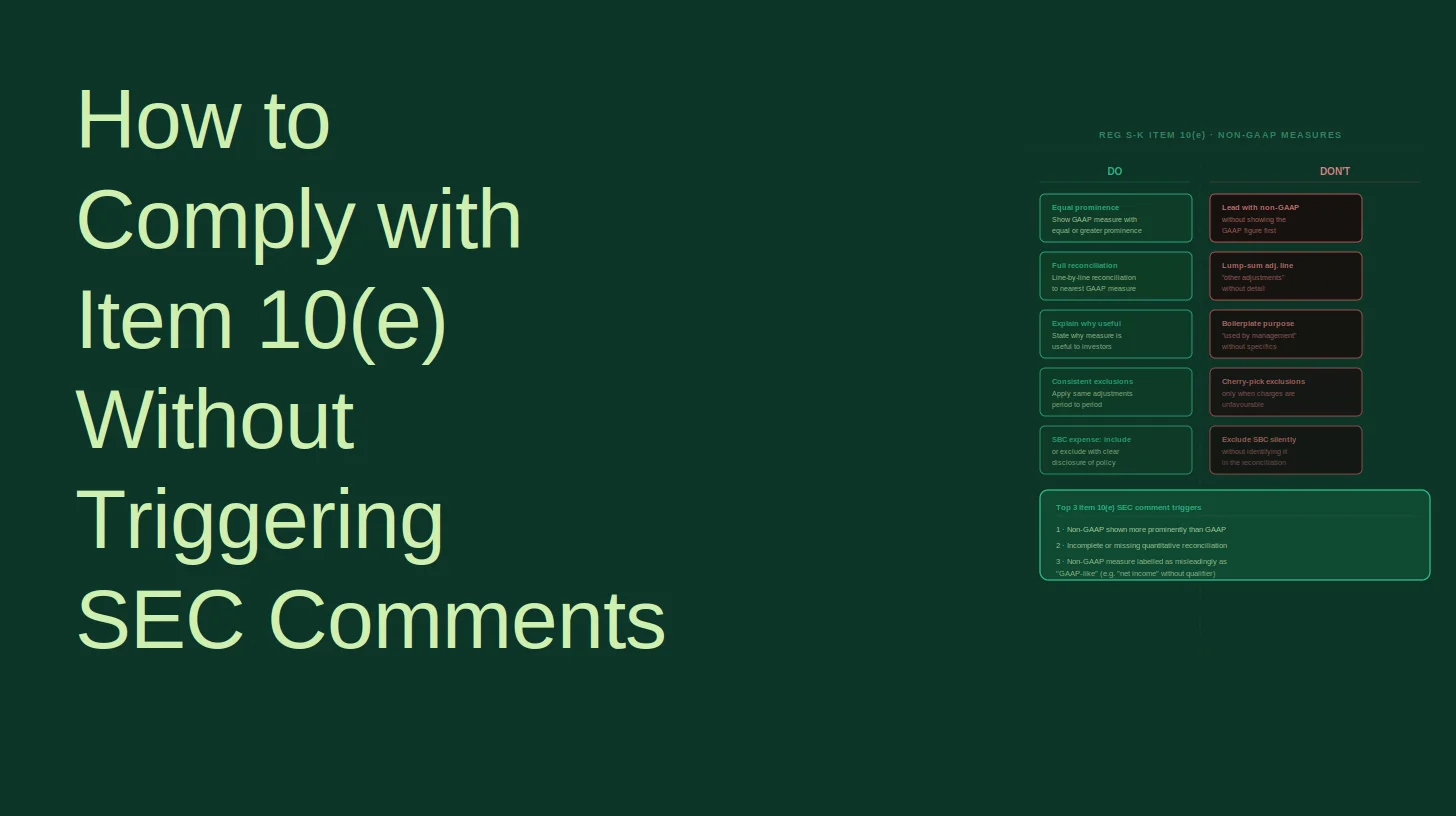
- The most common presentation mistakes that trigger SEC comments
- A practical review checklist before every earnings release
What Is the SEC's Main Concern With Non-GAAP Financial Measures?
The SEC's primary concern is not whether companies use non-GAAP measures it is whether investors receive a balanced presentation.
A non-GAAP measure becomes problematic when it is displayed more prominently than the most directly comparable GAAP measure or when investors cannot clearly understand how the adjustment was calculated.
According to the SEC's Compliance and Disclosure Interpretations (C&DIs), companies should use non-GAAP measures only as supplemental information. Investors must always be able to evaluate the corresponding GAAP results first.
In practice, most SEC comments focus on:
- Presentation order
- Headline emphasis
- Missing reconciliations
- Inconsistent adjustments
- Insufficient explanation of management's rationale
Are Non-GAAP Measures Allowed Under SEC Rules?
Yes.
Public companies may present non-GAAP financial measures if they comply with both:
- Regulation G
- Item 10(e) of Regulation S-K
These rules require companies to provide transparency around adjustments rather than prohibit their use.
Common non-GAAP measures include:
- Adjusted EBITDA
- Adjusted EPS
- Adjusted operating income
- Free cash flow
- Adjusted gross margin
The SEC recognizes that these measures may provide useful supplemental information when properly explained and reconciled.
What Does Item 10(e) of Regulation S-K Require?
Item 10(e) establishes the presentation requirements for non-GAAP financial measures included in SEC filings and certain public communications.
A compliant presentation generally includes four key elements.
1. Present the Most Directly Comparable GAAP Measure
Investors should see the comparable GAAP measure alongside the non-GAAP measure.
For example:
- Net income before adjusted net income
- Operating income before adjusted operating income
The GAAP figure should not be omitted or difficult to locate.
2. Provide a Quantitative Reconciliation
Companies must reconcile each non-GAAP measure to its most directly comparable GAAP measure.
The reconciliation should clearly identify:
- Every adjustment
- Dollar amount of each adjustment
- Total impact on the final non-GAAP measure
The SEC expects reconciliations to be complete, transparent, and mathematically traceable.
3. Explain Why Management Uses the Measure
Companies should explain why management believes the measure provides useful information to investors.
The explanation should relate to:
- Performance evaluation
- Operating trends
- Period-to-period comparability
Generic statements such as "management believes this measure is useful" provide little value unless supported by a specific explanation.
4. Avoid Misleading Presentation
Even technically accurate reconciliations may violate SEC guidance if the overall presentation could mislead investors.
Presentation matters as much as calculation.
What Does "Equal or Greater Prominence" Mean?
Equal or greater prominence is one of the most frequently misunderstood aspects of non-GAAP compliance.
The principle is straightforward:
The comparable GAAP measure should receive at least the same level of visibility as the non-GAAP measure.
The SEC evaluates prominence across the entire communication—not just the reconciliation table.
Examples of balanced presentation include:
- GAAP results discussed before adjusted results
- Comparable font size
- Comparable placement
- Comparable headlines
- Comparable discussion throughout MD&A and earnings releases
What Presentation Practices Can Make a Non-GAAP Measure Too Prominent?
Several recurring practices appear in SEC comment letters.
Leading With Only Adjusted Results
Headlines such as:
"Adjusted EPS Increased 28%"
without mentioning GAAP EPS can create an imbalance.
A more balanced approach discusses both measures together.
Highlighting Only Positive Adjusted Metrics
Investor presentations should avoid emphasizing adjusted performance while minimizing GAAP declines.
Balanced reporting requires discussing both sets of results where material.
Omitting GAAP Measures From Graphics
Charts, tables, and earnings highlights should not exclusively display adjusted measures when comparable GAAP metrics are available.
Visual presentation is evaluated just as closely as narrative disclosure.
Using Larger Fonts or Headlines
The SEC has indicated that typography, formatting, and placement contribute to prominence.
Presentation design should not unintentionally prioritize adjusted performance.
What Adjustments Receive the Most SEC Attention?
The SEC generally focuses on adjustments that may obscure recurring operating performance.
Examples include:
- Recurring cash operating expenses
- Normal compensation costs
- Regular restructuring charges that occur every year
- Individually tailored accounting principles
- Adjustments that appear inconsistent between reporting periods
Consistency matters.
If an adjustment is included in one quarter but excluded in another without explanation, the SEC may question whether the measure remains meaningful.
What Are the Most Common Non-GAAP Comment Letter Issues?
Although every comment letter is fact-specific, recurring themes appear consistently.
Inadequate prominence
Adjusted results receive greater emphasis than GAAP results.
Missing reconciliations
Required quantitative reconciliations are incomplete or omitted.
Boilerplate explanations
Management provides generic language without explaining why investors benefit from the measure.
Inconsistent adjustments
Comparable expenses are adjusted differently across reporting periods.
Misleading labels
Measures described as "non-recurring" include expenses that occur regularly.
These issues generally relate to presentation quality rather than calculation errors.
How Should Investor Relations Review Non-GAAP Disclosures Before Publication?
Investor Relations should review the entire earnings package—not only the reconciliation schedule.
The review should include:
Headlines
Do headlines mention GAAP measures alongside adjusted measures?
Executive Summary
Does the opening narrative discuss GAAP performance first or alongside adjusted performance?
Tables
Does every non-GAAP table include a clear reconciliation?
Charts
Do graphics maintain equal prominence?
Management Commentary
Are adjusted metrics explained consistently throughout the document?
Reviewing only the reconciliation table may overlook presentation issues elsewhere in the earnings release.
What Internal Controls Can Reduce Non-GAAP Disclosure Risk?
Many companies use standardized review procedures before publishing earnings materials.
Common controls include:
- Standard reconciliation templates
- Legal review of earnings releases
- SEC reporting review of presentation order
- Investor Relations review for prominence
- Audit committee review of significant adjustments
- Consistent adjustment policies across reporting periods
Documented review procedures help promote consistency from quarter to quarter.
Non-GAAP Presentation Review Checklist
Before issuing an earnings release or filing, confirm the following:
- □ Every non-GAAP measure has a directly comparable GAAP measure.
- □ GAAP measures receive equal or greater prominence.
- □ Every adjustment is individually identified.
- □ Quantitative reconciliations are complete.
- □ Management explains why the measure is useful.
- □ Adjustments are applied consistently across reporting periods.
- □ Headlines and graphics present GAAP and non-GAAP information fairly.
- □ No recurring operating expenses are presented as one-time items without appropriate support.
Frequently Asked Questions
Does the SEC prohibit non-GAAP financial measures?
No. The SEC permits non-GAAP measures provided companies comply with Regulation G and Item 10(e) of Regulation S-K, present comparable GAAP measures with equal or greater prominence, and include appropriate reconciliations.
What is the most common SEC issue with non-GAAP reporting?
The most common issue is prominence. SEC comments frequently focus on situations where adjusted results receive greater visibility than comparable GAAP results rather than on the use of non-GAAP measures themselves.
Does every non-GAAP measure require a reconciliation?
Generally, yes. Companies must reconcile each non-GAAP financial measure to the most directly comparable GAAP measure and clearly explain every adjustment.
What does "equal or greater prominence" require?
It requires companies to present comparable GAAP measures at least as prominently as non-GAAP measures throughout the earnings release, SEC filing, or investor presentation. This includes headlines, graphics, tables, and narrative discussion.
Key Takeaways
Most non-GAAP disclosure issues arise from presentation rather than measurement. Item 10(e) does not prohibit companies from using adjusted financial measures—it requires them to present those measures in a way that allows investors to evaluate GAAP performance first.
For Investor Relations and SEC reporting teams, the highest-risk areas are prominence, reconciliation quality, adjustment consistency, and clear explanations of why management uses each measure. Reviewing these elements before every earnings release can significantly reduce the likelihood of SEC comments while improving the transparency and credibility of financial communications.