Most SEC reporting teams do not use it systematically before filing. They encounter comment letters after the fact, when their own filing gets flagged. The teams that use the database before filing, to identify what the staff has focused on in their industry, their form type, and their specific disclosure area, tend to produce filings that generate fewer comments.
This post covers exactly how to search the EDGAR comment letter database, what the filing type codes mean, how to run useful searches by form type and topic, what the staff's current comment priorities are for 10-K, 10-Q, and S-4 filings, and how to structure a response when you do receive a comment letter.
How Do You Find SEC Comment Letters on EDGAR?
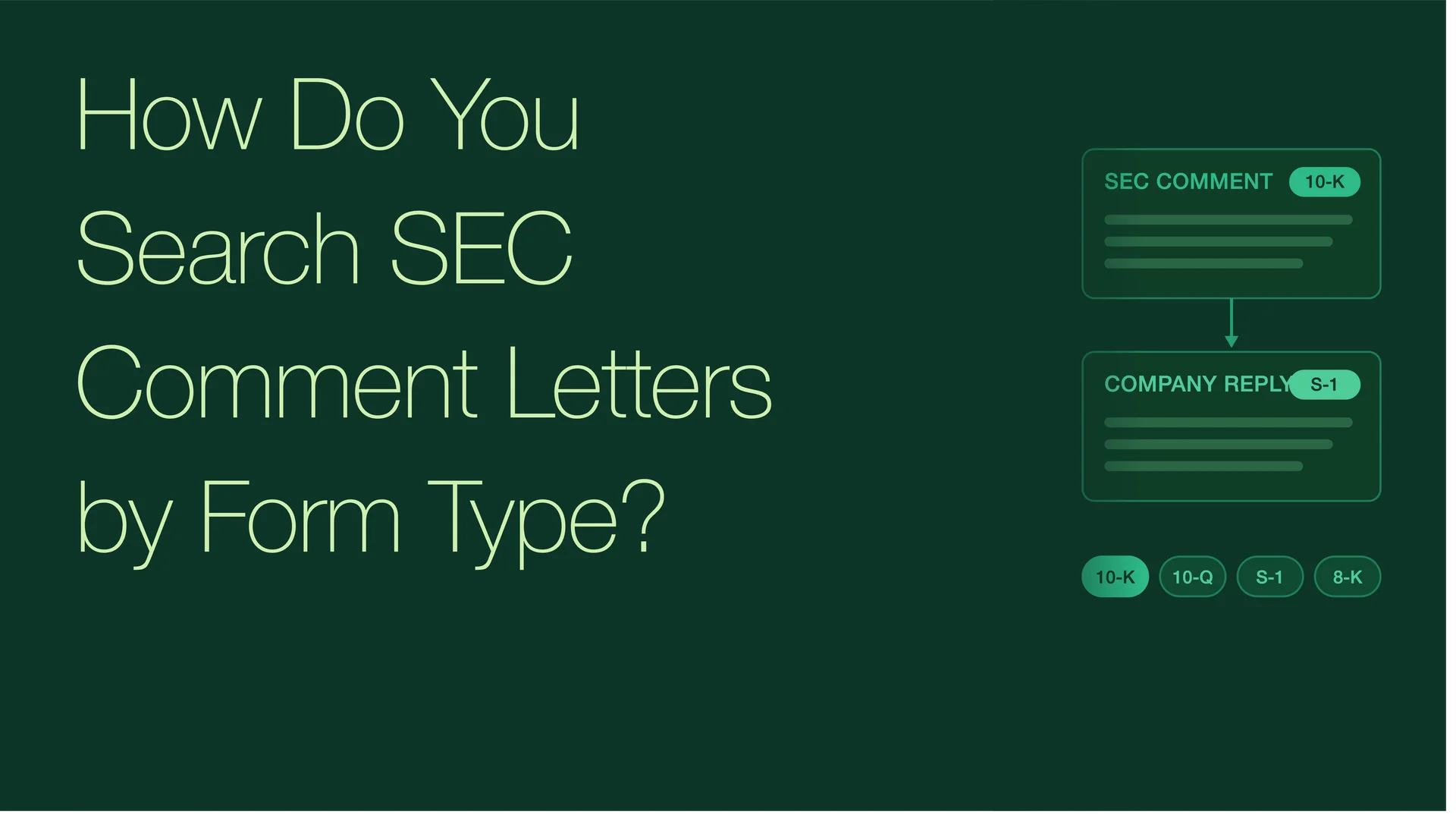
Comment letters and registrant responses live on EDGAR as specific filing types. The SEC staff's comment letter carries the filing type code UPLOAD. The registrant's response carries the filing type code CORRESP. Both are released publicly on EDGAR no earlier than 20 business days after the staff's review of the filing is complete.
There are three ways to get to them.
Company-specific search. Go to sec.gov, click EDGAR and then Company Search, and enter the company name, CIK number, or ticker. In the filing type field, type CORRESP or UPLOAD. This pulls every comment letter thread for that company in chronological order. Viewing the materials through a company's chronological filing list is often the best approach once you have found a relevant thread, since all related correspondence is identified in the document description list by the inclusion of the term [Cover].
Full-text search. Go to the EDGAR Full-Text Search page at efts.sec.gov and select the more search options view. In the filing type field, enter UPLOAD to find SEC comment letters, or CORRESP to find registrant responses, or both. This is the more powerful approach for research purposes because it lets you search the text of comment letters across all companies.
Boolean search syntax. EDGAR Full-Text Search uses an implied AND between query terms. Entering multiple terms without any operator means all terms must appear somewhere in the document. Exact phrases go in quotation marks. OR logic and NOT exclusions are supported. So a search for "revenue recognition" "performance obligation" in UPLOAD filing types finds every SEC comment letter that contains both phrases anywhere in the document.
Practical search combinations that produce useful results:
To find comment letters on a specific topic across all companies, search the phrase in UPLOAD filings. "disaggregation of revenue" in UPLOAD returns every comment letter where the staff asked about revenue disaggregation. "non-GAAP" "reconciliation" returns every comment letter where the staff flagged a non-GAAP presentation issue.
To narrow to a specific form type, use the form type field in the full-text search. You cannot filter UPLOAD filings by the underlying form type (10-K, S-4) directly, but you can include the form type in the search text itself. A search for "Form 10-K" "goodwill impairment" in UPLOAD filings narrows the results substantially.
To find comment letters for a specific industry, use the SIC code filter available in EDGAR Company Search. Pull CORRESP filings for all companies in your SIC code to see the full comment letter threads for your industry peers.
What Are the Most Common SEC Comment Letter Topics for 10-K and 10-Q Filings?
Based on EY's analysis of SEC staff comment letters for the periods ended June 30, 2025 and June 30, 2024, MD&A and non-GAAP measures continued to draw the most scrutiny from the SEC staff, followed by segment reporting and revenue recognition. Goodwill and intangible assets also remained in the top comment categories.
Within MD&A, the staff's focus is consistent and specific. The results of operations discussion accounts for the largest share of MD&A comments, with the staff repeatedly asking companies to quantify the contribution of each material factor to period-over-period changes rather than naming factors qualitatively. If a company's gross margin declined, the staff wants to know how many basis points were attributable to volume, pricing, mix, FX, and input costs separately. Naming all five factors as contributors without quantifying any of them is the disclosure pattern that reliably generates a comment.
Non-GAAP comments focus on two issues. The first is whether the GAAP reconciliation is given equal or greater prominence than the non-GAAP measure. The second is whether the non-GAAP measure excludes a recurring operating cost. OCA guidance in 2026 specifically addressed tariff cost exclusions as an example of a non-GAAP adjustment that is likely not appropriate for most companies, because tariff costs on imported goods represent a recurring operating cost rather than a one-time charge.
The SEC staff has issued more comments to smaller registrants (those with less than $700 million in market capitalisation) over the past three years than it has done historically. This is a meaningful shift from the previous pattern where comment activity concentrated on larger filers. If your company is a smaller reporting company or non-accelerated filer, the staff's increased focus on your filing size is something to account for in pre-filing review.
Segment reporting comments have increased since ASU 2023-07 became effective for interim periods within fiscal years beginning after December 15, 2024. The staff is reviewing whether companies have properly identified reportable segments, whether the chief operating decision maker determination is disclosed with specificity, and whether the significant expense disclosure requirements of the updated standard are satisfied.
Revenue recognition comments focus on performance obligation identification, standalone selling price methodology, and the adequacy of disaggregation disclosure. For SaaS and subscription companies, the staff has specifically flagged the disclosure of whether implementation fees are distinct performance obligations or setup activities that are combined with the licence obligation.
What Are the Most Common Comment Letter Patterns in Form S-4 M&A Filings?
The S-4 is the registration statement used for stock-for-stock mergers and certain other business combinations. It generates a higher volume of comments per filing than most other form types because it combines a registration statement, a proxy statement, and acquisition accounting disclosures in a single document.
Research examining S-4 filings found evidence that comment-driven revisions concentrate in three areas: pro forma financial statements, total purchase price disclosure, and goodwill allocations. S-4 filings that receive a comment letter are less likely to have a restatement or a goodwill impairment after the M&A deal is completed, which confirms that the staff's review process is improving the quality of the underlying accounting, not just the disclosure.
Pro forma financial statements under Article 11 of Regulation S-X. This is the highest-volume comment category in S-4 filings. The staff focuses on purchase price allocation adjustments, non-recurring transaction cost exclusions, and footnote disclosure of adjustment components. The most common specific comment asks the company to explain whether transaction costs excluded from pro forma net income are genuinely non-recurring and to provide the basis for that characterisation. A company that excludes $40 million in advisory fees from pro forma results without explaining why those fees would not recur in a comparable future period will receive a comment.
Total purchase price disclosure. S-4 filings that receive comment letters have a 25% higher proportion of downward purchase price revisions than those that do not. The staff asks companies to reconcile the total purchase consideration to each of its components, including the fair value of shares issued, cash paid, assumed debt, contingent consideration, and any other components. Incomplete or vague purchase price disclosure is one of the most consistent S-4 comment triggers.
Goodwill allocation. S-4 filings that receive comment letters have an 11% higher proportion of downward goodwill allocation revisions than those that do not. The staff asks registrants to explain how the preliminary purchase price allocation was derived, what fair value techniques were used for significant identifiable intangibles, and what the basis is for the amount allocated to goodwill. For transactions with high goodwill-to-total-consideration ratios, the staff often requests quantitative support for the intangible asset valuations.
Merger proxy disclosure. The staff reviews the background of the merger section for completeness, the description of the fairness opinion methodology, and the disclosure of any actual or potential conflicts of interest involving financial advisers. Incomplete background sections that omit key negotiation events or board discussions generate comments asking for expanded disclosure.
What to do before filing an S-4. Pull the CORRESP filings for the three or four most recent comparable transactions in your industry. Search for "purchase price allocation" "pro forma" in UPLOAD filings limited by date range to the last 24 months. Read the staff's comment letters for those transactions and the registrant's responses. The comment patterns repeat across transactions in the same industry with the same accounting complexity. A deal involving significant customer relationships, technology intangibles, or deferred revenue will attract the same questions that the prior deal in your space attracted.
How Do You Respond to an SEC Staff Comment Letter?
Receiving a comment letter is not a finding of wrongdoing. It is a request for additional information or an explanation of the basis for a disclosure decision. The staff review process is designed to improve disclosure quality, and a well-managed response process closes the review without a second round of comments in most cases.
The response process has a defined structure that experienced practitioners follow consistently.
Acknowledge the timeline immediately. The staff's initial comment letter typically requests a response within ten business days. If your team needs more time, request an extension before the deadline, not after it. Extensions are routinely granted. The CORRESP filings on EDGAR for most companies include at least one extension request. Failing to respond or asking for an extension late damages the company's working relationship with the staff assigned to the review.
Address every comment completely, in order. The response letter should address each comment in the exact sequence the staff listed it, numbered identically. Each response should begin by quoting the staff's comment verbatim, then provide the company's response. If the company is revising a disclosure, quote the original language and the revised language in the response letter. Do not make the staff go looking for what changed.
Never argue facts the staff is not contesting. The most common response letter error is spending paragraphs defending a disclosure position on a matter the staff did not challenge. Read the comment precisely. The staff asks specific questions. Answer them specifically. If the comment asks the company to explain the basis for a revenue recognition policy, explain the policy and cite the specific contract language or GAAP guidance supporting it. Do not also defend the accounting in areas the comment did not raise.
Provide the accounting support in the response, not by reference. A response that says "see the accounting policy note on page 42 of the filing" does not answer the comment. Reproduce the relevant guidance, the company's analysis, and the conclusion in the body of the response letter. The staff reviewer should be able to assess the company's position from the response without returning to the original filing.
Match the response to the comment's nature. Some comments are factual requests: provide the breakdown of the accounts receivable aging schedule. Others are accounting analysis requests: explain why the company concluded that three software deliverables represent a single performance obligation. Others are drafting requests: revise the risk factor to describe the company's specific exposure rather than the industry-level risk. Each type of comment has a different response structure. A factual request gets a factual answer with supporting data. An accounting analysis request gets a structured GAAP analysis. A drafting request gets proposed revised language.
When the company disagrees with the staff's comment. The company can respectfully disagree with a comment and explain the basis for its position. The staff does not have the authority to require a company to change a disclosure that complies with applicable standards. If the company believes its disclosure is correct and the comment reflects a misreading of the filing or an incorrect application of the standard, the company can say so clearly in the response, with the supporting analysis. Disagreements that are well-reasoned and supported by GAAP analysis are often resolved without requiring a change to the filing. Disagreements that are defensive or do not engage with the substance of the comment are not.
How Do You Use Comment Letter Research to Pre-Empt Staff Questions Before Filing?
The most valuable use of the EDGAR comment letter database is not responding to comments. It is avoiding them. A disclosure that has already been through a pre-filing comment letter review process, using the staff's actual comment patterns as the benchmark, is a more defensible disclosure than one that was not.
Three specific pre-filing uses of comment letter research produce the highest return.
Topic-specific pre-filing review. Before finalising a disclosure on a topic the staff has been actively commenting on, such as ASU 2023-07 segment reporting, non-GAAP measures, or tariff cost disclosure in 2026, pull the ten most recent comment letters on that topic from EDGAR and identify the specific questions the staff is asking. Then review your own disclosure against those questions before filing. If your disclosure cannot answer the staff's most common questions about a topic in your first reading of it, the staff will ask them after filing.
Peer disclosure benchmarking. Pull the CORRESP filings for five or six industry peers that have filed the same form type in the last 18 months. Read the staff's comment letters for those filings. The comment patterns repeat by industry because the underlying accounting and disclosure questions repeat. A retail company that is planning to file an S-1 can read the comment letters for the last three or four retail S-1 filings on EDGAR and identify the staff's questions about revenue recognition, inventory valuation, and segment presentation before writing those sections.
M&A transaction pre-filing review. Before filing an S-4, pull the comment letters for the three most recent comparable transactions. The staff's questions about pro forma financial statements, purchase price allocation methodology, and fairness opinion disclosure will concentrate on the same issues as in the comparable transactions. Building the S-4 disclosure with those prior comment letters as a checklist reduces the probability of a second round of S-4 comments, which is commercially significant because S-4 comment rounds delay deal closing.
Frequently Asked Questions
Where are SEC comment letters published and how do I find them?
On EDGAR. The SEC's comment letters carry the filing type code UPLOAD. Registrant responses carry the code CORRESP. Both are searchable through EDGAR Company Search (by company name, CIK, or ticker, filtered by filing type) or through EDGAR Full-Text Search at efts.sec.gov for topic-based research across all companies. Comment letters are released no earlier than 20 business days after the staff's review of the filing is complete.
What are the most common SEC comment letter topics for 10-K and 10-Q filings in 2025 and 2026?
Based on EY's analysis of comment letter activity for the periods ended June 30, 2025 and June 30, 2024, the top topics in order are MD&A (particularly results of operations quantification), non-GAAP financial measures, segment reporting, and revenue recognition. Goodwill and intangible assets also generate consistent comment activity. Smaller reporting companies and non-accelerated filers have attracted more comment activity over the past three years than historically.
What are the most common comment triggers in Form S-4 M&A filings?
Pro forma financial statements under Article 11 of Regulation S-X, total purchase price disclosure and reconciliation, goodwill allocation methodology, the background of the merger narrative in the proxy section, and fairness opinion methodology disclosure. Research on S-4 comment letters found that filings receiving comments show a 25% higher rate of downward purchase price revisions and an 11% higher rate of downward goodwill allocation revisions compared to filings that do not receive comments.
How long does the staff give you to respond to a comment letter?
Typically ten business days from the date of the letter. Extensions are routinely granted when requested before the deadline. The request should be submitted via CORRESP filing on EDGAR before the original deadline expires.
Can a company disagree with an SEC staff comment?
Yes. The staff does not have authority to require a change to a disclosure that complies with applicable GAAP and SEC rules. A company can respectfully disagree, explain the basis for its position with supporting accounting analysis, and maintain its original disclosure. Well-reasoned disagreements supported by GAAP analysis are often resolved without requiring a revision to the filing.
Does responding to a comment letter mean the company did something wrong?
No. Comment letters are requests for information or explanation, not findings of violation. The staff selects filings for review using a risk-based process and reviews the filings of most public companies at least once every three years. Receiving a comment letter is a routine part of being a public company.
Key Takeaways
- SEC comment letters (filing type UPLOAD) and registrant responses (CORRESP) are publicly available on EDGAR for all companies. Use EDGAR Full-Text Search at efts.sec.gov to search by topic and filing type.
- The top comment topics for 10-K and 10-Q filings in 2025 and 2026 are MD&A results of operations, non-GAAP measures, segment reporting (with heightened ASU 2023-07 scrutiny), and revenue recognition. Smaller registrants have attracted more comment activity than historically.
- The highest-volume S-4 comment categories are pro forma financial statements under Article 11 of Regulation S-X, total purchase price disclosure, and goodwill allocation. Companies receiving S-4 comments show meaningfully higher rates of purchase price and goodwill revisions, confirming the staff's review is substantively improving the underlying accounting.
- A well-managed comment letter response addresses every comment in sequence, quotes the staff's comment verbatim, provides complete accounting support in the body of the response, and proposes revised disclosure language where applicable. Responses that are incomplete, defensive, or require the staff to return to the original filing for supporting information generate follow-up comments.
- The highest-value use of the comment letter database is pre-filing research. Pulling the comment letters for industry peers and comparable transactions before filing identifies the staff's current question patterns and allows the disclosure team to address those questions in the filing before they become comments.