Goodwill Impairment Quantitative Test: 2026 Practitioner Walkthrough
If your team is staring down the annual goodwill impairment cycle, this guide is for you. It walks through the goodwill impairment quantitative test step by step, from determining the carrying amount of each reporting unit to calculating the impairment loss, selecting a valuation approach, and structuring disclosures that survive SEC review.
One thing to clear up immediately: the old two-step framework is gone. ASU 2017-04 eliminated Step 2 (the hypothetical purchase price allocation) for public companies with fiscal years beginning after December 15, 2019. If you still have a process document referencing the implied fair value of goodwill, update it before your next audit.
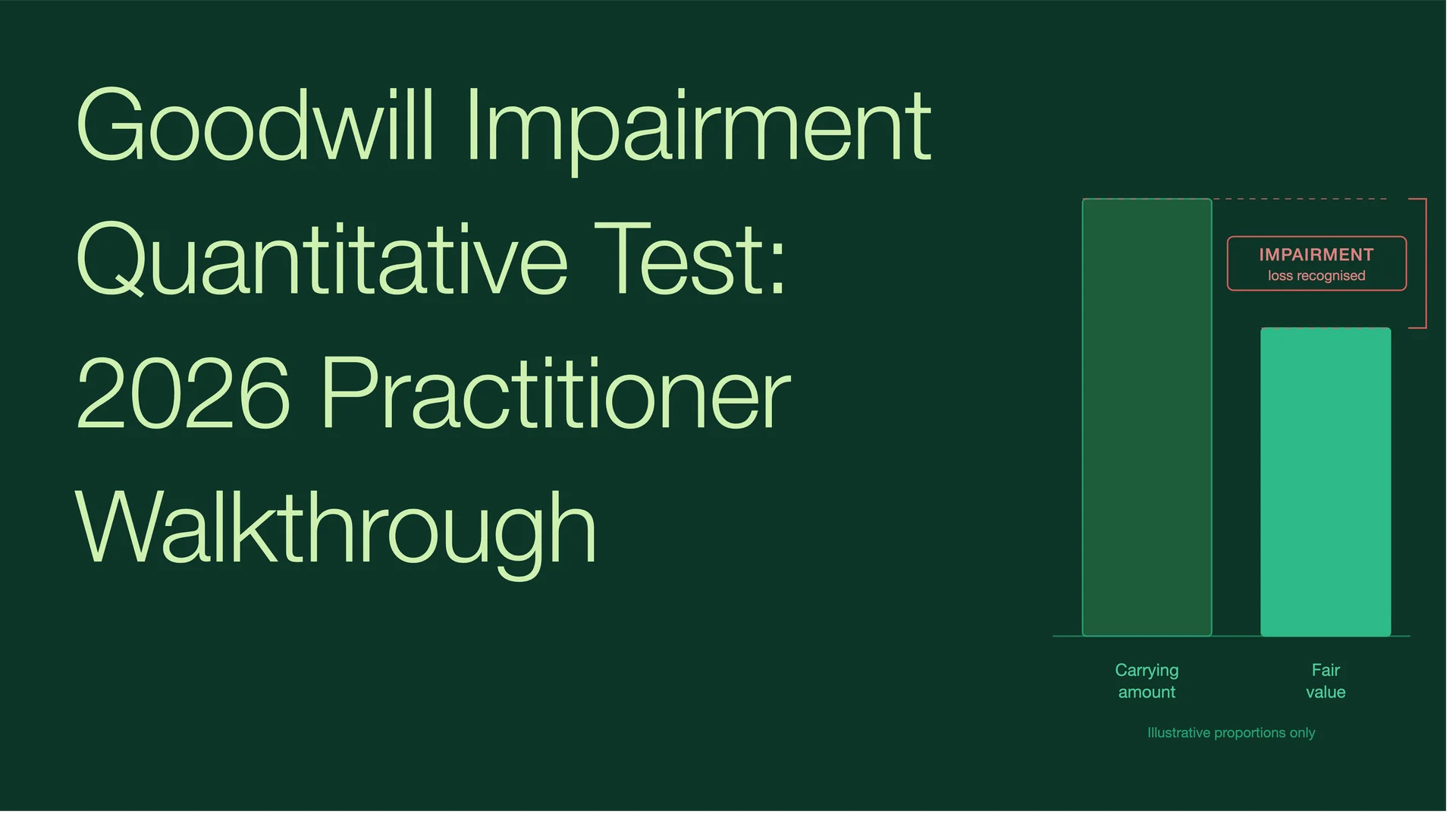
Key takeaway: The quantitative goodwill impairment test is now a single comparison: if a reporting unit's carrying amount exceeds its fair value, the difference is the impairment loss, capped at total goodwill allocated to that unit. No Step 2. No hypothetical PPA.
What Is the Goodwill Impairment Quantitative Test?
The quantitative test is the definitive, measurement-based step in ASC 350-20 goodwill impairment testing. It compares the fair value of a reporting unit with its carrying amount, including goodwill. If carrying amount exceeds fair value, an impairment loss is recognized for the difference, limited to the total goodwill allocated to that reporting unit.
As Deloitte's DART puts it: "The quantitative goodwill impairment test, used to identify both the existence of impairment and the amount of impairment loss, compares the fair value of a reporting unit with its carrying amount, including goodwill."
This is distinct from the optional qualitative assessment (Step Zero), which lets you bypass the quantitative test if you can conclude it is not more likely than not that fair value is below carrying amount. For a full walkthrough of that screen, see our Step Zero practitioner guide. This article picks up where that one leaves off: you are running the quantitative test.
When Is the Quantitative Test Required?
You must perform the quantitative test in three situations:
- The qualitative assessment concludes it is more likely than not (greater than 50% probability) that a reporting unit's fair value is below its carrying amount.
- You elect to skip the qualitative screen and go straight to quantitative measurement, which is always permitted.
- A triggering event occurs between annual test dates, such as a sustained share price decline, significant adverse change in business climate, or a new restructuring plan.
The triggering event scenario became highly relevant in 2022 and 2023, when 400 to 500 basis points of rate increases compressed DCF fair values sharply. Many companies that had passed qualitative screens comfortably in prior years found themselves running interim quantitative tests. For a detailed triggering event checklist, see our ASC 350 triggering events guide.
Public companies must test goodwill annually. The private-company alternative under ASU 2021-03, which allows testing only upon a triggering event, is not available to SEC registrants.
Step 1: Determine the Carrying Amount of Each Reporting Unit
The carrying amount of a reporting unit includes all assets and liabilities assigned to it, including goodwill and deferred income taxes.
Getting this right requires three things:
- Assign shared corporate assets and liabilities consistently. If a corporate headquarters building or a shared pension liability serves multiple reporting units, you need a rational, documented allocation methodology. Auditors and the SEC both scrutinize this.
- Include deferred taxes. Deferred income tax assets and liabilities assigned to the reporting unit are part of carrying amount. This matters for the tax structure comparison discussed below.
- Sequence impairment tests correctly. Before testing goodwill, you must first record any impairments of other assets in the reporting unit. The correct order is: (1) adjust carrying amounts of assets outside ASC 350 and ASC 360 scope, (2) test indefinite-lived intangibles under ASC 350, (3) test long-lived assets under ASC 360, then (4) test goodwill. Running goodwill impairment first, before other asset impairments reduce the carrying amount, is one of the most common sequencing errors KPMG identifies in practice.
For a detailed guide on how reporting units are identified and how assets are assigned to them, see our reporting unit identification walkthrough.
Step 2: Determine the Fair Value of Each Reporting Unit
Fair value is determined under ASC 820 and represents the price a market participant would pay to acquire the reporting unit in an orderly transaction. Three valuation approaches are acceptable:
| Approach | Method | Common Use Case |
|---|---|---|
| Income approach | DCF: discount projected cash flows at WACC | Most reporting units; primary approach when comparables are limited |
| Market approach (GPC) | EV/EBITDA or EV/Revenue multiples from comparable public companies | Units with identifiable public peers |
| Market approach (GT) | Multiples from comparable M&A transactions | Units where recent deal data is available |
| Cost approach | Current replacement cost of assets | Rarely appropriate for going-concern businesses |
In practice, most practitioners use the income approach as the primary method and the market approach as a corroborating check. When the two approaches diverge materially, you need to understand why and document your weighting rationale.
Income Approach: The DCF Model
The DCF model requires three core inputs:
- Projected cash flows (typically a 5 to 10 year explicit forecast period)
- Terminal value (usually a Gordon Growth Model: final year cash flow divided by WACC minus terminal growth rate)
- Discount rate (the WACC, reflecting market participant assumptions, not just your own cost of capital)
The WACC is where most of the risk concentrates. A 100 basis point increase in the discount rate can reduce a reporting unit's estimated fair value by 10 to 20% or more, depending on the growth profile and terminal value weight. Given that risk-free rates rose roughly 400 to 500 basis points between 2021 and 2023, many reporting units that had comfortable headroom in 2021 were sitting on thin or negative cushions by late 2023. For a full WACC build and defense, see our discount rate practitioner walkthrough.
Market Approach: GPC and Guideline Transaction Multiples
When using guideline public company (GPC) multiples, add a control premium. A reporting unit is valued as a controlling interest (as if sold), not a minority stake. GPC multiples reflect minority trading prices, so failing to add a control premium understates fair value. The size of the premium requires judgment and documentation.
KPMG flags a useful diagnostic: calculate the implied EV/EBITDA multiple at which your reporting unit would break even (fair value equals carrying amount). If that break-even multiple is at the high end of or above the observed range for comparable companies, the qualitative screen is hard to defend and a quantitative test is the cleaner path.
The Tax Structure Complexity
This is the area that trips up even experienced teams. Fair value under ASC 350-20 is typically measured assuming a hypothetical taxable asset sale, because that is what a market participant would assume. That means the fair value must reflect the tax cost a buyer would factor in for built-in gains on the reporting unit's assets.
Deloitte's DART guidance illustrates this with a concrete example: net assets (excluding goodwill and deferred taxes) of $60 with a tax basis of $35, and net deferred tax liabilities of $10. The $25 book-to-tax difference creates a significant fair value adjustment because a market participant acquiring the assets in a taxable transaction would price in the future tax cost of that built-in gain.
Before finalizing the transaction structure assumption, confirm:
- Whether the assumption is consistent with what marketplace participants would incorporate
- Whether a nontaxable structure is feasible for this reporting unit
- Whether tax laws or corporate governance requirements limit nontaxable treatment
- Whether the assumed structure produces the highest and best use value for the seller
Step 3: Calculate the Impairment Loss
This is the single-step calculation under post-ASU 2017-04 US GAAP:
Impairment loss = Carrying amount minus Fair value, floored at zero, capped at total goodwill allocated to the reporting unit.
Worked Example
Assume a technology reporting unit with the following facts:
| Item | Amount |
|---|---|
| Goodwill allocated to reporting unit | $400M |
| Total carrying amount (net assets + goodwill) | $950M |
| Fair value of reporting unit (DCF + GPC corroboration) | $870M |
Step 1: Carrying amount ($950M) exceeds fair value ($870M) by $80M.
Step 2: Is $80M less than total goodwill of $400M? Yes.
Impairment loss recognized: $80M.
Now change one assumption: if the fair value were $520M and the carrying amount $950M, the excess would be $430M. But the loss is capped at $400M (total goodwill). The remaining $30M excess does not create an additional impairment charge under ASC 350-20; it would be evaluated separately under ASC 360 for long-lived assets.
If fair value exceeds carrying amount, no impairment exists and no further calculation is needed.
Step 4: Assess Headroom and the Qualitative Screen Decision
Headroom is the excess of fair value over carrying amount, expressed as a percentage of carrying amount. It is the single most important number for deciding whether to rely on the qualitative screen in future periods.
The SEC does not define "substantially in excess" precisely, but staff guidance and comment letter patterns suggest that headroom below 10 to 20% is a disclosure trigger. When headroom is thin, the SEC expects enhanced MD&A disclosure about the potential for future impairment, the key assumptions driving fair value, and the sensitivity of those assumptions to change.
KPMG's guidance adds a practical caution: a 30 to 40% cushion from a quantitative test performed several years ago carries little weight. Auditors expect the cushion to be based on a recent valuation. If the last quantitative test was three years ago and macro conditions have shifted, the qualitative screen is difficult to defend.
Step 5: Documentation and Disclosure
What ASC 350-20-50 Requires
For reporting units where you performed a quantitative test, ASC 350-20-50 requires disclosure of the fair value of those reporting units in the current year. For units where only a qualitative assessment was performed, you must estimate fair value, either by adjusting prior quantitative results for subsequent events or by adjusting current carrying amounts for an estimate of fair value over carrying amount.
If an impairment loss is recognized, disclose:
- The amount of the loss and the reporting unit affected
- The total goodwill allocated to that reporting unit before impairment
- The facts and circumstances leading to the impairment
What the SEC Looks For
The SEC Division of Corporation Finance has issued comment letters to registrants on goodwill impairment disclosures for years. The four recurring themes:
- Insufficient disclosure of key assumptions. Discount rates, terminal growth rates, and market multiples must be disclosed, not just referenced generically.
- Failure to disclose headroom for at-risk units. When a reporting unit's fair value is not substantially in excess of carrying amount, the SEC expects disclosure of that fact and the amount of headroom.
- Inadequate sensitivity analysis. Registrants must explain how the fair value conclusion would change if key assumptions shifted by a reasonable range.
- MD&A inconsistency. If MD&A describes deteriorating business performance in a segment, but management concludes no impairment exists, the SEC will ask why. The narrative and the valuation conclusion must be coherent.
For a complete disclosure checklist, see our goodwill impairment disclosure requirements guide.
PCAOB Audit Focus
The PCAOB's 2023 Inspection Brief identifies goodwill and intangible asset impairment as a recurring audit deficiency area. Auditors must evaluate the reasonableness of management's significant assumptions, including the discount rate, projected cash flows, and market multiples. When the fair value measurement is complex, auditors are required to involve a valuation specialist. Expect your auditor to push back on WACC, terminal growth rate, and the selection of comparable companies, particularly if your reporting unit has thin headroom.
Insufficient documentation is one of KPMG's top five pitfalls. Documentation expectations have increased steadily, partly driven by PCAOB inspection findings and the adoption of the CEIV credential for valuation specialists. A debrief call with your audit team after each cycle, to identify recurring issues before they become material, is worth the time.
Common Mistakes to Avoid
- Still referencing Step 2. The hypothetical PPA is gone. Any process document or memo template that references "implied fair value of goodwill" needs to be retired.
- Wrong impairment test sequencing. Test other assets before goodwill. Running goodwill first inflates the carrying amount and can produce a false impairment.
- Relying on a stale cushion. A large headroom percentage from a prior-year quantitative test does not justify skipping the quantitative test indefinitely, especially after significant macro shifts.
- Ignoring market capitalization. For public companies, if market cap is below book equity, the qualitative screen is very difficult to sustain. The sum of reporting unit fair values should reconcile to market cap with a reasonable control premium.
- Understating the tax structure impact. Failing to reflect the tax cost of built-in gains in the fair value estimate can materially overstate fair value and understate impairment risk.
- Thin MD&A disclosure. Generic language about "key assumptions" without actual rates and multiples draws SEC comment letters.
The 2026 Macro Context
Goodwill impairment charges among S&P 500 companies totaled approximately $80 to $100 billion annually in 2022 and 2023, driven by rising discount rates and deteriorating business performance in technology, media, and healthcare, according to Audit Analytics data. The rate environment has eased somewhat from its 2023 peak, but WACCs remain materially higher than the 2020 to 2021 era. Reporting units in capital-intensive sectors with large goodwill balances relative to tangible assets remain at elevated impairment risk.
The FASB's ongoing goodwill project, which as of mid-2026 has not finalized any change to the impairment-only model for public companies, could eventually reintroduce amortization. If that happens, the relevance of the annual quantitative test changes significantly. Track the FASB project page and our FASB goodwill testing update for developments. For IFRS reporters, IAS 36 requires a mandatory annual quantitative test with no qualitative screen option; the IASB's Business Combinations disclosure project may bring further changes. Our ASC 350 vs IAS 36 comparison guide covers the framework differences in detail.
FAQ
What is the quantitative impairment test for goodwill under ASC 350-20? It is a single-step comparison of a reporting unit's fair value to its carrying amount, including goodwill. If carrying amount exceeds fair value, the difference is recognized as an impairment loss, capped at total goodwill allocated to that unit. ASU 2017-04 eliminated the former Step 2 (hypothetical PPA) for public companies effective for fiscal years beginning after December 15, 2019.
At what level is goodwill tested for impairment? Goodwill is tested at the reporting unit level, which is an operating segment or one level below (a component). The reporting unit determination is a critical upstream decision; aggregating components into a single unit can mask impairment in underperforming businesses.
How do I calculate fair value for the goodwill impairment test? Fair value is determined under ASC 820 using the income approach (DCF), market approach (guideline public company or guideline transaction multiples), or cost approach. The income and market approaches are most common. The WACC used in the DCF must reflect market participant assumptions, and a control premium must be added when using GPC multiples.
Is goodwill impairment good or bad? A goodwill impairment charge is a non-cash write-down that reduces the carrying value of goodwill to reflect that an acquired business is worth less than what was paid. It signals that the original acquisition premium has not been realized. It does not affect cash flow directly, but it does reduce equity and can affect debt covenants, credit ratings, and investor confidence.
How much headroom is safe before the qualitative screen becomes too risky? The SEC does not define a bright line, but comment letter patterns suggest that headroom below 10 to 20% of carrying amount is a disclosure trigger. KPMG advises that a cushion from a quantitative test performed several years ago carries little weight if macro conditions have shifted materially since then.
When does an interim quantitative test become required? When a triggering event occurs between annual test dates, such as a sustained share price decline, significant adverse change in business climate, loss of a major customer, or a new restructuring plan. The assessment of whether a triggering event has occurred requires judgment and should be documented at each interim reporting date.