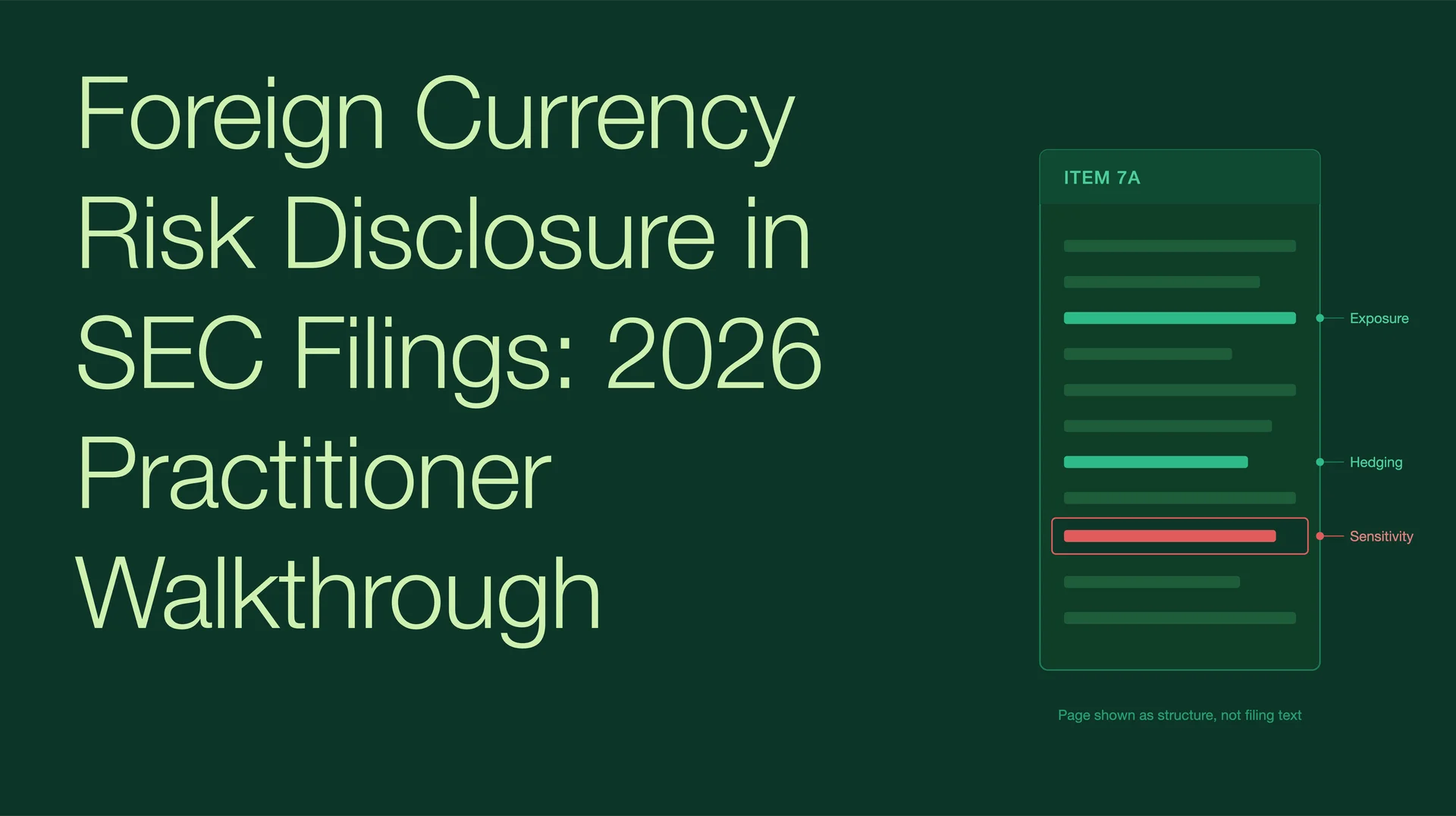
Foreign Currency Risk Disclosure in SEC Filings: 2026 Practitioner Walkthrough
If your company has material foreign currency exposure and files with the SEC, you face two distinct compliance tasks that most preparers conflate: satisfying the technical requirements of Item 305 of Regulation S-K and satisfying the SEC staff's actual expectations in comment letter review. The gap between those two things is where companies get tripped up.
This walkthrough covers the full sequence: which rule applies to you, which quantitative method to choose, what the qualitative disclosure must actually say, how to keep your MD&A and footnotes aligned, and the specific drafting mistakes that draw SEC comments in 2025-2026.
Key takeaway: Technical compliance with Item 305 is necessary but not sufficient. The SEC staff expects company-specific, decision-useful disclosures that reflect your actual exposures, your actual hedging instruments, and the actual impact of currency movements on your reported results.
Which Rule Governs Your Foreign Currency Risk Disclosure in SEC Filings?
The answer depends on your filer type. Domestic registrants filing Form 10-K are governed by Item 305 of Regulation S-K (17 CFR § 229.305), adopted January 28, 1997 (Securities Act Release No. 7386). Foreign private issuers filing Form 20-F are governed by Item 9A of that form, which mirrors Item 305 and carries the same three-method quantitative framework.
The SEC staff FAQ on market risk disclosure rules is explicit: "The quantitative and qualitative disclosures of market risk must be furnished by companies that must provide MD&A, except small business issuers." Registered investment companies are exempt. Foreign private issuers filing under Item 18 of Form 20-F must comply; those filing under Item 17 are exempt from the quantitative and qualitative requirements (though they should consider SAB Topic 1:D for accounting policy disclosures).
| Filer Type | Governing Rule | Filing Form | Quantitative Methods Required? |
|---|---|---|---|
| Domestic registrant | Item 305, Reg S-K | 10-K / 10-Q | Yes |
| Foreign private issuer (Item 18) | Item 9A, Form 20-F | 20-F | Yes |
| Foreign private issuer (Item 17) | Exempt from Item 305 | 20-F | No (consider SAB Topic 1:D) |
| Small reporting company | Exempt from Item 305 | 10-K / 10-Q | No |
| Registered investment company | Exempt | N/A | No |
The disclosures belong in the MD&A section of the annual report, outside the financial statements. Companies may cross-reference to financial statement footnotes, but only when the footnote actually contains the required information at the required level of detail. A bare cross-reference to a footnote that contains only notional amounts will not satisfy the staff.
The Three Quantitative Disclosure Methods: How to Choose
Item 305 permits three methods, but the choice is not always free. Understanding the constraints before you pick a method saves significant rework.
Method 1: Tabular Presentation
Tabular disclosure requires presenting fair values and contract terms of financial instruments sensitive to foreign currency exchange rates, organized by expected maturity dates. Under Item 305(a)(1)(ii), the table must include amounts, weighted average settlement rates, and maturity dates.
This method is the most transparent for investors but the most burdensome for companies with large, complex derivatives portfolios. It works well for companies with a small number of discrete currency exposures and simple hedging instruments (e.g., a handful of forward contracts in two currencies).
Method 2: Sensitivity Analysis
Sensitivity analysis shows the hypothetical effect of assumed changes in market rates on earnings, fair values, or cash flows. This is the most commonly used method for mid-to-large multinationals because it is flexible and relatively straightforward to explain.
The critical drafting decision here is the hypothetical rate change assumption. A 10% change is widely used, but it is not mandated. Per PwC's Viewpoint guidance on Item 305, the SEC staff has indicated that companies must use a rate change that is "reasonably possible" given their specific circumstances. Using a 10% assumption when the Argentine peso, Turkish lira, or Nigerian naira has moved 30-40% in the prior year is a known SEC comment trigger. If your material exposures include high-volatility emerging-market currencies, your sensitivity assumption needs to reflect that reality.
You must also disclose whether the sensitivity figures are presented on a pre-tax or after-tax basis, and apply that choice consistently year over year. The SEC staff FAQ explicitly permits either basis but requires disclosure of which is used.
Method 3: Value-at-Risk (VaR)
VaR discloses the potential loss in fair value, earnings, or cash flows over a specified holding period at a given confidence interval. The disclosure must include the VaR figure, the confidence interval, the holding period, and the model assumptions.
Here is the compliance point that most preparers miss: VaR is not merely one of three equally optional methods. When a company has material exposure to more than one foreign currency, Item 9A of Form 20-F states directly: "Registrants with multiple foreign currency exchange rate exposures should prepare foreign currency value at risk analysis disclosures that measure the aggregate risk." The same requirement applies under Item 305 for domestic registrants. A company with material EUR, GBP, and JPY exposures that uses sensitivity analysis for each currency separately, without aggregating them through VaR, is not satisfying the rule.
Companies may use different methods for different risk categories. A common approach is sensitivity analysis for interest rate risk and VaR for foreign currency risk, which is permissible.
What the Qualitative Disclosure Must Actually Say
Boilerplate fails, and the SEC staff will tell you so. Item 305(b) requires three things in the qualitative disclosure:
- A description of the company's primary market risk exposures at the end of the reporting period.
- An explanation of how those exposures are managed, including objectives, general strategies, and instruments used.
- A description of any changes in primary market risk exposures or risk management strategies from the prior period.
The SEC's 2021 staff guidance reinforced that companies should not use "cookie-cutter" language. For foreign currency risk specifically, the staff expects you to:
- Name the specific currencies that create material exposure, not just say "foreign currency risk."
- Explain why those currencies are material to your business (e.g., "60% of our European segment revenue is denominated in EUR, and we do not hedge revenue translation risk").
- Describe the actual hedging instruments you use: forward contracts, options, cross-currency swaps. A generic reference to "derivative instruments" is insufficient.
- Disclose changes when you enter new markets, exit existing ones, or change your hedging strategy. Copying prior-year boilerplate without updating for changed exposures is the single most common SEC comment trigger on this topic.
For companies with operations in high-inflation or restricted-currency jurisdictions, the staff expects additional specificity. Argentina has been designated a hyperinflationary economy under ASC 830 since 2018 and Turkey since 2022. Under ASC 830-10-45, when cumulative three-year inflation in a subsidiary's country exceeds 100%, the reporting currency (USD for US GAAP filers) becomes the functional currency. This eliminates translation risk for that subsidiary but leaves transaction risk intact. Companies with material operations in Argentina or Turkey face heightened SEC scrutiny and must explain the hyperinflationary accounting treatment and its interaction with their Item 305 disclosures.
How Item 305 and MD&A Item 303 Interact
These are complementary requirements, not substitutes. A company that satisfies Item 305 technically has not necessarily satisfied its MD&A obligations under Item 303 of Regulation S-K.
The 2020 MD&A amendments (effective February 10, 2021) require companies to discuss known trends, demands, commitments, events, or uncertainties reasonably likely to have a material effect on financial condition or results. If currency movements materially affected your revenue or operating income in the period, you must quantify that impact in the results-of-operations discussion, even if your Item 305 sensitivity analysis is technically complete.
The SEC comment letter database on EDGAR shows a recurring pattern: companies whose risk factor section describes foreign currency risk as "significant" but whose Item 305 disclosure uses a small hypothetical rate change, or whose MD&A results-of-operations discussion does not quantify the actual currency impact on revenue. That internal inconsistency draws comments. For sector-specific guidance, see our Risk Factor vs. MD&A Disclosure Requirements guide.
For companies with large international revenue bases in technology, consumer goods, or pharmaceuticals, the SEC staff expects the MD&A to break out currency impacts by major geographic segment, not just provide an aggregate sensitivity figure. This expectation flows from the segment reporting framework (ASC 280 / IFRS 8): if you report geographic segments, your currency risk narrative should map to them.
Key takeaway: If your risk factors say currency risk is significant, your Item 305 sensitivity assumption and your MD&A quantification of actual currency impacts must be consistent with that characterization. Inconsistency is a comment waiting to happen.
The Alignment Problem: Item 305 and ASC 815 Footnote Disclosures
This is the gap that no top-ranking result addresses, and it is the most common source of SEC comment letters on foreign currency disclosures.
FASB ASC 815 (Derivatives and Hedging) requires extensive footnote disclosures about hedging instruments: notional amounts, fair values, and the effect of hedging on the income statement and OCI. ASU 2017-12 (effective for public companies for fiscal years beginning after December 15, 2018) expanded eligible hedging relationships and simplified effectiveness testing, which led more companies to designate formal hedging relationships. More formal hedges means more complex ASC 815 footnote disclosures.
The SEC staff expects consistency between what the Item 305 narrative says about your hedging program and what the ASC 815 footnotes actually show. The failure pattern looks like this:
- Item 305 qualitative disclosure describes a "comprehensive hedging program" using forward contracts and options to manage EUR and GBP exposure.
- The ASC 815 footnote shows only a small notional amount of forward contracts, with no option activity, and no designated cash flow hedges.
- The staff asks: which is accurate?
The practical fix is to draft Item 305 and the ASC 815 footnote in the same sitting, with the same person reviewing both. Before filing, run a side-by-side comparison:
- Does the Item 305 narrative name the same instruments as the ASC 815 footnote?
- Does the economic effect described in Item 305 (e.g., "hedges approximately 50% of forecasted EUR revenue") align with the notional amounts in the ASC 815 table?
- Does the OCI roll-forward in the financial statements reflect the hedging gains and losses described in the MD&A currency discussion?
ASC 830 (Foreign Currency Matters) is the other accounting standard that feeds directly into Item 305. The functional currency determination under ASC 830-10 and the cumulative translation adjustment (CTA) in OCI are key inputs to what must be disclosed. If your CTA balance is material and growing, that is a disclosure signal: investors need to understand the currencies driving it and the conditions under which it would be reclassified to earnings.
For a deeper treatment of the quantitative method selection and general Item 305 mechanics, see our Item 305 Quantitative Market Risk Disclosure walkthrough.
How Foreign Private Issuers Handle Item 9A and IFRS 7
FPIs face a dual disclosure framework, and the two layers must be consistent.
Item 9A of Form 20-F requires the same three-method quantitative disclosure as Item 305, plus the qualitative overlay. The Form 20-F (OMB Number 3235-0288, expires December 31, 2026, estimated average burden 660.88 hours per response) explicitly states that registrants with multiple foreign currency exchange rate exposures must prepare VaR analysis disclosures measuring the aggregate risk.
For FPIs using IFRS as issued by the IASB, IFRS 7 Financial Instruments: Disclosures paragraphs 40-42 require a sensitivity analysis showing how profit or loss and equity would have been affected by reasonably possible changes in exchange rates. This is a mandatory quantitative disclosure for all IFRS reporters with material FX exposure, and it sits inside the financial statements rather than just in MD&A.
IAS 21 (The Effects of Changes in Foreign Exchange Rates) requires disclosure of the amount of exchange differences recognised in profit or loss, net exchange differences in OCI, and the functional currency of the entity.
The practical challenge for FPIs: the IFRS 7 sensitivity analysis in the financial statements and the Item 9A narrative in Form 20-F must tell a consistent story. If the IFRS 7 sensitivity shows a 10% EUR depreciation would reduce profit by $X million, the Item 9A qualitative discussion of EUR exposure management must be coherent with that figure. Inconsistencies between the two sections draw the same kind of SEC comment as the ASC 815 / Item 305 misalignment problem for domestic registrants.
The 10-Q Update Requirement: What "Material Change" Means in Practice
Item 305 disclosures are required in annual reports (10-K, 20-F). For quarterly reports (10-Q), the SEC staff FAQ clarifies that companies only need to update the disclosure when there have been material changes in quantitative and qualitative information about market risk since the most recent annual report.
This is not a license to skip the quarterly update. Material changes that require a 10-Q update include:
- Entering a new market with a currency exposure not previously disclosed.
- A significant change in hedging strategy (e.g., discontinuing a cash flow hedge program).
- A currency moving into hyperinflationary territory (triggering ASC 830-10-45 implications).
- A material increase in unhedged exposure due to business growth or acquisition.
The practical standard: if a reader of your annual report Item 305 disclosure would be materially misled about your current currency risk profile by relying on that disclosure, you need a 10-Q update. When in doubt, a brief update paragraph is lower risk than silence.
The Safe Harbor: How to Invoke It Correctly
Item 305(d) provides a specific safe harbor for forward-looking statements in market risk disclosures, separate from and in addition to the general PSLRA safe harbor. To qualify:
- The forward-looking statements must be identified as forward-looking.
- They must be accompanied by meaningful cautionary language specific to the factors that could cause actual results to differ.
This safe harbor covers the quantitative and qualitative disclosures themselves, including sensitivity analysis figures and VaR estimates. The cautionary language must be substantive, not boilerplate. A generic "forward-looking statements involve risks and uncertainties" disclaimer does not satisfy the "meaningful cautionary language" standard. The cautionary language should identify the specific assumptions underlying the sensitivity analysis (e.g., the 10% rate change assumption, the holding period, the instruments included) and the factors that could cause actual currency movements to differ from those assumptions.
How to Use EDGAR's Comment Letter Database to Benchmark Your Disclosure
This is an underused tool. The SEC's EDGAR full-text search system lets you search comment letters (UPLOAD filings) for specific Item 305 language. A search for "Item 305" and "foreign currency" in UPLOAD filings returns the actual staff comments sent to peer companies, which is the most direct way to understand current SEC expectations.
Use this to:
- Identify the specific language the staff flags as boilerplate in your industry.
- Benchmark the level of specificity (named currencies, named instruments, quantified impacts) that peer companies provide.
- Understand whether the staff is currently focused on emerging-market currency disclosures, hedging program specificity, or MD&A quantification in your sector.
For a broader view of current SEC comment letter trends, see our SEC Comment Letter Trends analysis.
The Emerging Intersection: IFRS S2 and Currency Risk
For companies in ISSB-adopting jurisdictions, IFRS S2 Climate-related Disclosures (effective for annual periods beginning on or after January 1, 2024) introduces a new dimension. IFRS S2 paragraph B26 notes that companies should consider currency risk arising from climate transition scenarios, for example, where carbon pricing policies affect emerging-market currencies in which a company has material exposure.
This does not create a new standalone FX disclosure obligation, but it does mean that for companies with material EM currency exposures and ISSB reporting obligations, the transition risk analysis and the FX risk disclosure need to be reviewed for consistency. A company that identifies significant transition risk in a country whose currency is also a material exposure should consider whether that connection warrants disclosure in both frameworks.
The SEC's 2024 climate disclosure rule (Release No. 33-11275) remains subject to legal challenges and a partial stay, but the underlying principle that material financial risks with a currency dimension must be disclosed is already embedded in Item 303 and Item 305.
Pre-Filing Checklist: Foreign Currency Risk Disclosure
Before the 10-K or 20-F goes out, run through these steps:
- Confirm your method is appropriate. If you have material exposure to more than one foreign currency, VaR is required to aggregate those exposures. Sensitivity analysis alone is insufficient.
- Verify your sensitivity assumption reflects actual volatility. A 10% hypothetical rate change is defensible for stable G10 currencies. For EM currencies with 30-40% historical volatility, document why your assumption is "reasonably possible" or adjust it.
- Name the currencies. Replace "foreign currency risk" with the specific currencies: EUR, GBP, CNY, BRL, or whichever are material. Explain why each is material to your business.
- Describe the actual instruments. Forward contracts, options, cross-currency swaps. Not "derivative instruments."
- Run the ASC 815 / Item 305 side-by-side. The hedging program described in Item 305 must match the notional amounts, designated relationships, and income statement effects in the ASC 815 footnote.
- Check the MD&A results-of-operations section. If currency movements materially affected revenue or operating income, quantify the impact. "Revenue decreased $X million due to a Y% strengthening of the USD against the EUR" is the level of specificity the staff expects.
- Update for changes. If you entered a new market, changed your hedging strategy, or have a new hyperinflationary economy exposure since the last annual report, the qualitative disclosure must reflect it.
- Confirm pre-tax or after-tax basis is disclosed and consistent with prior year.
- Review the risk factors section for consistency. If risk factors describe currency risk as significant, the Item 305 sensitivity assumption and MD&A quantification must be consistent with that characterization.
- Invoke the safe harbor correctly. Identify forward-looking statements and attach meaningful, assumption-specific cautionary language.
The companies that avoid SEC comment letters on foreign currency risk are not the ones with the most sophisticated hedging programs. They are the ones whose disclosures are internally consistent, company-specific, and updated to reflect the business as it actually operates today.