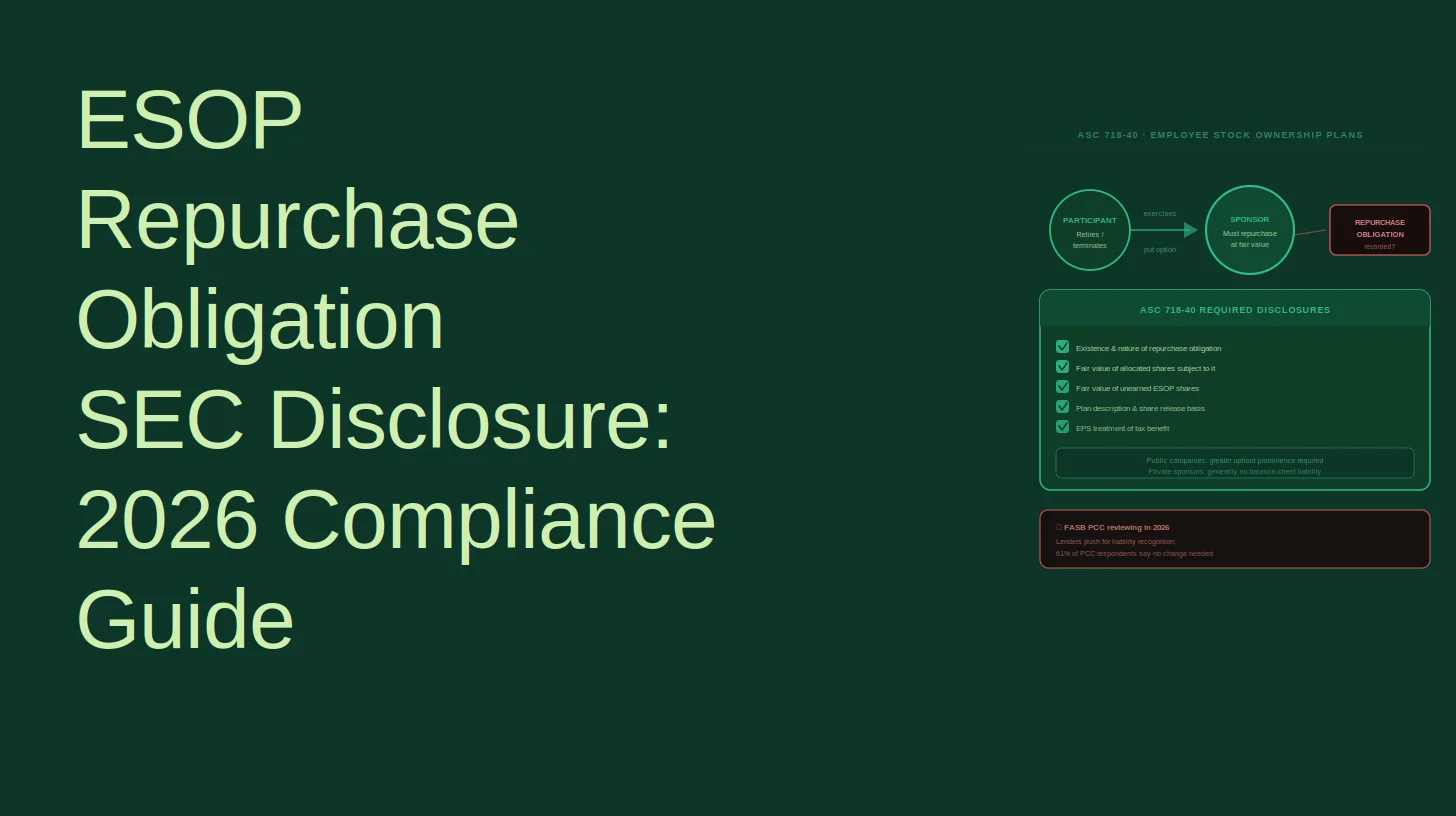
ESOP Repurchase Obligation SEC Disclosure: 2026 Compliance Guide
If your company sponsors an ESOP and files with the SEC, the repurchase obligation is one of the most under-disclosed material items in your financial statements. The GAAP minimum has not changed in over 30 years, SEC staff are asking harder questions in comment letters, and the FASB's Private Company Council formally put ESOP disclosure reform on its agenda in March 2026. This guide maps exactly what you must disclose today, where preparers routinely fall short, and what enhanced requirements may look like tomorrow.
Key takeaway: ASC 718-40-50-1(f) sets the floor, not the ceiling. SEC staff and the FASB's own investors have both signalled that floor is too low.
What Is the ESOP Repurchase Obligation?
The repurchase obligation is the employer's statutory duty to buy back ESOP shares from participants at fair value when those shares are not readily tradable on an established securities market.
The mechanics come from two statutes. Under ERISA §409(h) and IRC §409(o), a closely held ESOP company must give participants a "put option" on distributed shares. The participant can force the employer to repurchase those shares at fair market value during two windows: the first 60 days immediately following distribution, and a second 60-day window in the following plan year. That put option is the repurchase obligation.
FASB ASC 718-40-25-2 codifies this directly: "Employers are required to give a put option to participants holding ESOP shares that are not readily tradable, which on exercise requires the employer to repurchase the shares at fair value (referred to as a repurchase obligation)."
The phrase "readily tradable on an established securities market" matters. Stock traded on an over-the-counter system does not qualify, per IRS private letter ruling guidance, so most ESOP companies, including many smaller SEC registrants, carry this obligation. Once a company completes an IPO and its shares become listed, the put-option trigger disappears, which is a material disclosure point for S-1 filers to address explicitly.
For mature ESOP companies, the obligation is not trivial. NCEO research shows that many mature ESOP companies repurchase between 2% and 5% of outstanding shares every year. The median percentage repurchased in NCEO's 2023 survey was 5%, with 17% of respondents repurchasing more than 10% annually.
What ASC 718-40-50-1 Actually Requires: The Full Disclosure Checklist
ASC 718-40-50-1 contains six mandatory disclosure items for ESOP plan sponsors. Most preparers know item (f), but items (a) through (e) are equally required and equally subject to SEC staff review.
ItemWhat Must Be DisclosedRequired or Best Practice?(a)Description of the plan; basis for determining contributions; employee groups covered; nature and effect of significant matters affecting comparabilityRequired(b)Accounting policies: compensation measurement method, dividend classification, EPS treatmentRequired(c)Compensation cost recognized during the periodRequired(d)Number of allocated shares, committed-to-be-released shares, and suspense sharesRequired(e)Fair value of unearned ESOP sharesRequired(f)Existence and nature of any repurchase obligation, including the fair value of allocated shares subject to that obligation as of the balance-sheet dateRequired
Source: FASB PCC Staff Memo No. 6, February 17, 2026, summarising ASC 718-40-50-1.
Item (f) is the one investors have specifically flagged as inadequate. As the FASB PCC staff wrote in February 2026: "Investors provided feedback that ESOP repurchase obligation disclosure requirements could be enhanced. GAAP requires an entity to disclose the existence and nature of any repurchase obligation, including disclosure of the fair value of the shares allocated as of the balance sheet date, which are subject to a repurchase obligation."
Notice what item (f) does not require:
- A quantified estimate of the total future repurchase obligation
- A multi-year cash-flow projection
- A funding plan or sinking-fund status
- A sensitivity analysis on share-price assumptions
Those are all best practice, and increasingly what SEC staff ask for, but they are not yet codified GAAP requirements.
The Valuation Complexity Behind Item (f)
The fair-value figure required by item (f) is not a simple lookup. For non-publicly-traded employer stock, IRC §401(a)(28)(C) requires an annual independent appraisal by a qualified independent appraiser. That appraisal drives both the put-option price and the ASC 718-40-50-1(f) disclosure amount. If the ESOP holds convertible preferred stock rather than common stock, the fair-value disclosure must also reflect the preferred stock's conversion features, adding another layer of complexity per PwC's Stock-Based Compensation guide, Section 11.3.
The appraiser must also factor the repurchase obligation itself into the share valuation, since a large future repurchase obligation depresses enterprise value. This circularity is a known challenge in ESOP appraisal practice.
Do You Need to Record a Liability on the Balance Sheet?
No, not automatically. The repurchase obligation is generally a contingent liability, not an accrued liability, and ASC 718-40 does not require a quantified liability accrual. But the classification question is more nuanced than that.
Three possible treatments exist:
- Footnote-only disclosure under ASC 718-40-50-1(f): the most common approach for the contingent put-option obligation.
- Mezzanine (temporary) equity classification: PwC's Financial Statement Presentation guide, Section 15.7 addresses this directly. Shares subject to a repurchase obligation may need to be reclassified from permanent equity to temporary equity (mezzanine) if the repurchase is outside the company's control. This affects the equity section presentation, not just the footnote.
- Liability classification: PwC's Stock-Based Compensation guide, Section 11.5 addresses the interpretive question of when an ESOP plan document that requires repurchase at retirement creates a liability rather than mezzanine equity. The answer turns on whether the repurchase is unconditional or contingent on the participant's election.
Espey Mfg. & Electronics Corp. illustrates the liability treatment in practice. In its Form 10-Q for the quarter ended September 30, 2018, the company reported an "ESOP payable" of $101,361 as a current liability on the balance sheet, with $0 at the prior quarter-end, and disclosed in the notes that no shares were repurchased during the quarter. That quarterly variability illustrates how quickly the obligation can crystallise into a cash demand once a participant exercises their put option.
The FASB PCC's February 2026 memo signals that balance-sheet presentation, not just footnote disclosure, is under active review. The PCC asked members whether to focus on "presentation, disclosures, or both" as part of its research agenda, meaning mezzanine vs. permanent equity classification may also be on the table.
Common preparer error: Conflating the ESOP repurchase obligation with the ESOP loan liability. For a leveraged ESOP, the employer must report the ESOP loan as a separate liability on its balance sheet and recognise related interest cost, per PwC's Stock-Based Compensation guide, Section 11.4. These are two distinct items requiring separate disclosure treatment.
How SEC Staff Comment Letters Push Beyond the GAAP Minimum
SEC staff have asked registrants to go further than ASC 718-40-50-1(f) when the repurchase obligation appears material. The primary pressure points in comment-letter practice are:
- Quantification of the obligation: Staff have asked companies to provide an estimated dollar amount of the total repurchase obligation, not just the fair value of currently allocated shares.
- Funding plan disclosure: Staff have asked how the company intends to fund future repurchases, particularly when the obligation is growing faster than operating cash flow.
- MD&A liquidity discussion: Staff have pressed registrants to explain whether the repurchase obligation represents a known trend or uncertainty under Regulation S-K Item 303.
- Sensitivity to share-price changes: For companies where share value is growing rapidly, staff have asked how a change in valuation would affect the repurchase obligation.
The MD&A dimension is the one most often missed. Regulation S-K Item 303 requires disclosure of known trends, demands, commitments, events, or uncertainties that will, or are reasonably likely to, have a material effect on liquidity. A material ESOP repurchase obligation, particularly one growing in line with share appreciation and an aging workforce, is a textbook Item 303 trigger. If your 10-K footnote discloses a large and growing fair value of allocated shares subject to the repurchase obligation, but your MD&A liquidity section says nothing about it, expect a comment.
For guidance on structuring MD&A liquidity disclosures to avoid SEC staff comments, see how to write a results-of-operations section that won't draw SEC comments.
Should the Repurchase Obligation Also Be Disclosed Under ASC 450?
This question comes up when the obligation is both probable and estimable. ASC 450 (contingencies) requires accrual when a loss is probable and can be reasonably estimated. The ESOP repurchase obligation is contingent on participant elections, which makes it harder to characterise as "probable" in the ASC 450 sense. In practice, most preparers rely on ASC 718-40-50-1(f) as the specific, more targeted standard and do not separately accrue under ASC 450. But if a specific repurchase event is imminent and the amount is known, the ASC 450 analysis should be documented.
The XBRL Tagging Obligation
SEC filers must tag ESOP repurchase obligation disclosures in their iXBRL submissions. The SEC EDGAR XBRL taxonomy includes a specific element for tabular disclosure of ASC 718-40-50-1 information, referencing both the FASB ASC and the legacy AICPA SOP 93-6 (Paragraph 53). The taxonomy element covers the full checklist: plan description, accounting policies, compensation cost, share counts, fair value of unearned shares, and the repurchase obligation.
That taxonomy has not been materially updated since 2012, consistent with the PCC's finding that the disclosure framework is stale. If the PCC reform results in new disclosure requirements, expect a corresponding taxonomy update, which will require disclosure teams to map new data points to new XBRL elements.
The M&A Dimension: Repurchase Obligations in Deal Agreements
In M&A transactions, an undisclosed or under-quantified ESOP repurchase obligation is a deal risk, not just a disclosure issue. Buyers routinely treat it as a potential breach of the "no undisclosed liabilities" representation.
Two recent SEC-filed agreements illustrate current market practice:
Leidos/Dynetics (December 2019): The stock purchase agreement included a standalone Section 4.20 covering ESOP representations, alongside a separate Section 4.06 on "Financial Statements; Undisclosed Liabilities." Section 8.04 required the company to "take all action required under the terms of the ESOP and applicable Law" in connection with the transaction, including addressing the repurchase obligation on termination. The dual-protection structure, a dedicated ESOP rep plus the undisclosed-liabilities rep, is the standard buyer approach.
Firefly Aerospace/SciTec (October 2025): The agreement and plan of reorganization included a specific covenant on "ESOP Termination and Wind-up" (Section 9.10) and "ESOP Loan Receivable" (Section 9.9), and the conditions to closing included an "ESOP Determination" in form and substance satisfactory to the buyer. As of October 2025, sophisticated buyers are treating ESOP repurchase obligation resolution as a closing condition, not merely a disclosure item.
The practical implication: if your SEC filings understate the repurchase obligation, you face not just an SEC comment letter but also deal risk in any future transaction. Buyers will conduct their own repurchase obligation study and compare it to your disclosed figures.
For a broader treatment of how M&A disclosure filings attract SEC staff scrutiny, see anticipating SEC comments in M&A disclosure filings.
The S-1/IPO Dimension
A company going public with an ESOP faces two distinct disclosure challenges in its S-1. First, the SEC will review whether historical ESOP repurchase obligation disclosures in the financial statements included in the S-1 met the ASC 718-40-50-1 standard. Private companies often disclose less than SEC standards require, and the S-1 review process will surface those gaps.
Second, the IPO itself may eliminate the put-option obligation going forward. Once shares become "readily tradable on an established securities market" post-listing, the ERISA/IRC put-option requirement no longer applies. The S-1 should explain this transition explicitly, including how the repurchase obligation will be treated for shares already allocated to participants before the IPO.
For a broader guide to S-1 disclosure pitfalls, see mastering S-1 disclosures: avoiding critical errors in your IPO.
What the 2026 FASB PCC Reform Means for Your Disclosures
The ESOP repurchase obligation disclosure framework is under active review for the first time in over 30 years. The core GAAP requirement in ASC 718-40-50-1(f) traces back to AICPA Statement of Position 93-6, issued in 1993. It has been substantively unchanged since then.
At its March 3, 2026 public meeting, the FASB's Private Company Council formally considered adding ESOPs to its research agenda. The staff memo, dated February 17, 2026, states explicitly: "User feedback has indicated a need for enhanced disclosures in a plan sponsor's financial statements as described in this memo, particularly around repurchase obligations."
The PCC asked two specific questions of its members:
- Whether to research ESOPs as an agenda priority, and whether to focus on presentation, disclosures, or both.
- What education would be helpful for PCC members.
The framing of "presentation, disclosures, or both" is significant. It signals that balance-sheet classification (mezzanine vs. permanent equity) is also on the table, not just footnote enhancement.
What enhanced disclosures might look like, based on the investor feedback summarised in the memo:
- Multi-year repurchase obligation projections: a forward-looking estimate of expected cash outflows over a defined horizon (3 to 5 years is the typical repurchase study timeframe).
- Funding-status disclosure: whether the company has a sinking fund, life insurance arrangement, or recycling strategy in place, and its funded status relative to the projected obligation.
- Sensitivity analysis: how the obligation changes under different share-price growth scenarios.
- Demographic assumptions: the workforce and actuarial assumptions underlying any projection.
None of these are required today. But the PCC process, combined with rising SEC staff scrutiny, creates a strong case for voluntary adoption now rather than waiting for a final standard.
Should You Adopt Enhanced Disclosures Voluntarily?
The argument for moving early is straightforward. If SEC staff are already asking for quantification and funding plans in comment letters, and the PCC is signalling that enhanced requirements are coming, a company that already provides that information is better positioned on both fronts. The argument against is that voluntary disclosures create a baseline that future filings must maintain or explain.
A middle path: commission a repurchase obligation study (the standard practice recommended by ESOP advisors every three to five years, or more frequently as the ESOP matures), use its outputs to inform your MD&A liquidity discussion, and disclose the existence and general approach of the funding strategy without committing to specific projection figures until the GAAP framework is clearer.
ESOP Repurchase Obligation Disclosure Checklist for 2026 Filings
Use this checklist for your 10-K, 10-Q, and S-1 ESOP disclosures.
ASC 718-40-50-1 footnote (mandatory):
- Plan description, contribution basis, employee groups covered (item a)
- Accounting policies: compensation measurement, dividend classification, EPS treatment (item b)
- Compensation cost recognised during the period (item c)
- Share counts: allocated, committed-to-be-released, suspense (item d)
- Fair value of unearned ESOP shares (item e)
- Existence and nature of the repurchase obligation, including fair value of allocated shares subject to it as of the balance-sheet date (item f)
- XBRL tags applied to all items above per the SEC EDGAR taxonomy
Balance-sheet classification (judgment required):
- Assessed whether shares subject to the repurchase obligation should be classified as temporary equity (mezzanine) rather than permanent equity
- Documented the analysis distinguishing the repurchase obligation from the ESOP loan liability (separate line items)
- Considered whether any specific repurchase event meets the ASC 450 accrual threshold
MD&A liquidity and capital resources (Item 303):
- Assessed whether the repurchase obligation is a known trend or uncertainty material to liquidity
- If material: disclosed the estimated obligation, funding approach, and trend
- If a repurchase obligation study exists: considered whether its projections should be summarised in MD&A
M&A readiness:
- Repurchase obligation quantified and documented for due diligence purposes
- ESOP representations and warranties in any deal agreement reviewed against actual disclosed figures
- ESOP termination and wind-up obligations addressed in deal covenants if applicable
S-1/IPO-specific:
- Historical ESOP disclosures reviewed against SEC standards before filing
- Post-IPO elimination of the put-option obligation disclosed and explained
- Transition treatment for pre-IPO allocated shares addressed
FAQ
Do ESOPs create repurchase obligations?Yes, for closely held companies. Under IRC §409(h), any ESOP holding employer stock that is not readily tradable on an established securities market must give participants a put option, requiring the employer to repurchase distributed shares at fair value. Publicly traded companies are exempt because participants can sell shares on the market.
Can a company buy back ESOP shares?Yes, and in most cases it must. The employer is the primary obligor on the put option, though the ESOP itself may repurchase shares instead if the plan permits. The company cannot force the ESOP to honour the put option; the obligation ultimately rests with the employer.
What happens when an ESOP company is bought out?In an M&A transaction, the repurchase obligation typically becomes a closing condition or a subject of specific representations and warranties. Buyers require the seller to quantify the obligation, address it in deal covenants, and often require ESOP termination and wind-up as a condition to closing, as illustrated by the Firefly/SciTec agreement (Section 9.10, October 2025).
Is the ESOP repurchase obligation the same as the ESOP loan liability?No. For a leveraged ESOP, the employer must report the ESOP loan as a separate balance-sheet liability and recognise related interest cost. The repurchase obligation is a separate contingent liability arising from the put option on distributed shares. Conflating the two is a common preparer error that can result in incomplete disclosures.
What is the difference between public and private company disclosure obligations?Both are subject to ASC 718-40-50-1. SEC-reporting companies face the additional layer of Regulation S-K Item 303 (MD&A liquidity disclosure) and SEC staff comment-letter scrutiny. The FASB PCC reform process is focused on private companies as its primary constituency, but any enhanced standard would flow through to public companies via the Codification.
How quickly can the repurchase obligation become a cash demand?Fast. The ERISA put-option window opens 60 days after distribution. A participant who receives a distribution can exercise the put option within 60 days, creating a cash demand the employer must meet. A second 60-day window opens in the following plan year. For a company with a large retiring cohort, multiple put options can crystallise simultaneously.
The disclosure framework that governed ESOP repurchase obligations when SOP 93-6 was written in 1993 was designed for a different capital market. The FASB PCC's 2026 agenda decision will determine whether it finally catches up.