How to Prevent Repeat SEC Comment Letters: A 2026 Process Guide for CFOs
You cleared the comment. You filed the response, the staff sent a completion letter, and everyone moved on. Then the next review cycle starts and the same issue surfaces again. This guide explains why that happens and, more importantly, how to prevent it.
This is for compliance officers, CFOs, and securities counsel who have already been through at least one SEC comment letter and want a repeatable process for avoiding repeat SEC comments, not just a list of hot-button topics.
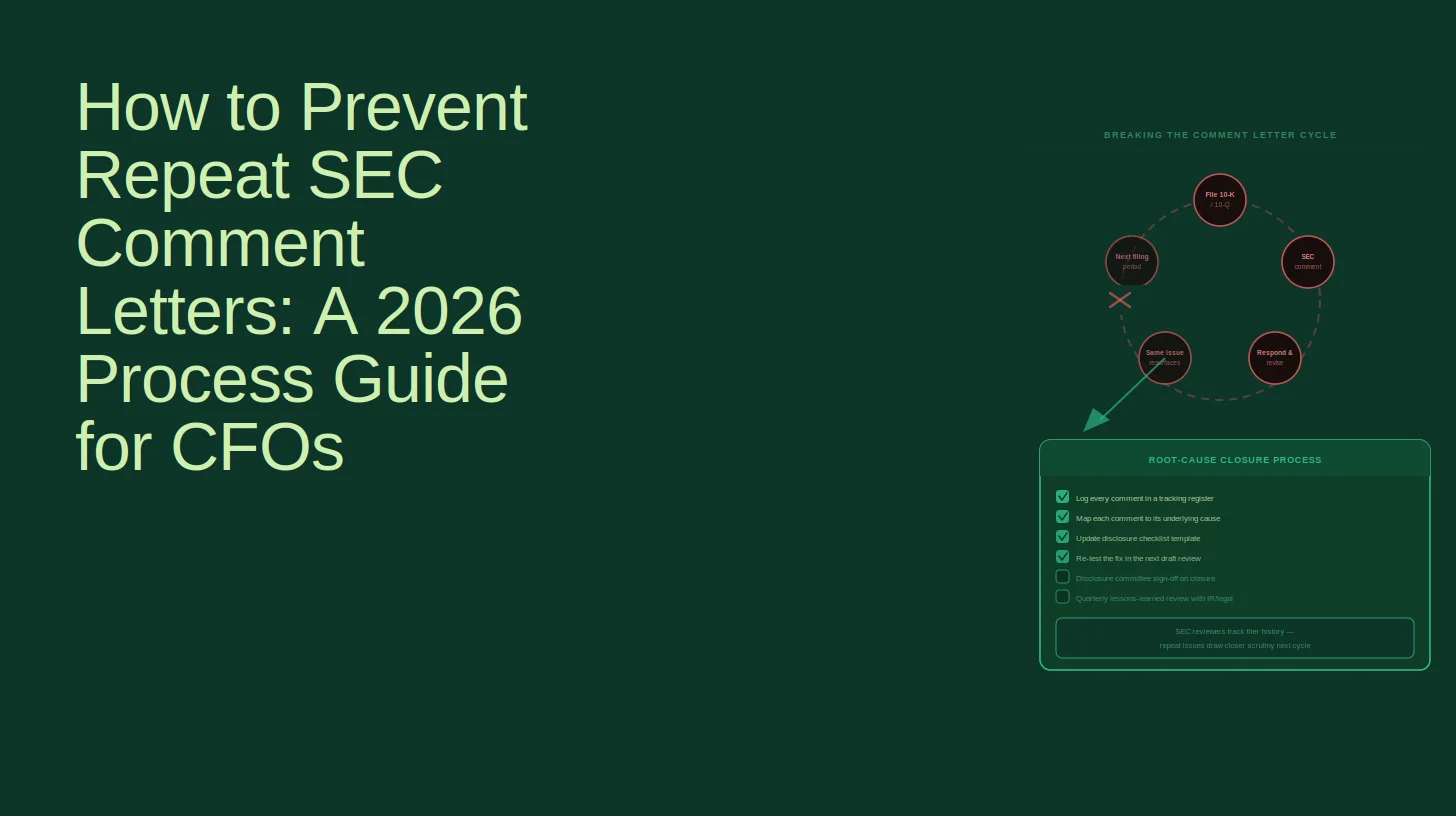
Key takeaway: Most repeat comments are not caused by bad disclosure. They are caused by a broken feedback loop: the company fixes the symptom in the response letter but never updates the underlying disclosure template, controls, or cross-filing review process.
Why Repeat SEC Comments Happen: Three Structural Failure Modes
Repeat comments are almost always a process failure, not a knowledge failure. The disclosure team usually knows what the SEC wants. The problem is that the response to a first-time comment is treated as a legal task rather than a disclosure-controls improvement exercise, and the lesson never makes it back into the system.
Three failure modes drive the vast majority of repeat comments:
-
No root-cause analysis after the first comment. The team responds to the specific question asked, clears the comment, and moves on. Nobody asks: why did this gap exist in the first place, and does the same gap appear in our 10-Qs, proxy, or earnings releases?
-
The response process is siloed. Outside counsel drafts the response letter. The disclosure committee sees it. But the filing template, the MD&A drafting guide, and the non-GAAP reconciliation checklist are never updated. The next 10-K is drafted from the same starting point as the one that drew the comment.
-
No monitoring of peer comment letters. The SEC's EDGAR system makes every comment letter and response publicly available, typically a few weeks after the review closes. Companies that systematically review peer correspondence before filing can spot emerging comment themes before they receive a first-time comment. Most companies do not do this.
The SEC's own internal process reinforces the stakes. The SEC OIG's audit of the Division of Corporation Finance's comment letter follow-up process found that the Division's screening process checks for comments from previous reviews that are pending resolution before initiating a new review. Inadequately resolved prior comments are flagged at the outset of the next cycle. If the staff is not satisfied with a response, it re-issues the comment, and in cases of material non-compliance, staff may contact the Enforcement Division.
How the SEC Staff Actually Evaluates Your Response
The staff applies a two-level review. First-level reviewers (staff accountants and attorneys) perform an in-depth review of the response and propose a disposition. Second-level reviewers perform a less detailed review and may agree, add comments, or waive. The comment is cleared only when the Division is satisfied, and that bar is higher than many registrants assume.
Two points from Deloitte's DART guidance are worth internalizing before you draft any response:
- "Just because the staff asks a question does not mean that it has reached a conclusion or that a change is required."
- "A registrant should not agree to include a disclosure in future filings solely to expedite the completion of a review."
The second point is the one most teams get wrong. Agreeing to add a disclosure in the next filing just to clear the comment quickly creates a disclosure commitment you must then maintain in every subsequent filing. If you omit it in year two, you have guaranteed a repeat comment. If the disclosure is genuinely immaterial, Deloitte's guidance advises communicating that belief to the staff early in the review process rather than simply adding the language.
The staff's review scope is also broader than most teams realize. As Deloitte's guidance states: "The scope of the staff's review encompasses information beyond the review of specific filings to include other information, such as press releases, information on a registrant's Web site, analyst calls, investor presentations, and other documents such as sustainability reports." Inconsistencies between your 10-K and your earnings call transcript or your sustainability report are a primary comment trigger, and they are a repeat-comment trigger if you fix the 10-K language without updating the other documents.
The Post-Comment Retrospective: Closing the Loop
The single most effective tool for avoiding repeat SEC comments is a structured post-comment retrospective, run as a formal disclosure committee agenda item within 30 days of receiving a completion letter. Most companies skip this entirely.
Here is a concrete protocol:
Step 1: Root-cause classification. For each comment received, classify the root cause:
- Disclosure template deficiency (the standard language was inadequate)
- Quantification gap (drivers were described qualitatively but not quantified)
- Cross-document inconsistency (10-K language conflicted with an earnings release or investor presentation)
- Emerging standard or rule (the comment reflected a new SEC focus area the team had not yet addressed)
- Peer-analogy error (the response was modeled on another registrant's response without adjusting for fact-pattern differences)
Step 2: Template and checklist update. For every comment with a disclosure template root cause, update the relevant drafting template before the next filing cycle begins. Do not wait until the next 10-K drafting process is underway.
Step 3: Cross-filing audit. Run a targeted review of the 10-Q filed most recently, the proxy statement, the most recent earnings release, and any investor presentations to confirm the same deficiency does not appear elsewhere. The OIG audit found that registrants tended to resolve registration-statement comments quickly because they needed the registration to become effective to raise capital, but were less rigorous about institutionalizing lessons in ongoing 1934 Act reporting. That asymmetry is where most repeat comments originate.
Step 4: DC&P assessment. Consult with SEC legal counsel about whether the comment reveals a deficiency in disclosure controls and procedures (DC&P) that affects the CEO/CFO certifications under SOX Sections 302 and 906. A comment that surfaces a material weakness in DC&P may require a restatement of those certifications. Failing to address this creates additional comment and enforcement risk.
Step 5: Auditor consultation. Consult with your auditors on the comment's impact on their ability to issue the current-year audit report. Unresolved or inadequately resolved comments can directly affect the audit opinion timeline and create filing deadline risk.
Step 6: Confirm clearance explicitly. If you have not received a follow-up letter or been contacted within two weeks of filing your initial response, Deloitte's guidance advises contacting the SEC staff reviewer to determine the status. If the review is complete, ask for a completion letter. Assuming clearance without confirmation is a common source of ambiguity that feeds the next cycle.
Writing Responses That Don't Invite Follow-Up Comments
The structure of your response letter matters as much as the substance. The standard format, illustrated in Apple's EDGAR correspondence on its FY2014 10-K, repeats each staff comment in full before providing the registrant's response. This ensures the staff can efficiently evaluate whether each comment has been fully addressed.
Four response-drafting practices reduce the probability of a follow-up comment:
-
Cite the specific standard paragraph. Responses that reference specific ASC or IFRS paragraphs are significantly less likely to generate follow-up comments. A response that cites "ASC 820-10-50-2bb" rather than "applicable fair value guidance" demonstrates substantive engagement with the standard. The SEC's own comment to Apple asked: "Please explain to us how you considered expanding this disclosure to include the specific valuation techniques used as well as examples of the significant inputs used in those valuations. We refer you to ASC 820-10-50-2bb."
-
Include the prospective disclosure in the response letter itself. Because some comments request disclosure in future filings, Deloitte's guidance advises including that disclosure in the response letter to potentially eliminate additional requests from the staff reviewer. This also creates a written record of exactly what you committed to, which disciplines the next drafting cycle.
-
Do not over-analogize to peer responses. EY's September 2025 SEC comment letter trend report explicitly warns registrants to "avoid overreliance on other registrants' disclosures or comment letter responses on similar topics because there may be differences in facts and circumstances." Deloitte's guidance echoes this: "A registrant should use caution when analogizing to other registrants' fact patterns since a small difference in facts could make a meaningful difference in the response."
-
File the response and the amended filing together. The OIG audit recommended that the Division request registrants file amendments and supplemental information together. Piecemeal responses that separate the response letter from the amended filing prolong the comment cycle.
The Highest-Recurrence Comment Categories in 2025-2026
The following categories generate the most repeat comments, based on EY's 2025 trend report and consistent Big-4 annual commentary. For each, the repeat-comment risk is specific.
Comment CategoryPrimary StandardRepeat-Comment RiskMD&A results of operationsReg S-K Item 303Quantification of drivers added in response but omitted in next filingNon-GAAP measuresNon-GAAP C&DIsReconciliation format corrected but prominence rules violated againSegment reportingASC 280Aggregation criteria analysis not documented; same question recursRevenue recognitionASC 606Disaggregation categories changed without updating contract-cost disclosuresFair value measurementASC 820Generic valuation language reinstated after one cycle of specificityRisk factorsReg S-K Item 105Boilerplate language returns after one filing with company-specific languageAI and cybersecurityItem 1.05 / Item 106First-time comment addressed in isolation; framework not updatedESG/climate inconsistenciesReg S-K / sustainability reports10-K language updated but sustainability report not reconciledExecutive compensation (CD&A)Reg S-K Item 402Pay-for-performance narrative vague; same comment in next proxy
For MD&A specifically, Finrep has a detailed guide on writing a results-of-operations section that avoids SEC comments.
AI, Cybersecurity, and ESG: The New Repeat-Comment Frontier
These three areas are where first-time comments in 2024 and 2025 will become repeat comments in 2026 and 2027 if companies do not respond systemically.
AI and cybersecurity disclosures under Item 1.05 of Form 8-K and Item 106 of Regulation S-K are generating comments at elevated rates. The pattern is predictable: a company receives a first-time comment asking for more specificity on AI governance or cybersecurity risk management processes, adds a paragraph to the next 10-K, and considers the matter closed. But if that paragraph is drafted in isolation rather than as part of a disclosure framework that is reviewed and updated each cycle, the specificity erodes and the comment returns. Finrep's guide on AI disclosure risks in SEC filings covers the substantive requirements in detail.
ESG and sustainability reports present a distinct risk. Deloitte's guidance explicitly includes sustainability reports within the staff's review scope. A company that publishes a sustainability report with emissions data or governance claims that are inconsistent with the risk factor disclosures in its 10-K is creating a comment trigger that will recur every cycle until the two documents are reconciled through a formal cross-document review process.
One important 2026 context point: the SEC under Chair Atkins has signaled deregulatory intent on some fronts, including Reg S-K reform proposals and streamlined IPO reporting rules. Companies that read this as a signal to reduce disclosure quality are misreading the environment. Corp Fin staff continue to issue substantive comments on AI, cybersecurity, and non-GAAP disclosures at elevated rates. Deregulatory reform and active comment review are not mutually exclusive, and treating them as such is a reliable path to more comments, not fewer.
Building a Disclosure Committee Governance Framework
The disclosure committee is the right governance mechanism for preventing repeat comments, but only if it has a structured comment-letter agenda item. Most disclosure committees review draft filings. Fewer have a formal process for translating comment-letter lessons into standing disclosure controls.
A practical framework has four components:
1. Pre-filing EDGAR monitoring. Assign a team member to review comment letters issued to three to five peer companies in the 60 days before each annual filing. EY's annual SEC comment letter trends report and equivalent publications from PwC, KPMG, and Deloitte are also essential inputs. Registrants that review these reports before drafting can proactively address emerging comment themes before receiving a first-time comment. The SEC's Corporation Finance Interpretations for Securities Act rules, last updated March 6, 2026, should also be monitored for staff guidance changes.
2. Comment-letter log. Maintain a running log of every comment received, the root-cause classification, the response approach, and the disclosure-template change made. This log is the institutional memory that prevents the same gap from recurring when personnel turn over.
3. Cross-document consistency review. Before each 10-K filing, run a structured comparison of the draft against the most recent earnings releases, investor presentations, analyst call transcripts, and sustainability report. Flag any inconsistency for resolution before filing, not after.
4. SOX 302/906 certification review. Before each CEO/CFO certification, the disclosure committee should specifically consider whether any open or recently cleared comment letters indicate a deficiency in DC&P that should be reflected in the certification or in the internal controls disclosure. This step is frequently skipped and is one of the higher-stakes omissions in the comment-letter response process.
SOX Section 408 requires the SEC to review every reporting company's filings at least once every three years. For companies reviewed more frequently, the feedback loop described above needs to run on an annual cadence. The SEC's plain English Staff Legal Bulletin No. 7 put the Commission's intent plainly: "By alerting issuers to these comments before they file their next registration statement, we hope to enable them to avoid receiving these comments again." The comment letter is a compliance tool, not a penalty. Companies that treat it as one are the ones that keep getting the same letter.
FAQ
How common are SEC comment letters?The Division of Corporation Finance reviews every reporting company's filings at least once every three years under SOX Section 408, and larger companies may be reviewed annually or more frequently. In FY 2000, the Division issued comments on 2,435 new issuers and 1,535 reporting issuers. Not every review results in a comment letter, but most public companies will receive at least one over a three-year period.
How long do you have to respond to an SEC comment letter?The standard deadline is 10 business days from the date of the comment letter. Extensions are available on request, and Deloitte's guidance notes that if possible, registrants should avoid requesting one because it may delay resolution. That said, a more thorough and complete response that takes a few extra days is almost always preferable to a rushed response that generates a follow-up comment.
Are SEC comment letter responses public?Yes. Both the comment letter and the registrant's response are posted on EDGAR, typically a few weeks after the review closes. This creates reputational exposure beyond the immediate review: investors, analysts, and peer companies can read your responses. It also means your competitors' comment letters are available for you to review before filing.
Can an SEC comment escalate to enforcement?Yes. As the SEC OIG audit documents, if the registrant's non-compliance appears material, the staff may contact the Enforcement Division. This is not the typical outcome of a comment letter, but it is the outcome of repeated material non-compliance.
Should we amend a prior filing or commit to prospective disclosure changes?This depends on whether the comment identifies a material misstatement or omission in the prior filing. If it does, an amendment is likely required. If the comment is requesting enhanced disclosure going forward, a commitment to prospective changes is usually sufficient. The critical discipline is to actually implement the commitment in the next filing and update the disclosure template so it persists.
How do we use peer EDGAR comment letters without over-relying on them?Use peer letters to identify themes and questions the staff is asking in your industry. Do not use them as response templates. As both EY and Deloitte emphasize, a small difference in facts can make a meaningful difference in the appropriate response. Peer letters inform your pre-filing disclosure review; they do not substitute for your own analysis of your specific facts and applicable standards.