ASU 2026-02 (Topic 818): Environmental Credits Accounting Guide for 2026
The FASB issued ASU 2026-02 on May 22, 2026, and it fills a gap that has existed in US GAAP for decades. For the first time, companies have authoritative guidance on how to recognize, measure, present, and disclose environmental credits and the regulatory compliance obligations that can be settled with them.
This guide is for CFOs, controllers, ESG finance teams, and technical accountants at any entity that buys carbon offsets, holds RECs, participates in cap-and-trade programs, or carries renewable fuel standard (RFS) obligations. If that describes your organization, ASU 2026-02 will change your balance sheet, your P&L, and your footnotes.
Key takeaway: ASU 2026-02 creates ASC Topic 818, the first comprehensive US GAAP model for environmental credits. Whether you capitalize or expense a credit now depends entirely on what you intend to do with it.
What Is ASU 2026-02 and Why Does It Matter?
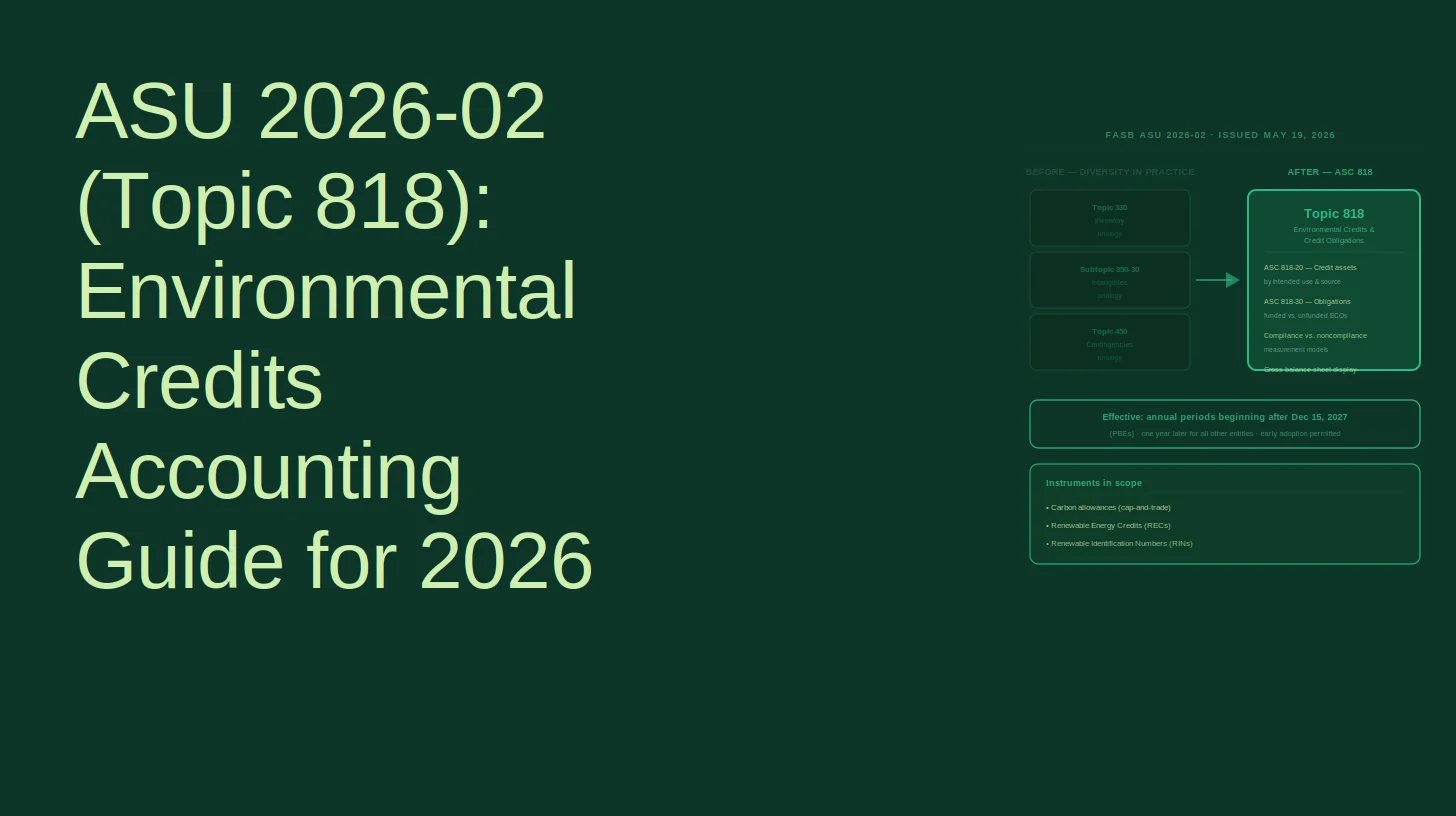
ASU 2026-02, formally titled "Environmental Credits and Environmental Credit Obligations (Topic 818)," establishes the first authoritative US GAAP framework for these instruments. Before this standard, no specific codified guidance existed. Teams applied analogies: some expensed credits immediately, others capitalized them under ASC 330 (Inventory) or ASC 350-30 (Intangibles), producing significant and unresolvable diversity in practice.
The FASB's own news release puts it plainly: "The new ASU adds guidance that will provide clarity around accounting and disclosures that previously did not exist in environmental credits and related credit obligations."
For companies with active sustainability programs, the stakes are real. The accounting directly affects:
- Balance sheet size (gross presentation required; no netting permitted)
- P&L timing (voluntary/net-zero credits are expensed immediately)
- EPS (retained earnings adjustment at transition)
- Footnote disclosures (new, detailed annual requirements)
For background on the scope of Topic 818 and which entities it touches, see Finrep's primer on what FASB Topic 818 is and who it applies to.
What Qualifies as an Environmental Credit Under Topic 818?
An environmental credit is an enforceable right that meets all four of the following criteria, per EY's AccountingLink analysis of the standard:
- It lacks physical substance and is not a financial asset.
- It is represented to prevent, control, reduce, or remove emissions or other pollution.
- It is, or previously was, separately transferable in an exchange transaction. (If no longer transferable, the entity must be able to use it to settle an ECO.)
- It is not an income tax credit that may be used to settle an entity's income tax liability.
Instruments that generally meet this definition include:
- Carbon offsets
- Renewable energy certificates (RECs)
- Cap-and-trade allowances and emission allowances
- Renewable identification numbers (RINs)
- Other industry-specific credits (e.g., credits under California's Low Carbon Fuel Standard)
One nuanced scoping point worth flagging: credits that have lost their separate transferability can still qualify if they can be used to settle an ECO. This matters for legacy or retired credits that an entity may still hold.
What Is an Environmental Credit Obligation (ECO)?
An ECO is a regulatory compliance obligation arising from existing or enacted laws, statutes, or ordinances represented to prevent, control, reduce, or remove emissions or other pollution, where the obligation may be settled with environmental credits. The FASB's Basis for Conclusions (paragraph BC6) confirms this definition captures cap-and-trade programs, renewable portfolio standard (RPS) programs, and renewable fuel standard (RFS) programs.
Two important exclusions:
- Obligations within the scope of ASC 410-30 (Environmental Obligations) are not ECOs.
- A voluntary initiative or statement of intent does not create an ECO liability.
The IRA Tax Credit Exclusion: A Critical Distinction
This is the scoping mistake practitioners are most likely to make. IRA renewable energy tax credits, including investment tax credits (ITCs) and production tax credits (PTCs), are explicitly excluded from Topic 818. The exclusion applies regardless of whether the entity has a current tax liability or intends to use the credit.
As EY notes: "Because income tax credits are excluded from the definition of an environmental credit, entities should continue to account for renewable energy tax credits, including those associated with the Inflation Reduction Act, in accordance with other US GAAP."
RECs and ITCs are not the same instrument. A REC certifies that one megawatt-hour of electricity was generated from a renewable source and is separately transferable. An ITC is a tax credit that reduces an entity's income tax liability. Only the REC falls under Topic 818.
The Capitalize-vs-Expense Decision: How the Recognition Model Works
The core of ASU 2026-02 is a use-intent-based recognition model. Whether a credit hits the balance sheet or the income statement depends on what the entity probably intends to do with it.
An environmental credit is recognized as an asset if it is probable, collectively, that the entity will:
- Use it to settle an ECO (compliance use)
- Transfer it in an exchange transaction (sale or trade)
- Use it in a nonreciprocal transfer (e.g., a grant to another party)
If none of those conditions are met, the cost is expensed immediately. This includes credits purchased for voluntary purposes, such as carbon-neutral or net-zero initiatives.
Key takeaway: A carbon offset bought to meet a cap-and-trade compliance obligation is capitalized. The same offset bought to support a voluntary net-zero pledge is expensed the day you acquire it.
This distinction creates an operational challenge: teams must document intended use at the point of acquisition and reassess it at each reporting date. A change in intent can trigger reclassification.
Compliance Credits vs. Noncompliance Credits
CategoryDefinitionSubsequent MeasurementCompliance creditHeld to settle an ECOMeasured at cost; not remeasuredNoncompliance creditAll others (held for sale, trading, or voluntary use)Measured at cost; assessed for impairment at each reporting date
Entities may also make a class-wide policy election to measure eligible noncompliance credits at fair value, per Deloitte's Heads Up on the standard.
Costing Methods
Three methods are permitted for measuring environmental credit assets:
- First-in, first-out (FIFO)
- Average cost
- Specific identification
Entities must disclose the method elected. The choice has real P&L implications for entities with large, actively traded credit portfolios where prices fluctuate.
How to Measure an ECO Liability: The Layered Model
ECO liabilities are recognized when obligating events occur on or before the reporting date. The measurement follows a layered model that distinguishes the funded portion (credits on hand) from the unfunded portion (credits still needed).
Funded Portion
The funded ECO is measured at the cost basis of the compliance credits on hand that the entity intends to use to settle the obligation. Critically, the funded ECO is measured after the recognition and measurement of the environmental credit asset. This sequencing is operationally important: you must first confirm which credits you have on hand and intend to use, then link the liability measurement to those assets' carrying amounts.
Unfunded Portion
The unfunded ECO (credits still needed at period-end) is measured in layers, working through three sub-categories in order:
Settlement IntentMeasurement BasisCash settlement (intent and ability to pay cash)Cash settlement amountFirm commitment to procure credits (unconditional purchase commitment at fixed price, or unconditional right to receive from regulator)Cost basis of credits to be obtained under the contract or grantRemaining unfunded (everything else)Fair value of credits needed to settle the ECO, per ASC 820, as of the balance sheet date
The residual unfunded portion requiring ASC 820 fair value measurement is where audit complexity concentrates. Auditors will scrutinize the inputs, market data, and assumptions used to value credits that may trade in thin or illiquid markets.
Gross Presentation
Environmental credit assets and ECO liabilities must be presented gross on the balance sheet. Netting is not permitted. For utilities, refiners, airlines, and other entities with large compliance programs, this requirement can materially increase reported total assets and total liabilities without changing net equity. Investor communication teams should prepare for questions.
Effective Dates and Early Adoption
Entity TypeEffective For Annual Periods Beginning AfterFirst Calendar Year-End ApplicationPublic business entities (PBEs)December 15, 2027Fiscal year 2028All other entities (private companies, NFPs)December 15, 2028Fiscal year 2029
Early adoption is permitted for all entities. KPMG's June 2026 effective date matrix flags ASU 2026-02 as having a "complex" effective date, meaning additional analysis is required to confirm applicability for a given entity's specific facts.
One practical note: EY's effective date matrix as of March 31, 2026 does not list ASU 2026-02, because the standard was issued May 22, 2026, after that matrix's cut-off. Teams relying on that matrix alone will miss it. Use the KPMG June 2026 matrix or the FASB's ASU page directly.
Should you early adopt? The case for early adoption is strongest when:
- Your current accounting produces results that are unfavorable or inconsistent with peers.
- You are redesigning your credit tracking systems anyway (e.g., for ISSB S2 or SEC climate disclosure readiness).
- Your auditors and audit committee want more time to work through the fair value measurement of the residual unfunded ECO.
The case against is simpler: the standard is new, implementation guidance is still developing, and the transition mechanics require careful opening-balance work.
Transition: Modified Retrospective, No Restatement
Adoption uses a modified retrospective approach. Entities recognize a cumulative-effect adjustment to retained earnings at the date of initial application. Prior reporting periods are not recast.
At transition, environmental credits on hand are measured as follows:
- Compliance credits: At the entity's carrying amount at the date of initial application.
- Noncompliance credits: At the lower of carrying amount or fair value at the date of initial application.
- Internally generated or regulator-granted credits: Either per intended use (the two bullets above) or at transaction costs incurred, under an entity-wide election.
- Eligible noncompliance credits: At fair value, under a class-wide policy election.
The retained earnings adjustment will be largest for entities that previously expensed credits that would now be capitalized (or vice versa). Controllers should map their existing credit inventory to the new classification framework well before the adoption date to estimate the balance sheet impact.
What Disclosures Does ASU 2026-02 Require?
ASU 2026-02 requires annual disclosures covering, per Deloitte's Heads Up:
- How environmental credits were obtained (acquired, granted, internally generated, or received in a nonreciprocal transfer)
- Intended use of credits and the current/noncurrent split of compliance and noncompliance credits, with balance sheet line items identified
- The costing method elected (FIFO, average cost, or specific identification)
- Applicable ASC 820 fair value disclosures for any fair value measurements
- Description of activities and events creating ECO liabilities under each regulatory program
- Nature and timing of settlement provisions
- Accounting policies for ECOs
- How the unfunded ECO portion is measured
- Significant estimates and judgments
These disclosures are substantive. Entities with multiple compliance programs across different jurisdictions (e.g., a utility subject to both federal RPS and state cap-and-trade requirements) will need program-level detail. Start drafting footnote language early.
How ASU 2026-02 Intersects With ESG Reporting Frameworks
This is the gap that existing coverage almost entirely ignores. The instruments at the center of Topic 818 (carbon offsets, RECs, emission allowances) are also the instruments at the center of corporate net-zero strategies and parallel reporting frameworks.
ISSB S2 (Climate-Related Disclosures): ISSB S2 requires disclosure of Scope 1, 2, and 3 greenhouse gas emissions and the strategies used to manage climate risk. Carbon offsets and RECs used in Scope 2 and Scope 3 accounting will now carry a specific US GAAP accounting treatment. Finance and sustainability teams need to align on which credits are compliance vs. voluntary, because that classification drives both the accounting (capitalize vs. expense) and the GHG accounting (market-based vs. location-based Scope 2).
SEC Climate Disclosure Rules: To the extent SEC climate rules require disclosure of carbon credit usage and costs, the Topic 818 accounting will feed directly into those disclosures. Gross balance sheet presentation and the immediate expensing of voluntary credits will be visible in the financial statements.
Voluntary Carbon Markets: Credits purchased for voluntary net-zero purposes are expensed immediately under ASU 2026-02. This is a P&L impact that boards and investors will notice, particularly for companies with ambitious near-term offset strategies. ESG teams making commitments and finance teams booking the costs need to be in the same room.
Operational Implications: What Needs to Change Before Adoption
The standard's use-intent model is not passive. It requires active process design. Here is what most entities will need to build or redesign:
- Credit intake process: Capture intended use at the point of acquisition for every credit purchased, received, or internally generated. The capitalize-vs-expense decision is made at acquisition.
- Reassessment at each reporting date: Intent can change. A credit originally held for compliance that is now expected to be sold must be reclassified, and the measurement may change.
- Funded ECO sequencing: Period-end close procedures must sequence the asset measurement before the funded ECO liability measurement. This is a new dependency in the close calendar.
- Fair value inputs for residual unfunded ECO: Identify market data sources for ASC 820 Level 2 or Level 3 inputs for each credit type and compliance program. Auditors will ask.
- Costing method election: Make the FIFO/average cost/specific ID election before adoption and document the rationale. Changing methods later requires justification.
For companies already building out their ISSB S2 or SEC climate disclosure data infrastructure, integrating the Topic 818 credit tracking requirements into that same system is the most efficient path.
FAQ
Does ASU 2026-02 apply to us if we only buy RECs for green power claims?Yes. RECs meet the definition of an environmental credit under Topic 818. If you buy RECs for voluntary purposes (e.g., to claim 100% renewable electricity), the cost is expensed immediately under the new standard. You are in scope regardless of whether you have a regulatory compliance obligation.
Are IRA investment tax credits (ITCs) and production tax credits (PTCs) covered by ASU 2026-02?No. Income tax credits are explicitly excluded from the definition of an environmental credit. ITCs and PTCs remain subject to other US GAAP guidance (see ASC 740 and the proportional amortization method under ASC 323-740). Do not apply Topic 818 to these instruments.
When does ASU 2026-02 take effect for a calendar-year public company?For a public business entity with a December 31 fiscal year-end, the standard is effective for the fiscal year beginning January 1, 2028 (i.e., the 2028 annual report). Interim periods within that year are also covered. Early adoption is permitted.
Do we restate prior-year financials when we adopt?No. Transition is modified retrospective. You record a cumulative-effect adjustment to opening retained earnings at the date of initial application. Prior periods are not recast.
What is the difference between a compliance credit and a noncompliance credit?A compliance credit is held to settle an ECO, a regulatory compliance obligation. A noncompliance credit is everything else: credits held for sale, trading, voluntary net-zero purposes, or nonreciprocal transfer. The classification drives both recognition (asset vs. expense) and subsequent measurement.
How does the gross presentation requirement affect our balance sheet?Environmental credit assets and ECO liabilities must be shown gross. You cannot net them. For entities with large compliance programs, this can materially increase reported total assets and total liabilities. The net equity impact is zero, but gross balance sheet size increases, which may affect leverage ratios and require explanation to lenders and investors.
Is ASU 2026-02 the same as the Topic 818 standard Finrep has covered previously?Yes. ASU 2026-02 is the ASU that creates Topic 818. They are the same standard. For a broader introduction to who Topic 818 applies to and its scope, see Finrep's Topic 818 explainer. This article goes deeper on the recognition model, ECO measurement mechanics, and transition.
The full ASU 2026-02 text is available from the FASB for entities that need to work through the standard directly with their auditors.