There is no GAAP accounting standard requiring companies to disclose their use of AI in financial reporting processes. No FASB ASU exists. No SEC rule mandates AI disclosure for registrants in their periodic reports. The governing framework for AI disclosure in financial statements, as of August 2026, is the existing materiality standard under Securities Act Rule 408 and Exchange Act Rule 12b-20: if AI use is material to understanding how financial results were produced or what risks the company faces, it must be disclosed. If it is not material, it need not be.
That framing matters because it prevents two opposite errors. The first error is treating AI disclosure as a box-checking exercise until a specific standard arrives, then scrambling to comply when it does. The second error is assuming the absence of a specific standard means no regulatory attention exists. Both errors are wrong.
The regulatory attention exists and is documented from four independent sources, each with different institutional authority. What each source confirms, what it requires today versus what it signals for tomorrow, and what controllers and CFOs should be building now to be ready for whichever standard arrives first, is the subject of this post.
What Has the SEC Actually Said About AI in Financial Reporting and What Does It Mean Now?
The SEC has not issued a standalone AI disclosure rule or formal guidance document for registrants. The framework that applies today is the existing materiality standard. The governing framework is the existing materiality standard under Securities Act Rule 408 and Exchange Act Rule 12b-20, applied to AI exactly as it applies to any other material development. The enforcement mechanism is the comment letter program, not a new rule.
The SEC's comment letter practice on AI disclosure, confirmed in the Orrick analysis of 92 comment letters to 56 companies between 2021 and October 2024, has two recurring themes. The first is specificity: risk factors describing AI risk are requested to be revised to ensure they reflect this company's specific systems, not generic industry language. The second is accuracy: AI claims in public filings must be consistent with the company's actual AI deployment.
SEC Chair Atkins confirmed at the March 2026 FSOC roundtable that the SEC is monitoring AI claims in public filings for accuracy. The Presto Automation enforcement action, confirmed from the SEC enforcement record, was brought against a company for false and misleading statements about its AI deployment. The enforcement action is a securities fraud case, not an AI disclosure rule case, but the practical message is identical: misrepresentation about AI capability in SEC filings is actionable now under existing law.
For CFOs, the SEC's current position produces two immediate obligations.
First: any AI-related claim in a public filing or investor communication must be accurate and consistent with the company's actual AI deployment. The Presto Automation enforcement case establishes the enforcement risk.
Second: any AI use that is material to understanding the company's results or risks must be disclosed under the existing materiality standard, even without a specific AI disclosure rule. A company that uses AI to generate material estimates in its financial statements (credit loss reserves, goodwill impairment DCFs, revenue recognition judgments) and does not disclose that AI use is exposed to SEC comment letter risk under the existing framework.
What Did FASB's Advisory Council Actually Say About AI in Financial Reporting at Its March 2026 Meeting?
FASB's Financial Accounting Standards Advisory Council (FASAC) met on March 10, 2026. The FASAC is FASB's external advisory body, consisting of senior financial statement preparers, users, and auditors. FASAC meetings address emerging issues that FASB staff is monitoring for potential standard-setting activity.
At the March 2026 FASAC meeting, AI in financial reporting was among the topics discussed. The FASAC's discussion represented the first formal FASB-level engagement with whether AI use in material financial reporting processes should be subject to disclosure requirements under GAAP.
What the FASAC discussion is and is not: it is a confirmation that FASB staff is monitoring the topic and that external stakeholders have views on it. It is not a technical agenda addition. It is not a proposed ASU. It is not a commitment to standard-setting. Based on the FASB's standard-setting process, a FASAC discussion is two to three stages before a proposed ASU: FASAC discussion, then potential research project, then potential technical agenda addition, then exposure draft, then final standard.
The FASB's current technical bandwidth: the goodwill impairment project (added July 29, 2026, covered in the companion blog in this cluster), the semiannual reporting research project (covered in the companion blog), and the ongoing DISE, software costs, and hedge accounting proposed ASUs are currently consuming FASB's near-term agenda capacity. An AI disclosure standard is not on the confirmed technical agenda.
The practical implication for financial reporting teams: the FASAC discussion confirms that FASB is aware of the AI disclosure question and has received stakeholder input. It does not confirm that a FASB AI disclosure standard is imminent. Companies preparing for AI disclosure requirements should use the FASAC discussion as a directional signal, not as a countdown to a specific effective date.
What Has the PCAOB Confirmed About AI in Audit Engagements and What Does That Mean for ICFR?
The PCAOB's 2025 inspection priorities report specifically identified auditor use of technology, including AI, as a focus area for 2026 inspections. The PCAOB inspection blog in this cluster confirmed the two questions PCAOB inspectors are asking about auditor AI use: is the AI tool adequately supervised and documented, and are auditor descriptions of AI use accurate and supported by the workpapers?
The ICFR implication for companies is a direct corollary of the PCAOB's auditor AI focus. If the auditor is using AI tools in an ICFR-relevant process, and if those AI tools are themselves subject to PCAOB inspection scrutiny, then the company's own ICFR assessment must address whether the AI tools in the close process are within the ICFR scope.
PCAOB staff and SEC staff have both confirmed that AI used in processes relevant to financial reporting must be assessed as an IT general control, with implications for SOX 404 testing and documentation. An AI model that generates revenue recognition estimates or credit loss reserve outputs is an IT application in the financial reporting process. The IT general controls over that application, including input validation, model accuracy testing, change management controls, and access controls, must be within the ICFR scope for any company subject to SOX 404.
The practical implication for controllers: before Q3 close, identify every AI tool currently used in material financial reporting processes and assess whether each tool is within the current ICFR scope. A tool introduced in 2025 or 2026 that generates outputs used in the financial statements but that has not been added to the ICFR scope represents a control gap that the auditor may identify during the year-end engagement.
What Is the OPR Alert 2026-19 Implication for Finance Teams Using AI in Tax Provision Work?
IRS OPR Alert 2026-19, issued June 24, 2026, addressed AI use in federal tax practice under Circular 230. The OPR Alert blog in this cluster covers the six Circular 230 provisions it maps to AI. The Alert's relevance to the GAAP AI disclosure question is indirect but real.
The Alert's Section 10.22 (due diligence) obligation requires tax practitioners to independently verify all AI-generated facts, citations, and calculations before submitting to the IRS or delivering to clients. This obligation applies to tax advisors and enrolled agents at accounting firms. But it also implies a standard for companies' own finance teams using AI in their tax provision preparation.
If a company's tax team uses an AI tool to assist with the OBBBA provision (NCTI calculation, CAMT AFSI, Section 163(j) EBITDA restoration), and if that AI tool's output is used in the ASC 740 provision without independent verification, the company's own provision documentation may be deficient under the due diligence standard that OPR Alert 2026-19 has now articulated for tax professionals.
The corporate finance implication: wherever an AI tool contributes to a material financial reporting estimate, the documentation of that contribution and the documentation of the human review of the AI output is part of the evidence base that supports the financial statement. An AI-assisted calculation with no documented human verification is exactly the kind of documentation gap the PCAOB's auditor AI focus is designed to identify.
What Must Be in Your AI Inventory and Why Most Companies Do Not Have One
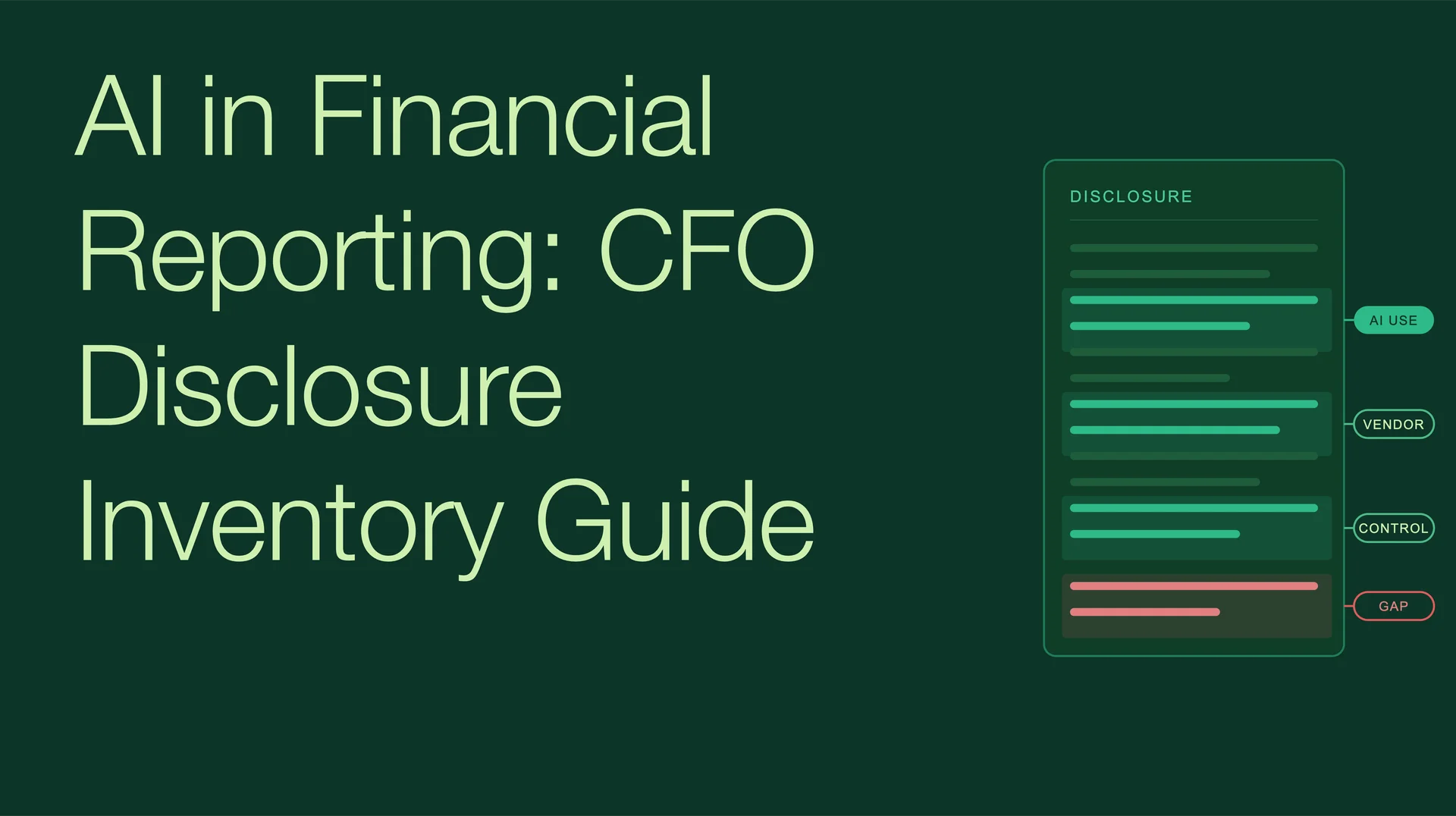
An AI inventory for financial reporting purposes is a documented list of every AI tool used in processes that affect material financial statement amounts or disclosures. The inventory is the prerequisite for any AI disclosure, any ICFR assessment of AI tools, and any response to an SEC comment letter about AI use.
Most companies do not have one because the tools that qualify as AI for financial reporting purposes are not always labelled as AI by the people using them. The finance team member who uses an AI-assisted variance analysis tool may not think of it as "AI" in the compliance sense. The tax team that uses an AI-assisted research platform to support the OBBBA provision may not have flagged it as an AI tool for ICFR purposes. The disclosure drafting team that uses a large language model to produce first-draft MD&A commentary may not have documented it as an AI use in the financial reporting process.
The inventory must capture, for each tool: the name and vendor of the tool, the specific financial reporting process in which it is used (close automation, tax provision, disclosure drafting, audit support), the output the tool generates and whether that output affects reported financial statement amounts, the human review process applied to the tool's output before it affects reported amounts, the frequency of model validation or revalidation, and known limitations of the tool that affect the reliability of its outputs.
This inventory is not a technology catalogue. It is a financial reporting controls document. Its purpose is to identify which AI tools are in scope for ICFR assessment, which AI uses might require disclosure under the existing materiality standard, and what the human oversight structure looks like for each tool.
The time required to build the inventory depends on the size and complexity of the organisation. For a company with multiple business units, multiple AI tools in the close process, and AI use in the tax provision, building a complete and accurate AI inventory from scratch takes weeks, not days.
The preparation logic: whether the signal for AI disclosure comes from an SEC comment letter under the existing materiality standard, from a future FASB standard, or from a PCAOB ICFR scope finding, the AI inventory is the prerequisite response. Building it before the signal arrives is the only operational approach that works.
The Four Financial Reporting Processes Most Likely to Have Undocumented AI Use
Based on the AI in financial reporting workflows analysis from the companion blog in this cluster and from the KPMG, Deloitte, and EY AI adoption surveys, four specific financial reporting processes are most likely to have AI tools in use that are not yet documented or within the ICFR scope.
Account reconciliation and close automation: AI-assisted reconciliation tools that match transactions, flag exceptions, and track resolution status are in wide deployment. Many were implemented as productivity tools without ICFR assessment. If the AI reconciliation tool's outputs feed into the period-end general ledger balances, the tool is in an ICFR-relevant process.
Income tax provision preparation: AI-assisted tax research platforms, OBBBA provision calculators, and scenario modelling tools are increasingly used in the tax provision. The OPR Alert 2026-19 due diligence implication makes this category particularly important for documentation.
Disclosure drafting: AI tools that generate first-draft MD&A commentary, risk factor language, or footnote text from structured data inputs are used by disclosure teams at many companies. The output of these tools affects SEC filings directly. The human review process and the accuracy verification steps must be documented.
Audit support and workpaper preparation: AI tools that assist with audit scheduling, evidence gathering, and workpaper organisation may be used by internal audit teams or by the company in preparing audit-support documentation. Where these tools affect the documentation supporting the external audit, they are in an ICFR-adjacent process.
What Should Your Controller Do in the Next 30 Days Before Any Standard Arrives?
Five specific actions, each achievable in 30 days, that prepare the company for AI disclosure requirements regardless of which regulatory signal arrives first.
First: conduct the AI inventory. Survey all finance and tax team leaders, asking them to list every software tool used in any financial close, tax provision, or disclosure preparation process, including tools with AI-assisted features (even if those features are not labelled as "AI"). Document the process, output, and human review structure for each tool identified.
Second: assess ICFR scope for each AI tool. For each tool in the inventory, determine whether its output affects a material financial statement amount or disclosure. If yes, assess whether the tool's IT general controls (input validation, model accuracy, change management, access) are currently within the SOX 404 ICFR scope. If not, add them to the scope assessment memo for the year-end audit.
Third: document the human review process for each AI tool. For each AI tool that generates outputs affecting financial statements, document the specific human review process: who reviews the output, what they check, how they confirm the output is accurate, and how that review is documented. This documentation is the due diligence record required by OPR Alert 2026-19 for tax AI use and is the standard that auditors will look for under the amended AS 2101 audit planning standard.
Fourth: assess materiality of AI use for disclosure purposes. For each AI tool, apply the materiality standard: would a reasonable investor consider the company's use of this AI tool important in making an investment decision about the company's securities? If any AI use rises to this level, assess whether current disclosures (risk factors, MD&A) adequately describe that use.
Fifth: brief the audit committee. The audit committee oversight function includes oversight of the financial reporting process. The existence and scope of AI tools in the financial reporting process is information the audit committee should have before the year-end audit planning conversation begins. Include the AI inventory and the ICFR scope assessment in the Q3 audit committee materials.
Frequently Asked Questions
Is there a GAAP standard requiring disclosure of AI use in financial reporting?
No. As of August 2026, no FASB ASU or SEC rule specifically requires disclosure of AI use in financial reporting processes. FASB's advisory council discussed the topic at its March 2026 meeting, but no technical agenda addition or proposed ASU has been confirmed for an AI disclosure standard. The governing framework for AI-related disclosures is the existing materiality standard under Rule 408 and Rule 12b-20.
What regulatory signals exist about AI in financial reporting disclosure?
Four confirmed signals from independent institutional sources: the SEC's comment letter practice requiring company-specific AI risk factor language (confirmed from Orrick analysis), SEC Chair Atkins's monitoring of AI claims for accuracy (confirmed from March 2026 FSOC roundtable), PCAOB inspection focus on auditor AI tool use and documentation (confirmed from 2025 inspection priorities report), and IRS OPR Alert 2026-19 confirming Circular 230 due diligence obligations for AI use in tax practice.
What is an AI inventory for financial reporting purposes?
A documented list of every AI tool used in processes that affect material financial statement amounts or disclosures, including for each tool: the name and vendor, the specific financial reporting process, the output and its effect on reported amounts, the human review process, model validation frequency, and known limitations. The inventory is the prerequisite for ICFR assessment, AI-related disclosures, and SEC comment letter responses.
Does AI use in financial reporting need to be in the SOX 404 ICFR scope?
Yes, for AI tools whose outputs affect material financial statement amounts. PCAOB and SEC staff have confirmed that AI used in ICFR-relevant processes must be assessed as an IT general control. The IT general controls over AI tools (input validation, model accuracy, change management, access controls) must be within the ICFR scope for companies subject to SOX 404.
Should AI use be disclosed in the Q3 2026 10-Q?
If AI use is material to understanding how the company's financial results were produced or what risks it faces, it must be disclosed under the existing materiality standard, regardless of whether a specific GAAP standard exists. The decision about whether AI use is material is the disclosure committee's judgment. The AI inventory is the prerequisite for making that judgment.
Key Takeaways
- No FASB ASU and no SEC rule currently requires specific disclosure of AI use in financial reporting processes. The governing standard is the existing materiality framework under Rule 408 and Rule 12b-20.
- Four institutional signals confirm that AI in financial reporting is under active regulatory attention: SEC comment letter specificity requirements, Atkins AI-washing monitoring, PCAOB inspection focus on auditor AI use, and OPR Alert 2026-19 Circular 230 obligations.
- FASB's advisory council discussed AI in financial reporting at its March 2026 meeting. This is a directional signal, not a confirmed standard. No FASB technical agenda addition for an AI disclosure standard has been confirmed.
- AI tools whose outputs affect material financial statement amounts must be assessed as IT general controls within the SOX 404 ICFR scope. PCAOB and SEC staff have both confirmed this.
- An AI inventory is the prerequisite for ICFR assessment, materiality-based disclosure decisions, and SEC comment letter responses. Most companies do not have one. Building it takes weeks, not days.
- The four financial reporting processes most likely to have undocumented AI use: account reconciliation and close automation, income tax provision preparation, disclosure drafting, and audit support document preparation.
- Five 30-day preparation actions: conduct the AI inventory, assess ICFR scope for each tool, document human review processes, assess materiality for disclosure purposes, and brief the audit committee.