AI in Financial Reporting Audit Risk: The 2026 Compliance Map for CFOs and Audit Committees
AI is already inside your financial close, your auditor's workpapers, and your disclosure drafts. What is not yet inside any binding rulebook is a clear standard governing any of it.
That gap is the central compliance risk for finance teams in 2026, and it is more specific and more actionable than the generic "AI introduces risk" framing that dominates most practitioner content. This article maps exactly where the regulatory vacuum sits today, translates it into the five audit-risk categories your team faces right now, and gives a concrete governance checklist you can act on before your next audit cycle.
Who this is for: CFOs, Controllers, SEC Reporting Managers, and Audit Committee members at public companies where AI is being used in financial reporting, the financial close, or disclosure drafting, and where the external auditor is also deploying AI tools.
Why AI in Financial Reporting Audit Risk Is a 2026 Problem, Not a Future One
AI adoption in financial reporting is not a pilot-stage phenomenon. KPMG's survey of 1,800 senior financial reporting executives (April 2024) found that 39% of North American companies are already selectively or widely implementing AI in their financial reporting process, ahead of Europe at 32% and Asia Pacific at 29%. The telecoms and technology sector leads all industries at 41%. Companies with revenue above $10 billion are twice as likely to be "Leaders" in AI-enabled financial reporting compared to peers below $5 billion in revenue (40% vs. under 20%).
A KPMG follow-up across 23 markets (November 2024) found that 73% of Swiss companies are already piloting or using AI in financial reporting, with adoption expected to reach nearly 100% within three years. The most common use cases globally: research and data analysis, fraud detection, and automated financial reporting.
The regulators have not kept pace. The PCAOB's Technology Innovation Alliance (TIA) Working Group completed its "Future State Deliverable" in May 2024, but the document was only publicly released in August 2025, a 15-month delay that is itself a signal of how far regulatory thinking lags deployment reality. As of mid-2026, none of the TIA's four strategic pillars have been enacted as binding PCAOB standards.
The Regulatory Vacuum: What the PCAOB and SEC Have (and Have Not) Done
The honest answer to "are there binding rules on AI in audits?" is no. Here is the precise state of play.
PCAOB: Four Pillars, No Binding Standards Yet
The PCAOB TIA's Future State Deliverable recommended four strategic pillars:
- A standardised audit documentation taxonomy for AI and data analytics
- AI risk-management guidance for audit firms
- An Innovation Lab for structured experimentation
- A formal definition of audit quality in an AI context
None of these are enacted rules. A PCAOB board member was explicit about the problem in a September 2025 speech: "A technology-neutral approach is akin to being an anchor that weighs down innovation. Today with technological innovation in just AI alone moving at break-neck speed, a technology-neutral approach might have been appropriate in the past when technological innovation moved at a much slower pace."
The same speech called for the PCAOB to become "an engine that catalyzes innovation in public company auditing" rather than a passive bystander. That is a statement of aspiration, not current policy.
The PCAOB's July 2024 GenAI Spotlight found that current GenAI integration in audits is "focused primarily on administrative and research activities," including drafting memos, summarising accounting policy documents, and researching internal guidance. Full deployment in risk assessment, substantive testing, and controls evaluation is described as nascent. Critically, the Spotlight noted that audit firms believe existing PCAOB standards "are not currently viewed as impediments to the development and use of GenAI in the audit." The PCAOB has not confirmed that interpretation. Firms are proceeding on an assumption, not a safe harbour.
Existing Standards That Apply by Implication
Two existing PCAOB standards create implicit obligations that AI use has not yet resolved:
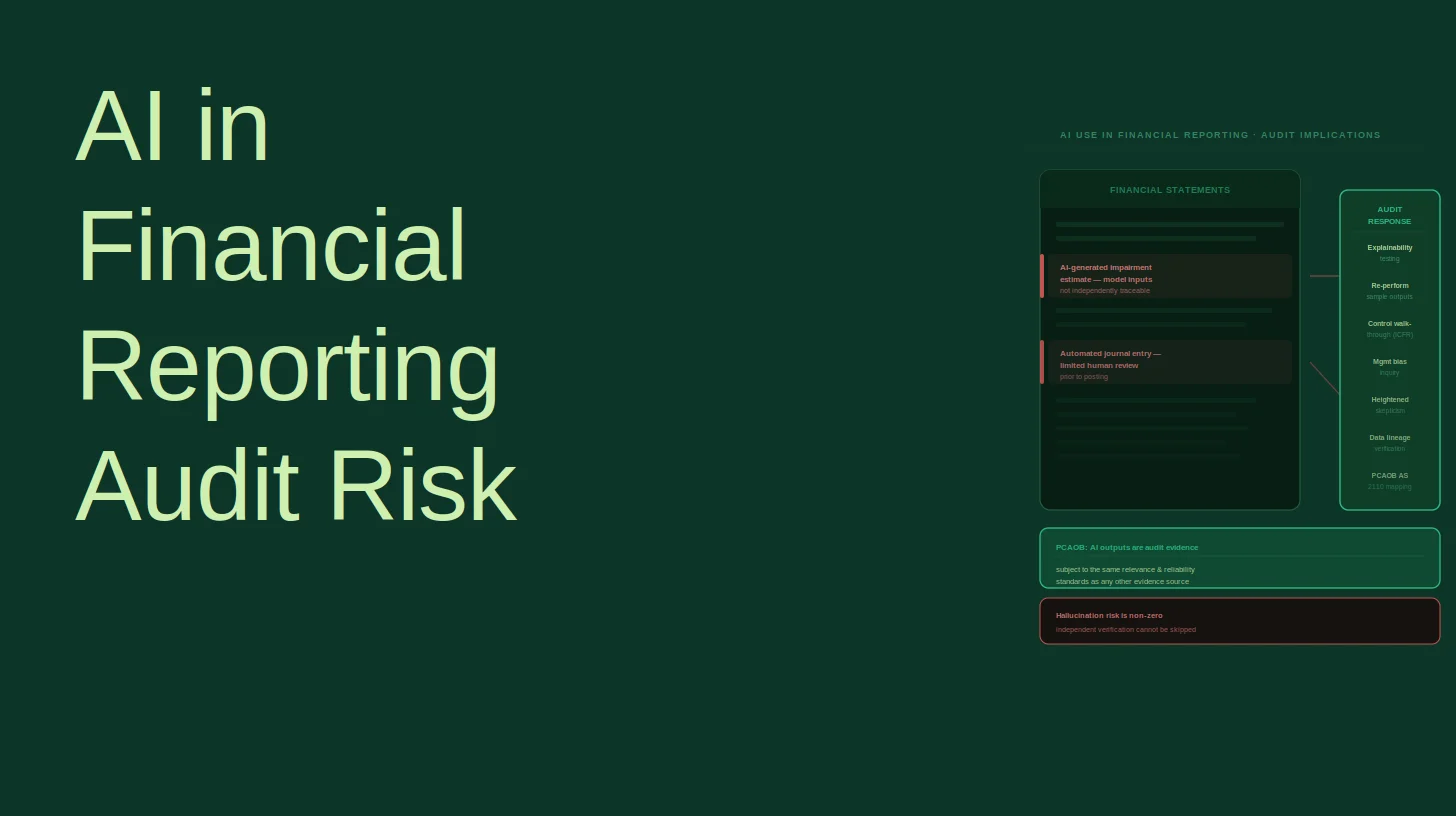
- AS 2110 (Identifying and Assessing Risks of Material Misstatement): Requires auditors to understand the entity's use of IT in financial reporting. As preparers deploy AI in the close and disclosure process, AS 2110 implicitly requires auditors to understand and evaluate those AI systems. The standard was written before modern AI existed.
- AS 1215 (Audit Documentation): Requires documentation of procedures performed, evidence obtained, and conclusions reached. When an AI tool assists in a substantive procedure, must the auditor document the tool's training data, validation methodology, and known limitations? Current guidance does not say.
SEC: Comment Letters as a Leading Indicator
The SEC's Division of Corporation Finance has begun including AI-related questions in comment letters to registrants, asking about AI governance, AI risk disclosures, and the use of AI in financial reporting processes. No formal AI disclosure rule has been finalised specifically for financial reporting (distinct from the SEC's cybersecurity and climate disclosure work), but comment-letter scrutiny reliably precedes formal requirements. If you have not yet received an AI-related comment, you may.
IAASB: A Different Timeline
The IAASB's revised ISA 315 (effective for periods beginning on or after 15 December 2021) introduced enhanced requirements for understanding IT systems and automated controls, a framework now being interpreted to cover AI. The IAASB is also developing broader technology-specific guidance under its technology project. For multinational companies subject to both PCAOB and IAASB regimes, these two frameworks are evolving on different timelines and with different principles, creating compliance complexity that no practitioner content has yet mapped.
The Five Audit-Risk Categories Finance Teams Face Right Now
The regulatory vacuum does not mean risk is theoretical. It means the risk is real and the guardrails are not yet in place. Here are the five categories that matter most.
1. The 100%-Testing Ambiguity
This is the compliance paradox almost no practitioner content addresses. AI enables auditors to test 100% of journal entries rather than a statistical sample. Intuitively, that sounds like an improvement. The PCAOB's own board member raised the scenario where a PCAOB inspector might either recognise AI-enabled 100% testing as an enhancement, or penalise the firm for deploying a methodology that lacks clear standards on what constitutes an "acceptable AI-based audit." There is no PCAOB guidance resolving this. Audit firms using AI for full-population substantive testing are operating in a compliance grey zone, and so are the companies they audit.
2. GenAI Hallucination in Disclosures
GenAI hallucination is the specific risk that a model generates plausible but factually incorrect text. In financial reporting, the highest-risk applications are MD&A drafting, footnote disclosures, and earnings release commentary, precisely the places where reviewers are most likely to anchor on the AI output and under-scrutinise it. The PCAOB GenAI Spotlight confirmed that preparers are exploring GenAI for drafting disclosures and automating portions of the close. The Spotlight also noted that when preparers use GenAI to draft financial statements, auditors must understand and evaluate that use as part of their risk assessment under AS 2110. If the auditor does not know which sections of your MD&A were AI-drafted, they cannot apply appropriate scepticism to those sections.
3. Shadow AI in the Financial Close
Finrep has covered shadow AI as a disclosure risk in the CB Financial 8-K context. The audit-risk angle is distinct: when staff use unapproved consumer GenAI tools (ChatGPT, Copilot, or similar) in the close process, the resulting outputs typically lack the audit trail, validation documentation, and change management records that external auditors require. The output may look correct and pass human review. The problem surfaces when the auditor asks for the evidence supporting a calculation or classification and the answer is "someone ran it through ChatGPT."
KPMG identifies three root causes that make shadow AI more likely: data security vulnerabilities in early adoption, limited AI skills and knowledge, and difficulty gathering consistent data. All three are also conditions that produce unreliable AI outputs.
4. The Documentation Standard Gap
AS 1215 requires documentation of procedures, evidence, and conclusions. When an AI tool assists in a substantive audit procedure, the standard raises questions that no PCAOB guidance has yet answered: must the auditor document the AI tool's training data? Its validation methodology? Its known failure modes? The PCAOB TIA recommended developing a standardised audit documentation taxonomy precisely because the current absence of one creates inconsistency across firms and engagements. Until that taxonomy exists, every Big Four engagement using AI in substantive procedures is making its own documentation judgments, and PCAOB inspectors may evaluate those judgments differently across inspections.
The scale of this problem is significant. The PCAOB's Firm Inspections Group has approximately 430 FTEs and in 2024 inspected 255 Big Four audit engagements. The Big Four audit approximately 80% of U.S. listed public company market capitalisation. Documentation inconsistency at that scale is a systemic risk.
5. The Preparer-Auditor Information Asymmetry
This is the dual-AI problem that existing audit standards were not designed to address. When preparers use AI to draft disclosures or run the financial close, and auditors use different AI tools to audit those outputs, neither party fully understands the other's AI methodology. The preparer does not know what the auditor's AI flagged or missed. The auditor does not know which outputs in the financial statements were AI-generated or how those models were validated. Deloitte's senior managers put the burden squarely on the preparer: "These teams must have confidence in the data they receive from AI applications and must also demonstrate why their trust is justified."
The asymmetry is compounded by a budget gap. KPMG found that most companies allocate only 5 to 15% of IT budgets to AI initiatives despite rising usage. Under-resourced AI governance means inadequate controls, inadequate testing, and inadequate audit trails. That combination is a direct path to a material-weakness finding.
What Agentic AI Means for Audit Responsibility
The PCAOB TIA's Future State Deliverable referenced "agentic AI auditing" as a near-term possibility, noting that a standardised documentation taxonomy would "accelerate the adoption and accessibility of AI technology including agentic AI auditing for auditors of all sizes and regulators." This is the first time a PCAOB-affiliated document has used the term in a forward-looking context.
Agentic AI means autonomous AI agents conducting audit procedures without a human initiating each individual step. The professional-standards implications are unresolved: if an AI agent identifies a risk, designs a test, executes it, and documents the result, where does auditor professional scepticism sit in that chain? The PCAOB's January 2026 speech was clear that "the profession's core values of independence, professional skepticism, and responsibility must be preserved in an AI-augmented audit environment." How that preservation works when the agent acts autonomously is an open question that finance teams and audit committees should be asking their auditors now, before the technology is deployed.
The Governance Checklist: What to Do Before Your Next Audit Cycle
The absence of binding standards does not mean the absence of expectations. The SEC's comment-letter activity, the PCAOB's implicit AS 2110 and AS 1215 requirements, and Deloitte's four-pillar governance framework all point to the same set of controls. Build these before your auditor asks for them.
For preparers (your own AI use in financial reporting):
- Inventory every AI tool in the financial close and disclosure process. Include approved enterprise tools and any consumer tools staff may be using informally. Shadow AI you do not know about is audit risk you cannot manage.
- Document inputs and outputs for every AI-assisted process. Archive the data fed into the model, the output produced, and any human review applied. This is the audit trail AS 2110 will require your auditor to evaluate.
- Validate AI models before deployment and on a recurring schedule. Deloitte's practical example of invoice classification AI illustrates the level of technical validation required: character error rate, word error rate, and semantic similarity scoring. Most finance teams are not doing this. If your vendor does it, obtain and retain their validation documentation.
- Flag AI-drafted disclosure sections for enhanced human review. Assign a specific reviewer to check AI-generated MD&A and footnote language against source data, not just for readability but for factual accuracy. Hallucination risk is highest where the AI has the most latitude to generate narrative.
- Build a cross-functional AI governance group spanning finance, IT, legal, and compliance. KPMG's research identifies siloed AI deployment as the root cause of shadow AI risk and audit-trail gaps.
- Consider whether AI use in financial reporting requires disclosure. The SEC's comment-letter activity on AI governance is a leading indicator. Review your risk factors and MD&A for completeness on this point. Finrep's guide on AI risks in SEC filings covers the current SEC expectations in detail.
For audit committees (overseeing both management and the external auditor):
- Ask management: Which financial reporting processes use AI? How are those outputs validated? What is the audit trail? Who approved the tools?
- Ask the external auditor: Which AI tools are you using in this engagement? In which procedures? How are those tools validated? How are you documenting AI-assisted procedures under AS 1215?
- Ask both: If your AI flags something and the other party's AI does not, how will that discrepancy be resolved? Who is responsible for the final judgment?
- Update the audit committee charter to include explicit oversight of AI use by both management and the external auditor. The dual-AI scenario is not covered by standard charter language.
- Monitor PCAOB inspection findings for AI-related deficiencies as the TIA pillars move toward enactment. The first inspection cycles that explicitly evaluate AI documentation practices will set the de facto standard before formal rules arrive.
The Vendor Dependency Risk
One risk that almost no practitioner content addresses: finance teams using third-party AI vendors for financial reporting face a specific audit exposure if the vendor changes the model, updates training data, or discontinues the product. The audit trail for prior-period outputs may become inaccessible or unverifiable. Before signing an AI vendor contract for any financial reporting application, confirm that you can export and retain the model version, training data documentation, and output logs for the duration of your audit retention requirements. This is not a theoretical concern. It is a going-concern-adjacent risk for any reporting process that becomes dependent on a single vendor's AI infrastructure.
For a deeper look at how audit trail requirements work in practice for disclosure teams, see Finrep's guide on evidence and audit traceability and the related piece on bridging internal and external audit for disclosures.
FAQ
Are there binding PCAOB rules on AI use in audits as of mid-2026?No. The PCAOB TIA's Future State Deliverable (released August 2025) recommended four strategic pillars including AI risk-management guidance and a standardised documentation taxonomy, but none have been enacted as binding standards. Audit firms are proceeding on the assumption that existing standards permit AI use, but the PCAOB has not issued a formal safe harbour confirming that interpretation.
Does AI-enabled 100% journal-entry testing satisfy PCAOB standards better than sampling?The answer is unresolved. A PCAOB board member explicitly raised the scenario where inspectors might penalise a firm for using 100% AI testing because no clear standard defines what constitutes an acceptable AI-based audit. Until the PCAOB issues guidance, firms using AI for full-population testing are operating without a defined compliance benchmark.
What is shadow AI and why does it create audit risk?Shadow AI refers to staff using unapproved consumer GenAI tools in financial processes without IT or legal oversight. The audit risk is that outputs produced by shadow AI typically lack the validation, documentation, and audit trail that external auditors require under AS 2110 and AS 1215. The result can be undetected material misstatements with no evidentiary support.
What should I ask my auditor about their AI methodology?Ask which AI tools are used in your engagement, in which specific procedures, how those tools are validated, and how AI-assisted procedures are documented. Also ask how they would identify and resolve a discrepancy between their AI's findings and your own AI-generated outputs.
How does IAASB's approach to AI in audit differ from the PCAOB's?The IAASB's revised ISA 315 (effective December 2021) introduced enhanced IT and automated-controls requirements now being interpreted to cover AI, and the IAASB is developing broader technology-specific guidance. The PCAOB is taking a separate path through its TIA process. The two frameworks are on different timelines and with different principles, creating compliance complexity for multinationals subject to both regimes.
Does our ICFR programme need to cover AI-generated outputs?Yes. If AI is used in any process that feeds into financial reporting, the controls over that AI system are part of your internal controls over financial reporting. A control deficiency in an AI system that produces a material misstatement is a potential material weakness. Finrep's piece on AI and SOX internal controls covers the ICFR implications in detail.
The regulatory standards will arrive. The PCAOB has signalled it wants to move from neutral bystander to active catalyst. When those standards land, the companies with documented AI governance, clean audit trails, and cross-functional oversight structures will have a significant head start. The companies that waited will be retrofitting controls under scrutiny.