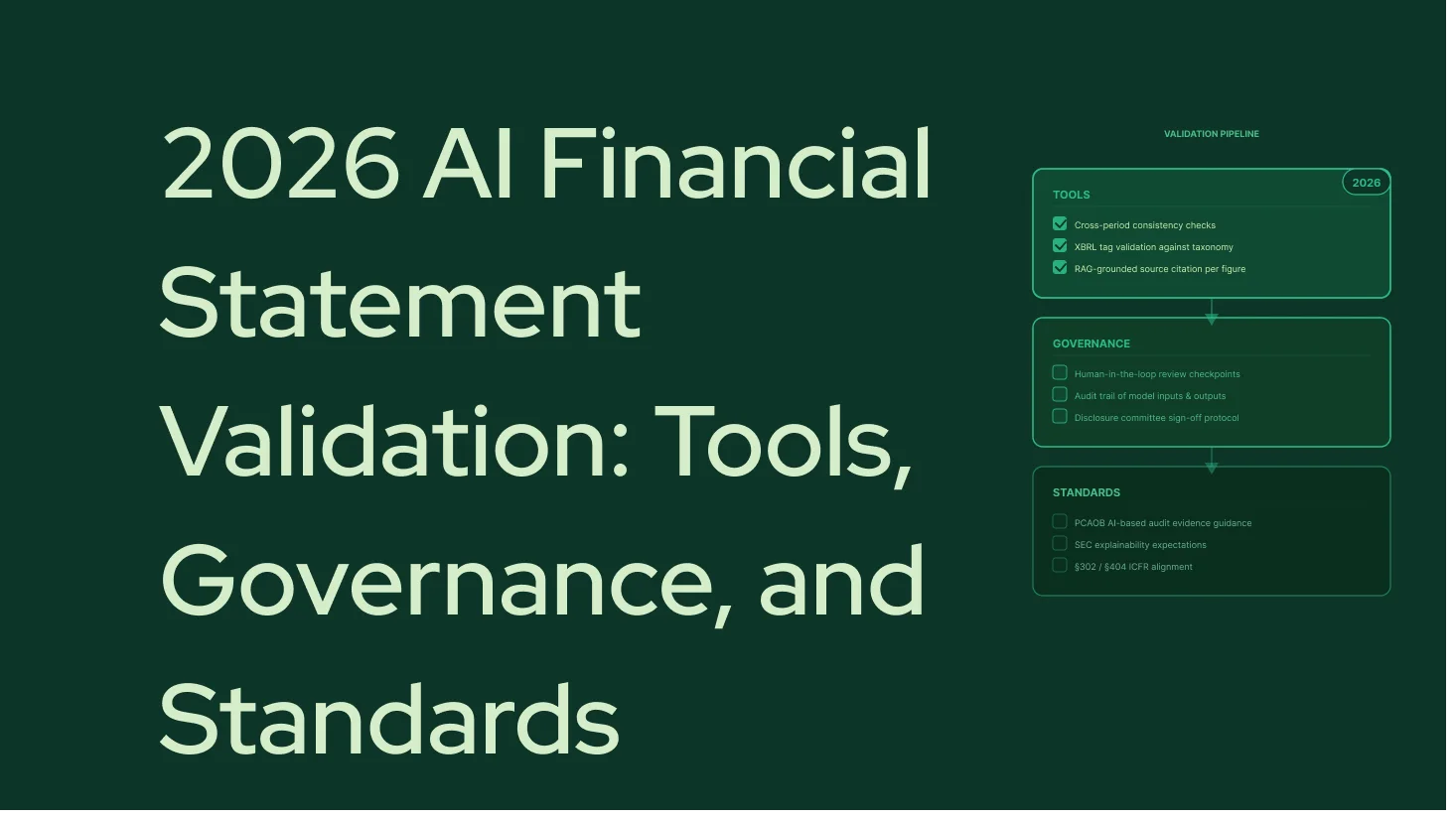
AI Financial Statement Validation: Tools and Standards in 2026
AI financial statement validation is no longer a vendor promise. EY, KPMG, and Caseware have live, deployed tools running thousands of checks per engagement. The harder question for CFOs, controllers, and audit committees is not whether to use them, but how to govern them, what they actually cover, and where they will still let you down.
This guide maps the six distinct validation layers AI can address today, anchors every capability claim to a regulatory or Big Four source, and addresses the governance and evidentiary questions that most content ignores entirely.
Key takeaway: AI financial statement validation assists human review at every layer from arithmetic to disclosure sufficiency, but professional responsibility for the conclusion remains with the human auditor or preparer. No tool changes that.
What AI Financial Statement Validation Actually Does
AI financial statement validation is the application of rule-based automation, machine learning, natural language processing, and generative AI to detect errors, inconsistencies, and compliance gaps in financial statements before and during the audit process. Most content treats this as a single capability. It is not. There are six distinct layers, each with different technical requirements and regulatory implications.
Validation LayerWhat AI ChecksRegulatory BasisArithmetic / recalculationTotals, subtotals, EPS calculations, per-share figuresAS 2301 (auditor response to risks)Internal cross-referenceFigure-to-figure consistency within one documentAS 2301; ICFRCross-document consistencyFinancials vs. MD&A vs. press release vs. proxyPCAOB AS 2710 (other information)XBRL / iXBRL taxonomyTags match underlying data and correct taxonomy elementSEC iXBRL rules (2019); IFRS taxonomyDisclosure sufficiencyDoes the disclosure meet the standard's requirements?GAAP / IFRS disclosure checklistsPeriod-over-period consistencyUnexplained changes in accounting policies, estimates, or presentationAS 2710; SEC comment letter practice
Most vendor marketing collapses all six into "AI validation." The distinction matters because each layer requires different tooling, different human oversight, and different documentation.
PCAOB Board Member Christina Ho drew a useful line in November 2023: "AI can automate all of these tasks and can execute them consistently and better than humans. The AI models for these tasks should be simpler because they are deterministic and require minimal judgment." Arithmetic and cross-reference checks are deterministic. Disclosure sufficiency and period-over-period narrative consistency require judgment, and that is where AI assistance ends and human review must begin.
Which Tools Are Actually Deployed Today
The PCAOB's July 2024 GenAI Spotlight confirmed that integration of GenAI in audits is "in its early stages but rapidly evolving," with firms primarily deploying tools for administrative tasks, research, and checklist-style validation, with clear roadmaps toward substantive audit procedures.
Here is what is live, not roadmap:
- EY Financial Statement Tie Out (integrated with EY Canvas): automates validation of calculations and identifies inconsistencies requiring follow-up. EY describes it as accelerating the tie-out process by "automating certain procedures such as validating calculations and identifying inconsistencies that require follow-up."
- EY Intelligent Checklist: uses generative AI to locate disclosures within financial statements, evaluate their sufficiency, and flag disclosures requiring follow-up. This is the disclosure sufficiency layer, and it is live.
- EY Canvas AI: compares a company's key financial ratios with industry peers and monitors relevant company news, adding a cross-entity and cross-document validation layer beyond arithmetic.
- EY Code Explainer: converts IT program code into plain language to help auditors validate automated controls, including the AI validation tools themselves. This is meta-validation: using AI to audit the AI.
- Caseware Validate: a market-available tool claiming 450+ AI-driven checks for errors and inconsistencies, with customers reporting over 50% reduction in review time and up to 90% reduction for specific tasks. One CA ANZ member put it plainly: "I will not look at a set of accounts unless it has been through Validate."
- KPMG AI-assisted analytics: the KPMG November 2024 implementation guide references a Gartner framework positioning AI validation as a human-in-the-loop system generating recommendations for human validation, not autonomous decisions.
Deloitte's DARTbot and PwC's AI-enabled audit tools are also in deployment, though detailed public specifications are limited.
The XBRL and iXBRL Validation Use Case
This is the most underserved angle in existing content, and it is structurally mandatory for most large listed companies.
The SEC has required iXBRL (Inline XBRL) filings since 2019. The IFRS Foundation's April 2024 digital reporting article confirmed that over 90% of listed companies by global market capitalisation are now required to undertake digital financial reporting to some extent. IASB member Ann Tarca stated directly: "Capital markets without digital financial reporting requirements face the risk of lower foreign investment and a higher cost of capital."
For preparers, this means AI validation of XBRL tags is not optional. The SEC's Division of Corporation Finance issues comment letters on taxonomy mismatches with regularity. For a detailed breakdown of which XBRL errors trigger SEC review, see Finrep's guide to XBRL tagging errors that trigger SEC review.
AI validation tools that check iXBRL tags against the IFRS Accounting Taxonomy or US GAAP taxonomy operate on the same infrastructure as EDGAR's own API, which provides programmatic access to tagged financial data for cross-referencing against prior periods, peer companies, and taxonomy definitions in near-real-time. The IFRS Foundation explicitly notes that regulators benefit from "automated validation checks and technology-driven monitoring" enabled by digital financial reporting, meaning AI-assisted validation is embedded in the regulatory oversight model, not just a preparer convenience.
A complex multi-segment filing like Accenture's FY2025 10-K illustrates the scale of the problem: hundreds of cross-referenced figures across income statement, balance sheet, cash flow, segment disclosures, and footnotes, all of which must be consistently tagged and internally consistent. Manual validation at that scale is not realistic.
The Regulatory Framework: What PCAOB Standards Actually Govern AI Validation
No PCAOB standard specifically governs AI-assisted validation. The PCAOB's GenAI Spotlight confirmed that audit firms do not currently view existing standards as impediments, and the PCAOB's standard-setting agenda includes an active research project on technology-based tools, but no new standards had been issued as of July 2024.
The relevant existing standards are:
PCAOB AS 2710 (Other Information) is the standard most directly relevant to cross-document consistency checking. Paragraph .04 states: "The auditor has no obligation to perform any procedures to corroborate other information contained in a document. However, he should read the other information and consider whether such information, or the manner of its presentation, is materially inconsistent with information, or the manner of its presentation, appearing in the financial statements."
AI tools that automate this reading and flagging process directly operationalise AS 2710 at scale. The catch: the professional judgment about whether an inconsistency is "material" remains with the human auditor. AS 2710 paragraph .05 adds that when an auditor becomes aware of a material misstatement of fact, the auditor "should consider that he may not have the expertise to assess the validity of the statement." That limitation applies equally to AI tools.
PCAOB AS 1215 (Audit Documentation) governs what must be in the workpaper file. If an AI tool flags or clears an item, the auditor must document the basis for the professional conclusion, not just the AI output. The evidentiary status of an AI-generated validation finding is not equivalent to an auditor's documented judgment.
PCAOB AI 18 (AS 2601 Interpretation) is the governance gap most finance teams have not addressed. When an AI validation tool is operated by a third-party service organization, the user auditor must assess whether the processing performed by that vendor affects financial statement assertions. This may require obtaining a SOC 1 report or performing direct testing of the vendor's controls. Caseware Validate, for example, is working toward ISO 27001 and SOC 2 certification. Finance teams deploying third-party AI validation tools should confirm their auditor's position on this before deployment.
Preparer-Side vs. Auditor-Side AI Validation
This distinction is absent from almost all existing content, and it matters for governance.
Preparer-side validation is run by the finance team before filing. It is a quality control procedure, not an audit procedure. Its outputs do not substitute for audit evidence. The PCAOB's GenAI Spotlight noted that preparers are at an earlier stage than audit firms in deploying these tools, and that governance frameworks for preparer-side AI use are less developed.
Auditor-side validation is run by the external auditor during the audit engagement. Its outputs are subject to PCAOB documentation standards and must support the auditor's professional conclusions. The auditor retains full professional responsibility regardless of what the AI tool reports.
The two can interact: a preparer who runs AI validation and shares results with the auditor is not providing audit evidence. The auditor must independently assess the validation tool's reliability, including whether PCAOB AI 18 applies.
For teams thinking through how AI fits into their broader internal controls over financial reporting, Finrep's article on how AI is strengthening internal controls over financial reporting covers the ICFR framework in detail.
The Failure Modes: Where AI Validation Goes Wrong
Hallucination risk is the critical failure mode that no existing content addresses. A generative AI tool that confidently reports "no inconsistencies found" when inconsistencies exist is potentially worse than no tool at all, because it creates false assurance. This is not hypothetical: LLMs are trained to produce fluent, confident outputs, and their confidence is not calibrated to their accuracy.
The practical failure modes to govern against:
- False negatives on narrative inconsistencies: AI arithmetic checks are reliable. AI assessment of whether an MD&A narrative is consistent with the financial tables requires semantic understanding that current tools handle inconsistently.
- Taxonomy hallucination in XBRL validation: AI tools may map a financial concept to a plausible but incorrect taxonomy element, especially for non-standard line items or industry-specific disclosures.
- Version control failures: If the AI validation tool is not connected to the authoritative version of the document, it may validate a draft that has since been superseded.
- Disclosure sufficiency gaps: AI checklist tools can confirm that a disclosure exists. They are less reliable at assessing whether the disclosure meets the qualitative requirements of the standard, particularly for estimates, judgments, and going concern.
- ESG and sustainability disclosure blind spots: Most AI validation tools cover traditional financial statements only. CSRD (ESRS) and ISSB (IFRS S1/S2) create new consistency requirements between sustainability disclosures and financial statements that current tools largely do not address. For the connection between financial and non-financial disclosures, see Finrep's piece on how AI bridges the disconnect between financial and non-financial disclosures.
KPMG's implementation guide frames the appropriate governance model clearly: AI generates recommendations and provides diagnostic analytics for human validation and exploration. It is a human-in-the-loop system. Teams that treat AI validation outputs as conclusions rather than inputs are misusing the tool and creating liability exposure.
Governance: Who Owns the Output
This is the operational question finance teams are actively grappling with, and there is no industry consensus yet.
A practical governance framework should address:
- Ownership: Designate a named owner for AI validation outputs, typically the Controller or VP Financial Reporting. IT and external auditors are stakeholders, not owners.
- Scope documentation: Document which validation layers the AI tool covers and which it does not. Do not assume coverage extends beyond what the vendor has specified and tested.
- Human review thresholds: Define which AI-flagged items require human review before the flag can be cleared, and at what materiality level.
- Workpaper integration: For auditor-side use, document the AI tool's role in the workpaper file consistent with AS 1215. For preparer-side use, document the tool as a quality control procedure within the ICFR framework.
- Vendor assessment: Confirm whether PCAOB AI 18 applies to your third-party validation tool and obtain the relevant SOC report if required.
- Periodic testing: Test the AI tool's outputs against known errors on a sample basis. Vendor claims about accuracy rates are not independently benchmarked.
For a broader treatment of audit traceability and evidence standards in disclosure workflows, Finrep's guide on how disclosure teams can master evidence and audit traceability covers the documentation framework in detail.
CHRISTINA Ho's framing from the PCAOB is the right benchmark: "Data and technology can improve audit quality and enhance investor protection, but embracing it effectively and responsibly requires expertise, collaboration, and ongoing iterations in an agile and transparent environment."
The 100% Population Testing Opportunity
One genuinely transformative implication of AI validation is the shift from sampling to full-population testing. PCAOB Board Member Ho stated: "If auditors can rely on machines to perform these routine tasks efficiently, they could then expand the testing population to 100% for some significant accounts."
For financial statement validation specifically, this means AI could check every figure, every cross-reference, and every disclosure against source data rather than a sample. The arithmetic and internal cross-reference layers are already close to this in practice. The cross-document and disclosure sufficiency layers are not.
The capital markets implication is material. The IFRS Foundation frames digital financial reporting as reducing information asymmetry and lowering the cost of capital for companies that get it right. Errors in machine-readable filings have systemic consequences beyond individual company compliance.
FAQ
Is there an AI that can analyze financial statements?Yes. EY Financial Statement Tie Out, EY Intelligent Checklist, Caseware Validate, and tools from KPMG and Deloitte are live in audit workflows. For preparers, tools like Evolution AI parse and structure financial statement data from PDFs. The distinction between analysis (extracting insights) and validation (checking for errors and consistency) matters: most tools do one or the other, not both.
How do you validate financial statements with AI?AI validation works across six layers: arithmetic recalculation, internal cross-reference, cross-document consistency, XBRL/iXBRL taxonomy compliance, disclosure sufficiency, and period-over-period consistency. Each layer requires different tooling. Arithmetic and cross-reference checks are highly reliable. Disclosure sufficiency and narrative consistency require human review of AI-flagged items.
Can ChatGPT review financial statements?ChatGPT can perform ratio analysis, identify trends, and flag apparent inconsistencies in financial data you provide. It cannot access EDGAR filings directly, does not validate XBRL tags, and its outputs are not audit evidence. Hallucination risk is real: ChatGPT can produce confident but incorrect assessments of numerical consistency. Use it as a research and drafting assistant, not a validation tool.
What does the PCAOB say about AI in financial statement validation?The PCAOB's July 2024 GenAI Spotlight confirmed that AI integration is "in its early stages but rapidly evolving" and that existing standards are not viewed as impediments. No AI-specific validation standards exist yet. AI validation outputs must be documented under AS 1215, and third-party AI tools may trigger AS 2601 (PCAOB AI 18) service organization requirements.
Does AI validation provide legal or regulatory protection if an error is missed?No. Professional responsibility for financial statement accuracy remains with the preparer and the auditor. An AI tool that clears an item does not shift liability. If anything, deploying an AI validation tool and still filing a materially misstated statement raises questions about whether the tool was properly governed and whether its limitations were understood.
Do AI validation tools cover ESG and sustainability disclosures?Most do not. CSRD (ESRS) and ISSB (IFRS S1/S2) create consistency requirements between sustainability disclosures and financial statements that current AI validation tools largely ignore. This is a growing compliance gap as assurance requirements for sustainability reporting expand. Finance teams should explicitly scope ESG disclosure validation when evaluating tools.